Biochemistry · Skim version
Fatty Acid Degradation: The β-Oxidation Spiral
Read the full lesson → Skim the whole course →
The guiding idea
Fat comes apart two carbons at a time, and that is how a fasting body keeps its tissues running when glucose is scarce.
Fat is the body's long-term fuel reserve, and when glucose is scarce the body gets its energy from it in three stages: mobilize the triacylglycerol in adipose, activate each fatty acid and shuttle the long-chain ones into the mitochondrion, then chop it two carbons at a time by beta-oxidation.
From the film
- For a saturated, even chain, beta-oxidation removes two carbons per turn.
- Activation costs two ATP equivalents before beta-oxidation begins.
- Long-chain fatty acids use the carnitine shuttle to enter the mitochondrial matrix.
- Palmitate yields 8 acetyl-CoA, 7 FADH₂, 7 NADH, and roughly 106 net ATP.
-
Why fat is the reserve: the electrons
-
Stage 1: Mobilization, unlocking the droplet
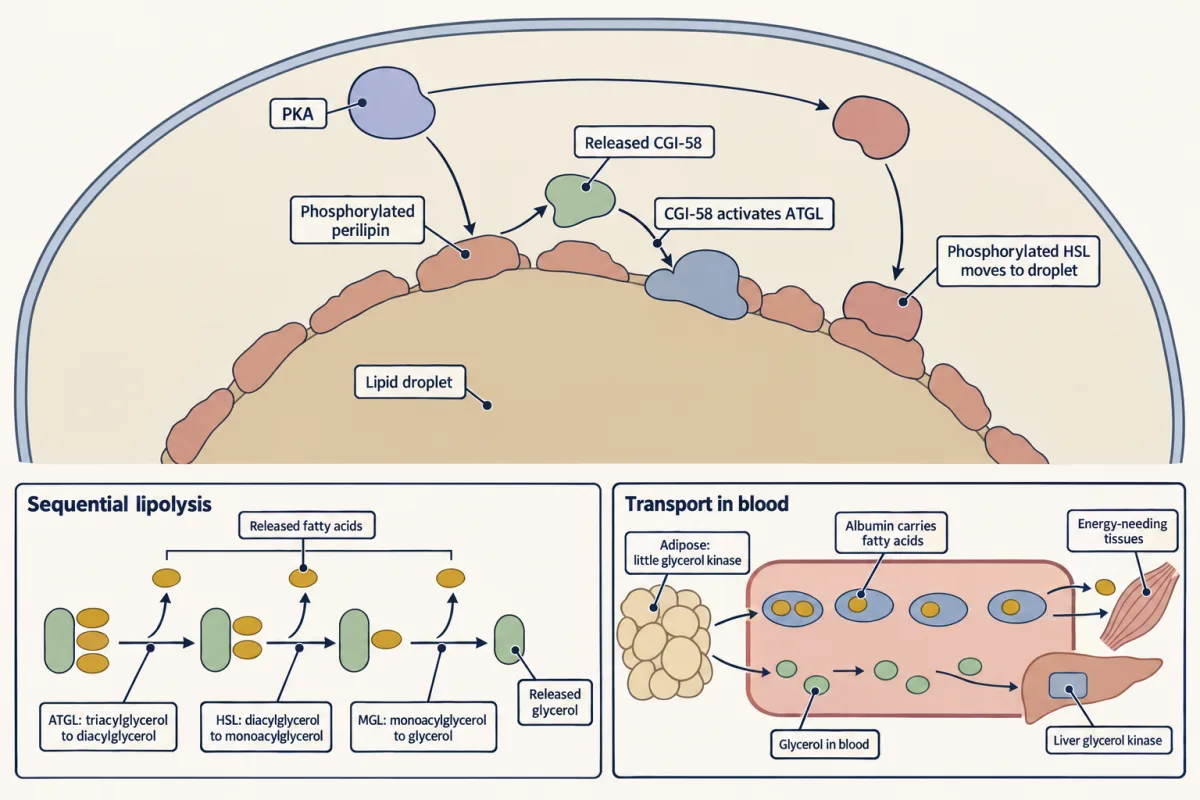
Hormone signalling loosens the droplet's protein coat (perilipin, which releases CGI-58 to switch on ATGL), and three lipases (ATGL, HSL, then monoacylglycerol lipase) strip the chains off. Fatty acids travel on albumin to tissues; glycerol goes to the liver, because adipose has little glycerol kinase. AI-generated illustration -
Stage 2: Activation and the carnitine gate
-
Stage 3: Beta-oxidation, one cycle run again and again
-
The ledger: counting packets
-
MCAD deficiency: a block in the middle stalls the spiral
-
Special cases that bend the rule
-
Why even-chain fat gives no net glucose
-
Ketone bodies: the liver’s fasting export
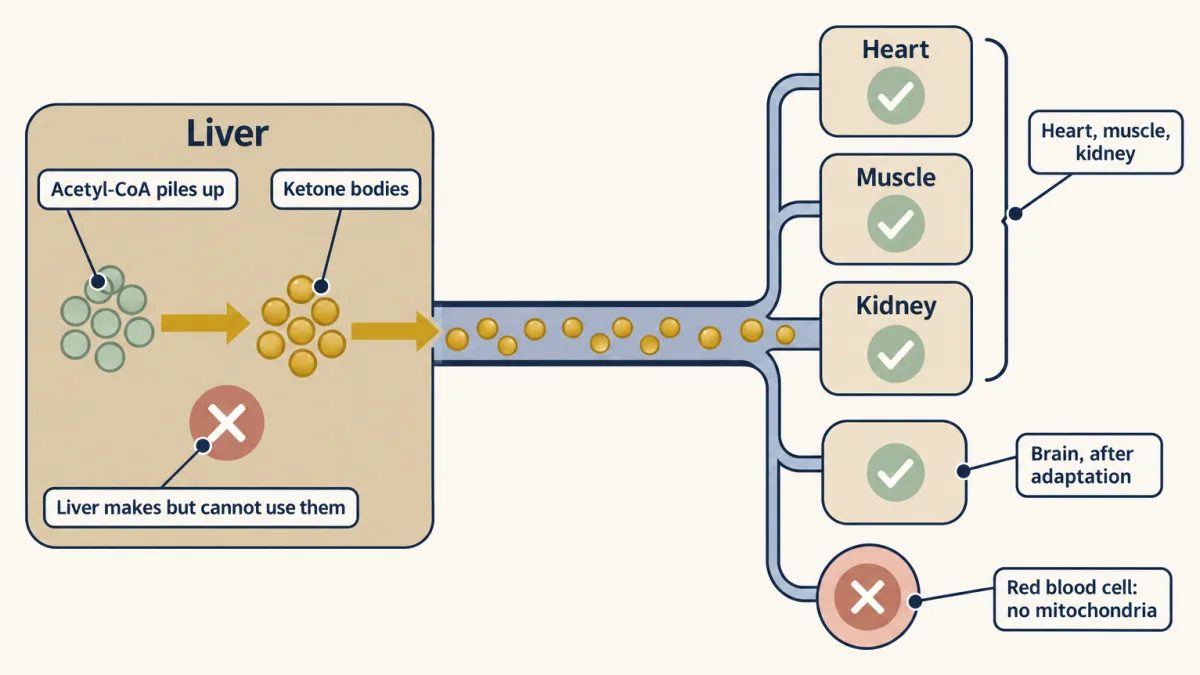
Ketone bodies leave the liver, which cannot use them, for the tissues that can. AI-generated illustration -
Going deeper
Where this lesson fits
Before thisReview first
- The Citric Acid Cycle: Harvesting ElectronsThis course · Lesson 19
You need to know how acetyl-CoA is burned for NADH, FADH2 and GTP to count palmitate's ATP.
- Oxidative Phosphorylation: The Electron-Transport ChainThis course · Lesson 20
The 2.5 and 1.5 ATP per NADH and FADH2 used in the ledger come from there.
- Signal-Transduction Pathways: How Cells Compute With Molecular SwitchesThis course · Lesson 13
The epinephrine, cAMP and PKA relay that starts fat mobilization is built there.
After thisStudy next
- Fatty Acid Synthesis: Building the Chain Two Carbons at a TimeThis course · Lesson 26
It builds fat in the other direction, starting from the malonyl-CoA that shuts the carnitine gate here.
- Integration of Metabolism: How the Body Switches FuelsThis course · Lesson 30
It shows how fasting hormones switch fat burning and ketone making up or down alongside other pathways.
- Protein Turnover and Amino Acid Catabolism: Tag, Recognize, Destroy, RecycleThis course · Lesson 28
Fasting fat burning and ketones spare the muscle protein whose breakdown this lesson tracks.
Suggested by an AI model from the lessons themselves, then checked. How we use AI