Physiology · Skim version
Exercise: The Whole Body at Work
Read the full lesson → Skim the whole course →
The guiding idea
At maximal exercise a healthy young adult takes up ten or more times the oxygen used at rest. Which link in the chain sets the ceiling?
Exercise tests every organ system at once.
-
Oxygen uptake is flow times extraction
-
Where the extra flow goes
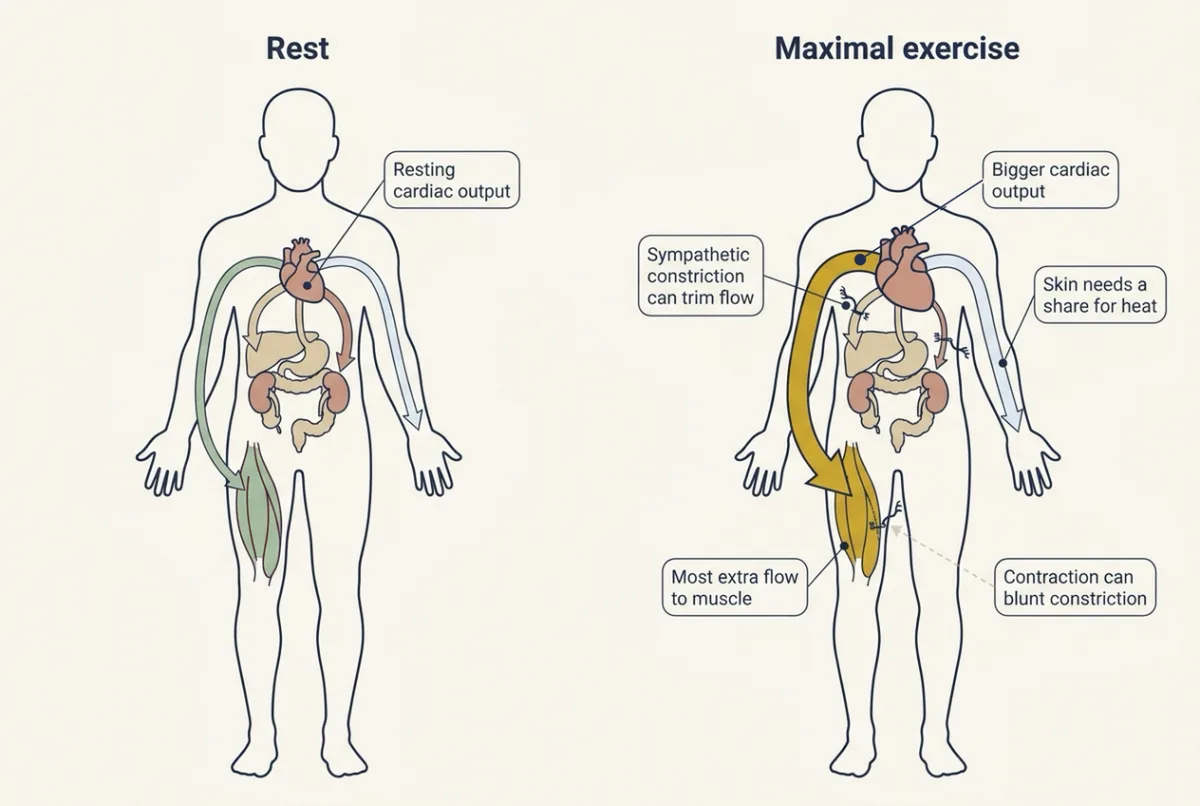
Most of the extra blood that reaches working muscle comes from a much larger cardiac output; sympathetic nerves can trim gut and kidney flow, contraction can blunt the same constriction in working muscle, and skin needs its own share to shed heat. AI-generated illustration -
How much could muscle take?
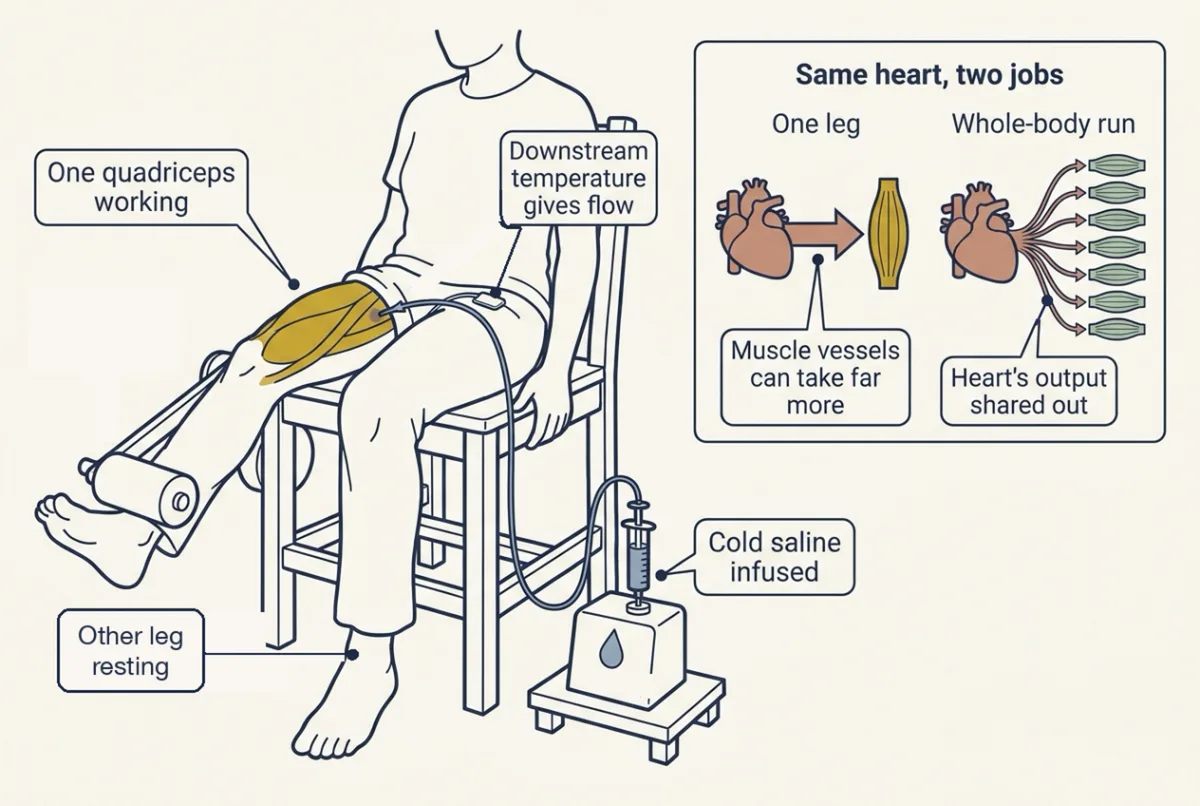
Working one quadriceps alone, Andersen and Saltin's five subjects reached an estimated 2.5 L of blood per kilogram of muscle per minute, far more per kilogram than the heart could send to every muscle of a run, which argued that in healthy people the muscle's vessels are not the ceiling. AI-generated illustration -
Why the evidence points to delivery
-
Breathing protects the oxygen in each litre
-
Heat competes for the flow
-
What the ceiling is for: fuel, lactate and the fraction you can hold
-
What training changes
-
Heart failure: the Fick split as a diagnostic
-
Going deeper
Where this lesson fits
Before thisReview first
- Cardiac Output and Venous ReturnThis course · Lesson 7
It introduces the Fick principle and what sets cardiac output, which this lesson splits into flow and extraction.
- Ventilation, Perfusion and Gas ExchangeThis course · Lesson 13
You need alveolar gas and the A-a difference from there to see how the lung keeps arterial oxygen up.
- Skin, Sweat and Human ThermoregulationThis course · Lesson 26
Sweat, skin blood flow and heat loss from there explain how heat competes with muscle for flow.
Elsewhere on the siteFilms, simulations and method films in other courses
- Oxygen content and the Fick principleSimulation · Organismal Biology
Oxygen content of blood and the Fick principle are worked through there, giving the extraction term used here.
- Why Blood Needs an S-Shaped CarrierFilm · Organismal Biology
It shows how hemoglobin lifts blood oxygen content, the CaO2 you check in this lesson.
- Where the Balance SitsFilm · Organismal Biology
It shows how heat made, gained and lost balance, which explains the heat cost of running.
- Spending ATP, Rebuilding ATPFilm · Biology
It shows how cells rebuild ATP for work, the muscle demand that drives oxygen uptake.
Suggested by an AI model from the lessons themselves, then checked. How we use AI