Where the Balance Sits
Read the transcript of “Where the Balance Sits”
Film transcript: Where the Balance Sits
On a desert morning, a basking iguana is warmer than the air. So is a mouse nearby. Yet the iguana makes far less heat of its own than the mouse. How can both be warmer than the air? Picture each body as a tank of warmth. The level in the tank is body temperature. Heat flows in, heat leaks out, and the level settles where the two match. Two taps fill the tank. The orange tap is heat made by the body's own metabolism. The yellow tap is heat gained from outside, from sunlight or a warm rock. The blue outlet is the dry leak. Its width is conductance, how readily heat escapes for each degree of difference. The flow also grows with the gap between body and air.
Three routes make up that leak. Radiation, conduction, and convection by moving air or water. Each can run in or out, so the leak is their net. Sunlight and a warm rock count once, in the yellow tap, not the leak. A fourth outlet is evaporation. Water turning to vapour carries heat away, as in sweating or panting. In practice it only removes heat, and it costs water. So the level sits where heat in equals heat out. Body temperature rises above the air by the heat coming in, minus evaporation, divided by conductance. The iguana's orange tap runs small. Its yellow tap pours, from the sun above and the rock below. That inflow alone lifts it well above the air.
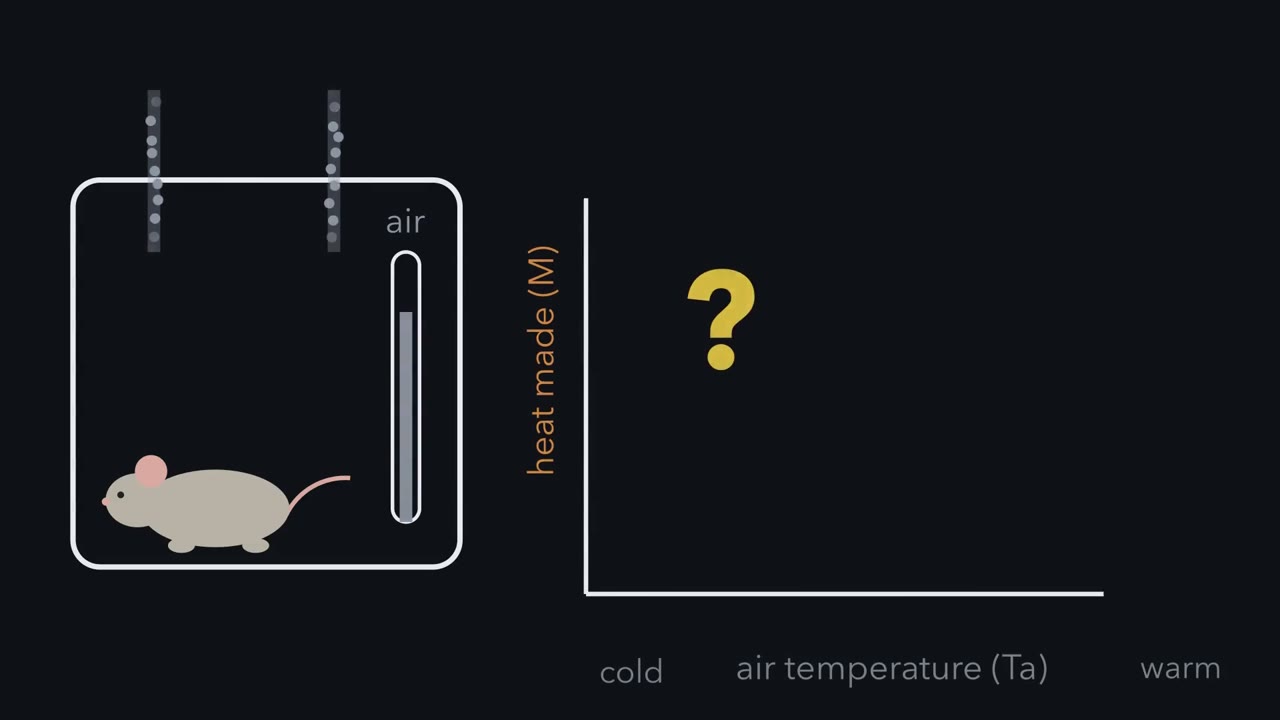
The mouse has almost no yellow tap. Its orange tap runs strong, and fur keeps its blue outlet narrow. Its own metabolism holds it above the air. That is the real difference between an ectotherm and an endotherm. The words name where the heat comes from, not how warm the animal is. Now move the mouse into colder air, with the same fur. The gap widens, and heat leaks faster. Name two ways it can hold its level.
Make more heat, by opening the orange tap. Or narrow the leak, by closing skin blood vessels and fluffing the fur. Every dial an animal has changes one of these terms. Who turns the taps? Sensors in the skin and deep in the body report to a controller in the brain. In mammals it sits in the preoptic area of the hypothalamus. It chooses the target temperature. Skin sensors give early warning. Cold air on the skin can start heat-saving responses before the core has cooled at all.
How can a lizard basking on a desert rock end up warmer than you are, without making much heat of its own?
Continue in the lesson: Heat Balance and Body Temperature →
3:13 · Free, with captions and a transcript. The lesson has the full text, the questions and the sources.
More films from this lesson
How this film was made. Narration: written from this lesson's text and read by an AI narrator voice (Kokoro, af_heart). Animation: AI-generated in code (Manim) by Claude, a schematic with no drawn molecular structures. Captions come from the narration script. See something wrong? Report it.