Physiology · Skim version
Endocrine Axes and How to Test Them
Read the full lesson → Skim the whole course →
The guiding idea
Two people have the same low morning cortisol. In one the adrenal has failed; in the other it is healthy but unsignalled. Which second number tells them apart?
How do you find where a hormone axis has failed?
-
One chain, three links, one feedback loop
-
Which link failed? Read the pair
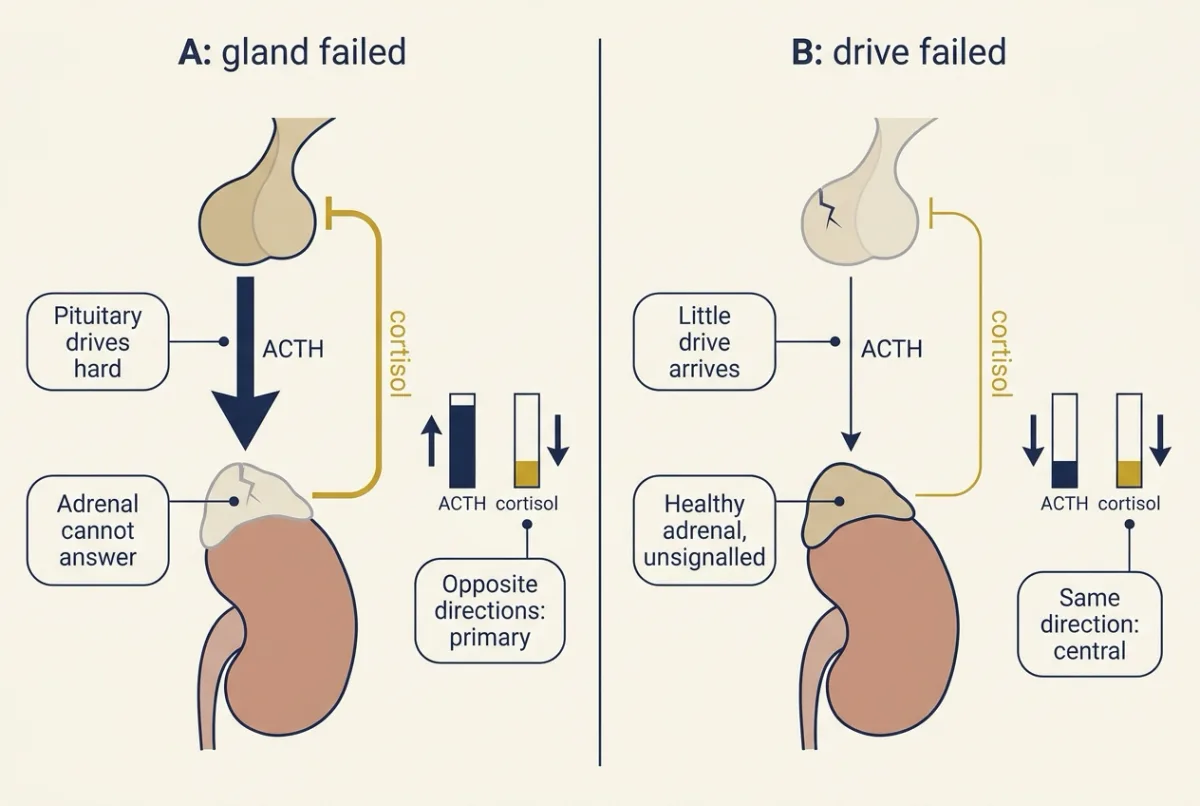
Same low cortisol, two different faults: when the gland fails, feedback drives the trophic hormone up and the pair moves in opposite directions; when the drive fails, both fall together, which points above the gland but cannot say whether to the pituitary or the hypothalamus. AI-generated illustration -
Change one input: stimulation and suppression tests
-
Condition 1: catch the right moment
-
Condition 2: know what the assay measured
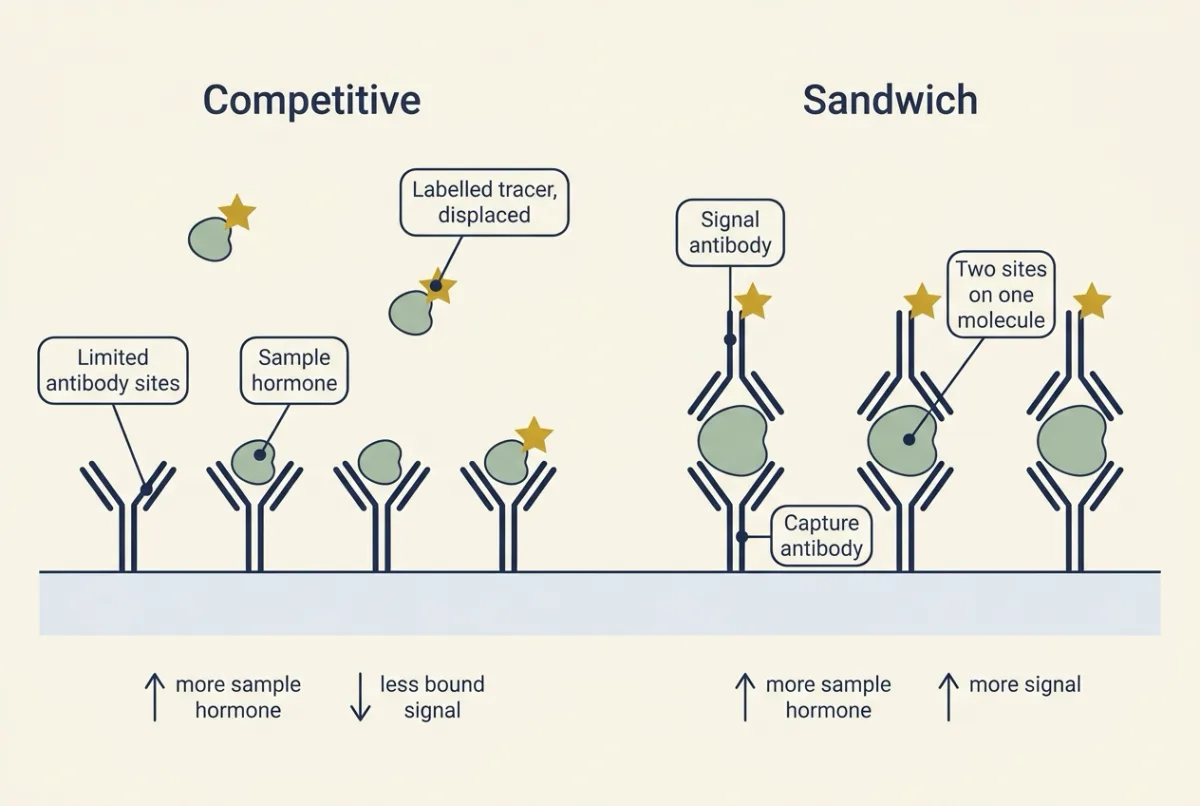
In a competitive assay sample hormone displaces labelled tracer, so signal falls as hormone rises; in a sandwich assay two antibodies grip one molecule, so signal rises with hormone, and that opposite wiring is why one interference can push TSH and free T4 in opposite directions. AI-generated illustration -
Going deeper
Where this lesson fits
Before thisReview first
- Body Water and Its CompartmentsThis course · Lesson 1
It sets up the body's internal environment, which hormone axes regulate, though this lesson uses it only loosely.
After thisStudy next
- Thyroid Hormone: Tissues Decide What T4 BecomesThis course · Lesson 19
It applies the paired TSH and free T4 reading to where T4 becomes T3 in tissues.
- The Adrenal Cortex and MedullaThis course · Lesson 20
It takes the ACTH and cortisol axis further, including how blocking an enzyme changes the feedback loop.
- Insulin, Glucagon and Blood GlucoseThis course · Lesson 21
It uses a challenge test, the glucose drink, to read how a hormone system responds.
Elsewhere on the siteFilms, simulations and method films in other courses
- RadioimmunoassayMethod film
It shows how competitive hormone assays work, which the lesson needs to say what a measured number means.
- Receptor binding and dose-response analysisMethod film
It covers binding and dose-response, the basis of how assays and challenge tests read a hormone.
- When the Body Pushes BackFilm · Biology
It shows how feedback pushes a variable back toward its range, the loop behind the long-loop feedback here.
- Leak and Push-BackFilm · Organismal Biology
It shows a control loop with a sensor and push-back, the same wiring as an endocrine axis.
Suggested by an AI model from the lessons themselves, then checked. How we use AI