Neuroscience · Skim version
Emotion and Stress
Read the full lesson → Skim the whole course →
The guiding idea
A rat freezes to a tone that once came before a shock. Damage one region of its hypothalamus and it still freezes, but its learned rise in blood pressure is impaired.
In a rat that has learned that a tone predicts shock, the tone reaches the amygdala, and the learned responses leave by separable routes, two fast and one slow.
From the film: One Signal, Three Routes
- Paired minus unpaired freezing estimates what a rat learned about the tone.
- A learned threat cue reaches the amygdala, then leaves by separate routes: one for freezing, one for the pressure rise, and a mostly indirect one to the hormone response.
- Freezing and the pressure rise appear while the tone is still playing, but the hormone response peaks tens of minutes later.
- This map describes learned responses to an outside cue in rats; it does not say what the rat feels.
From the film: Cutting One Route at a Time
- In rats, damage to lateral hypothalamus neurons impaired mainly the pressure rise, and damage to the caudal periaqueductal gray impaired mainly freezing.
- Each lesion impairing one response and sparing the other is a double dissociation, so different targets below the amygdala contribute to different responses.
- Damage to the shared central amygdala node should impair both learned responses.
- This experiment finds the routes out of the amygdala, but it says nothing about a feeling.
From the film: The Slow Route, and Where the Map Stops
- The hormone route runs through the hypothalamus, pituitary and adrenal, so levels peak tens of minutes after the stress begins.
- As the hormone rises, it feeds back to turn down further release, with a fast arm over seconds to minutes and a slow arm over hours to days.
- Hormone levels also rise and fall with a daily rhythm and pulses about once an hour, and in one rat preparation a steady CRH infusion still gave hourly pulses.
- The map stops at feeling: rat circuits can find necessary steps for a measured response, but cannot alone say what is felt.
-
One signal, several routes, two speeds
-
Learning what predicts harm
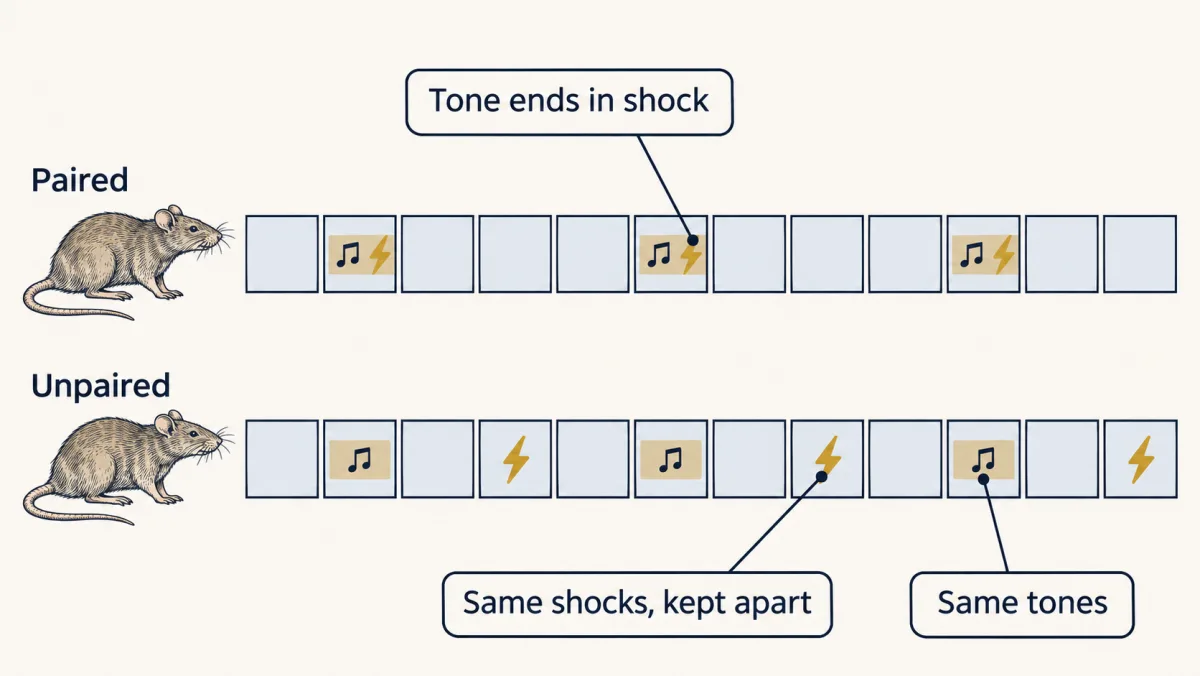
Both groups get the same tones and the same shocks and only the pairing differs, so paired minus unpaired freezing estimates learning about the tone. AI-generated illustration -
The map: one node, several routes
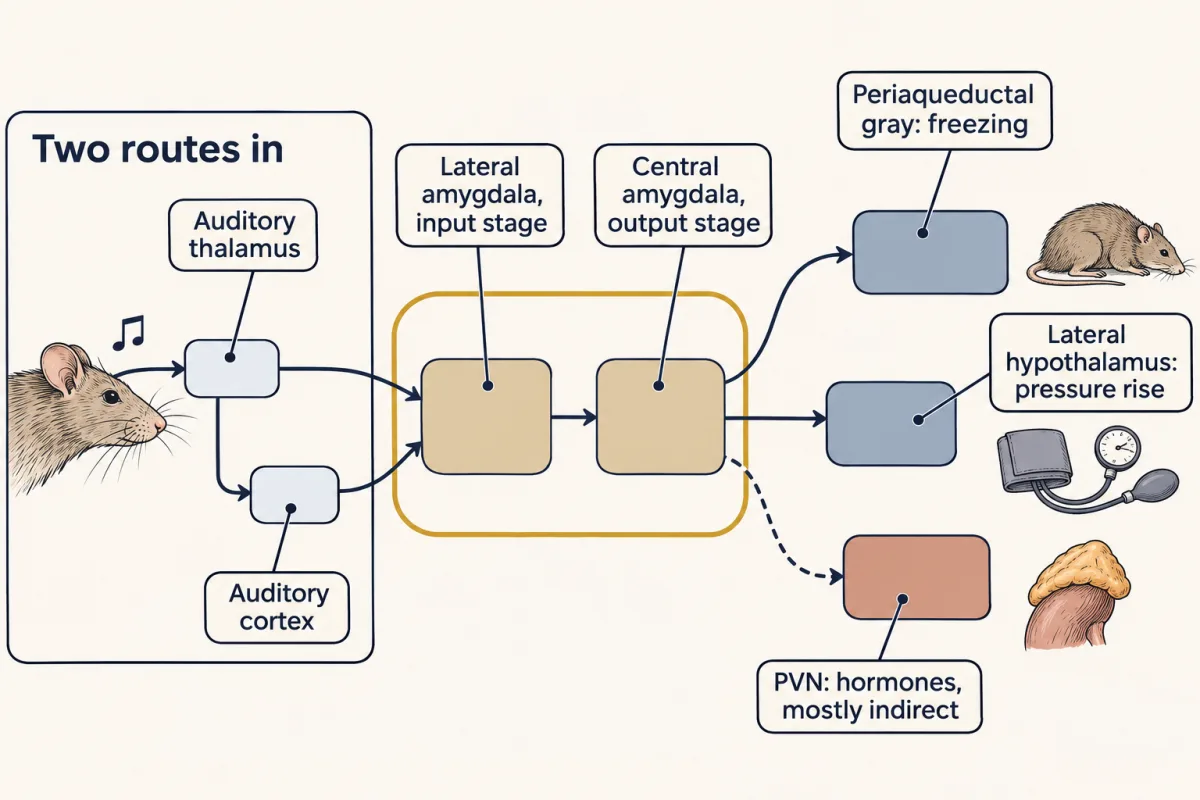
In the simplest working map, the tone reaches the lateral amygdala by two routes, and the central amygdala sends separate routes out to freezing, to the pressure rise and, mostly indirectly, to the slower hormone response. AI-generated illustration -
The key experiment: cutting one route at a time
-
The slow route: the HPA loop
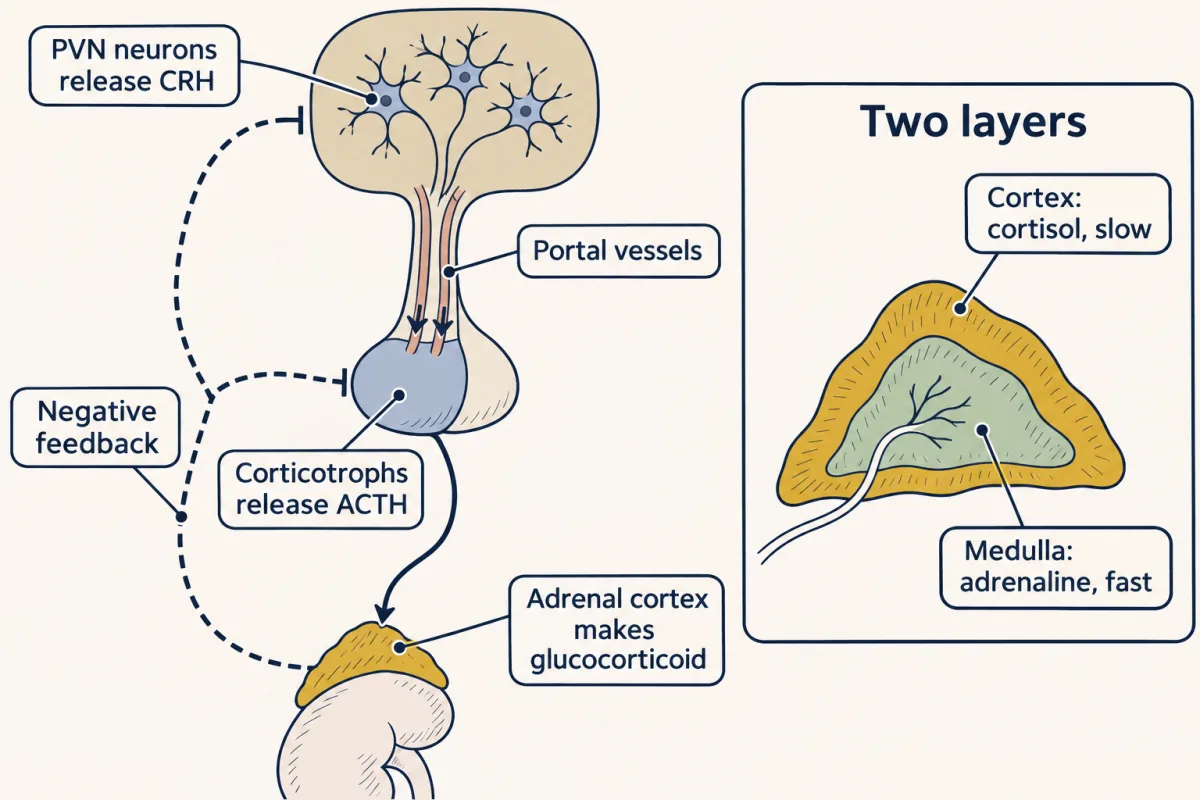
The slow route is three hormone relays, CRH to ACTH to glucocorticoid, held in check by negative feedback; adrenaline from the adrenal medulla, driven by a nerve, belongs to the fast clock. AI-generated illustration -
Where the rule stops
-
What a freezing rat can tell us
-
Going deeper
Where this lesson fits
Before thisReview first
- Autonomic Control and the HypothalamusThis course · Lesson 18
You need its hypothalamic sympathetic outputs and autonomic control to follow the pressure-rise route here.
- Synaptic PlasticityThis course · Lesson 8
The lateral amygdala change after pairing is an LTP-like strengthening that this lesson takes as understood.
- Feeding, Motivation and RewardThis course · Lesson 19
It uses hypothalamic circuit logic and prediction learning that this lesson builds on for cue-outcome learning.
After thisStudy next
- Memory SystemsThis course · Lesson 22
It takes up the facts-versus-conditioning split seen in patients with amygdala or hippocampal damage.
- Plasticity, Networks and ConsolidationThis course · Lesson 23
It takes the amygdala and hippocampus learning of fear further, including tagged cells that drive freezing.
- Designing a Causal Circuit ExperimentThis course · Lesson 28
It extends the logic of cutting routes to causal tests, with controls for what a manipulation really does.
Elsewhere on the siteFilms, simulations and method films in other courses
- One sample, many answersSimulation · Physiology
Reading cortisol and its feedback pair shows how the HPA axis is tested in practice.
- An Enzyme Guards the ReceptorFilm · Physiology
It shows how the adrenal makes cortisol and how a loop controls it, the hormone end of this stress route.
- When the Body Pushes BackFilm · Biology
It shows how a body pushes back against a change through feedback, the idea behind the HPA fast and slow feedback.
Suggested by an AI model from the lessons themselves, then checked. How we use AI