Sensory Systems · Skim version
Where Touch Is First Processed: Dorsal Horn and Dorsal Column Nuclei
Read the full lesson → Skim the whole course →
The guiding idea
The brainstem can hear about one touch of the paw twice: directly, and again by a route through the spinal cord that, in a simple conduction model, arrives a few milliseconds later. What does the second report add?
In mice, a touch reaches the gracile nucleus by two routes, a direct afferent axon that keeps precise timing and an indirect dorsal horn route, rebuilt by local circuits, that reports sustained pressure.
From the film: Two Routes, One Patch of Skin
- A touch on the mouse hindpaw reaches the gracile nucleus by two routes: the afferent's own axon, and a route through the dorsal horn.
- For thalamus-projecting gracile neurons, the two inputs had highly aligned receptive fields, so both report the same patch of skin.
- The direct route keeps precise timing, while the indirect route reports sustained pressure, up to high forces.
From the film: Silence One Route
- Silencing one route at a time showed that the direct input carries vibration with high temporal precision.
- The indirect route carries sustained pressure, and gentle displacement uses both routes.
- The high-force result rests on a drug that is not specific to PSDC neurons, so it carries that limit.
From the film: Why Later Is Fine, and What the Cord Does
- In a simple model the indirect route arrives a few milliseconds later, but that lag is illustrative, not a measurement.
- A fixed delay does not blur a route's own timing; random jitter at each synapse could, which would cost fast vibration more than a sustained press.
- Losing feedforward or presynaptic inhibition enlarged the receptive fields of PSDC neurons in anaesthetized mice.
-
Two routes on one drawing
-
The key experiment: silence one route at a time
-
What a slower route costs
-
What the dorsal horn does to the signal
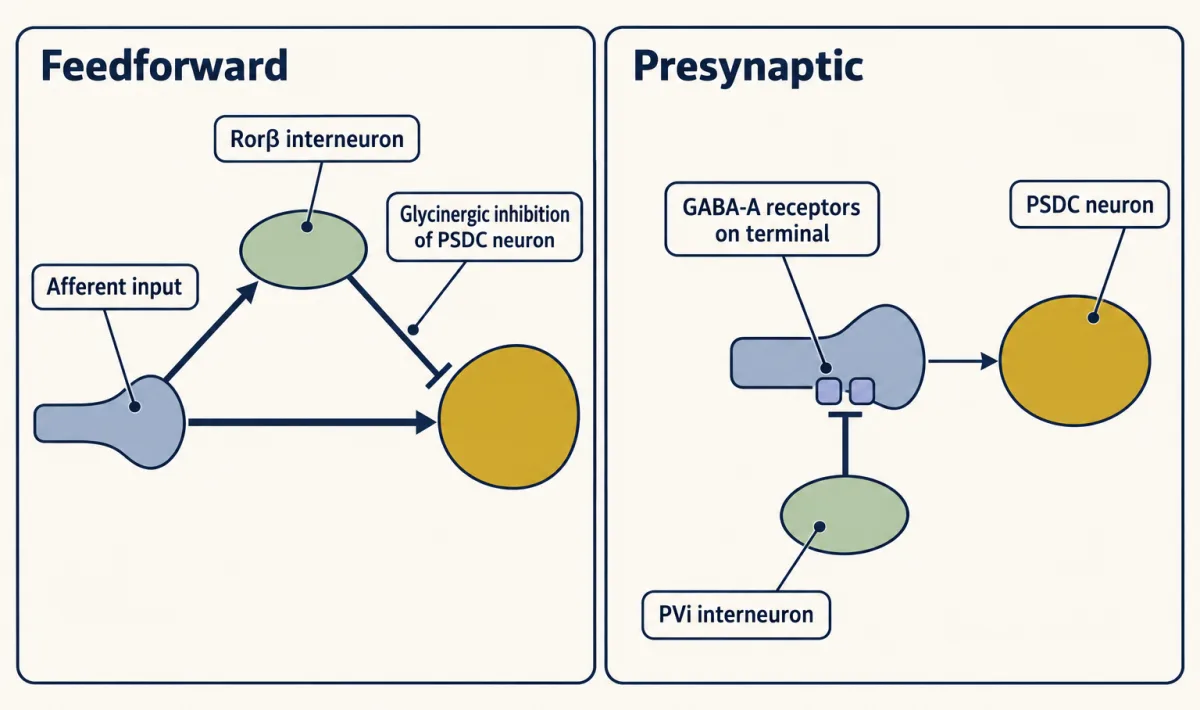
Feedforward inhibition follows the same afferent input onto the PSDC neuron (Rorβ interneurons, glycinergic), while presynaptic inhibition acts on the afferent terminal and scales down its transmitter release (GABA-A dependent, with PVi neurons among its sources). Disrupting either enlarged PSDC receptive fields in Chirila and colleagues' mice; presynaptic inhibition was removed from all sensory neurons, not through PVi neurons. AI-generated illustration -
Who is in the zone: an atlas
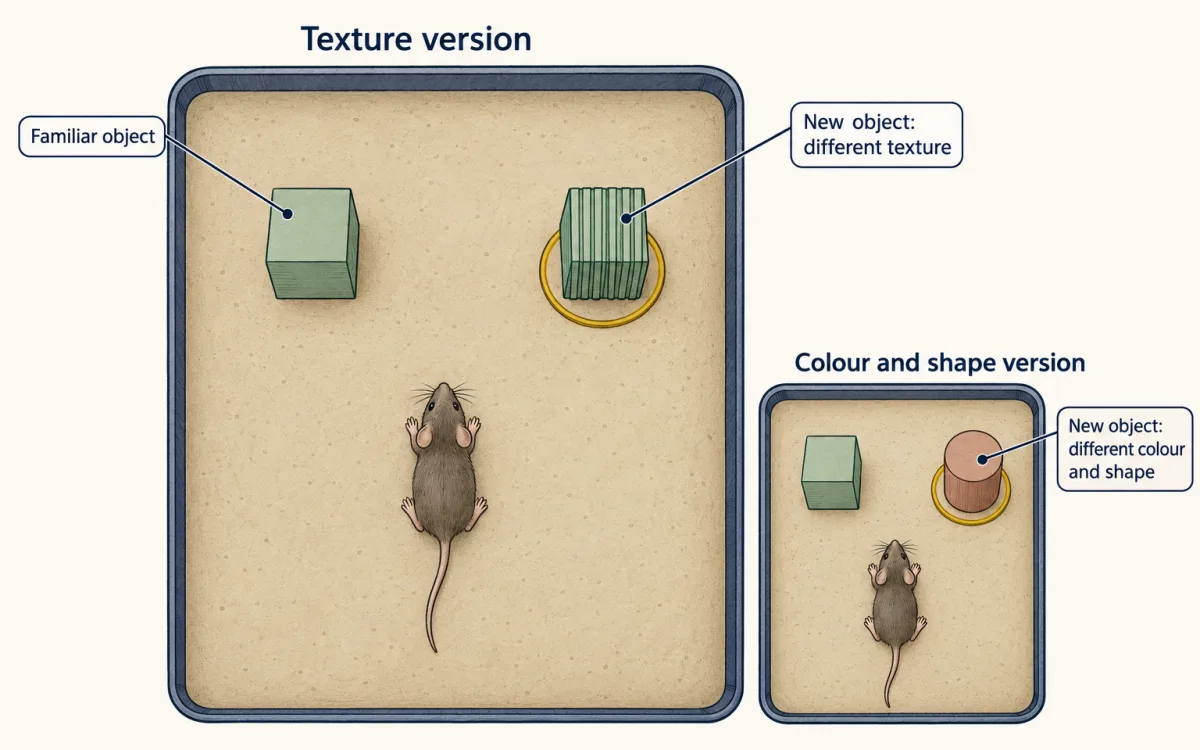
Abraira and colleagues tested a texture version of the novel object recognition test, in which a mouse that remembers an object explores a new one more. Mice with CCK or Rorβ lineages silenced lost the preference for the newly textured object but kept it when objects differed in colour and shape. AI-generated illustration -
When inhibition fails
-
Where the idea stops
-
Design problem
-
Going deeper
Where this lesson fits
Before thisReview first
- The Low-Threshold Mechanoreceptors: One Touch, Several SignalsThis course · Lesson 4
This lesson starts from the Aβ low-threshold mechanoreceptor classes whose branches split into the direct and dorsal horn routes.
- Sensory Neurons by Their Genes: the Atlas EraThis course · Lesson 3
The reporter-defined interneuron populations and genetic access used here build on how sensory neurons are sorted by their genes.
After thisStudy next
- Spinal Circuits That Gate PainThis course · Lesson 12
It takes the dorsal horn inhibitory gating of Aβ input further, covering the Duan experiment this lesson only sketches.
- Touch Over-reactivity in Autism ModelsThis course · Lesson 9
It follows the loss of feedforward and presynaptic inhibition into tactile over-reactivity, which this lesson introduces.
Elsewhere on the siteFilms, simulations and method films in other courses
- Where Every Command EndsFilm · Neuroscience
It shows a sensory axon branching to act on several targets at once, as the touch afferent does here.
- Why Capsaicin Feels HotFilm · Neuroscience
It introduces touch pathways and the spinal cord, which this lesson works out in detail.
Suggested by an AI model from the lessons themselves, then checked. How we use AI