Biology · Skim version
DNA: Structure and Copying
Read the full lesson → Skim the whole course →
The guiding idea
If you kept only one strand of a DNA molecule and threw the other away, could you rebuild the whole thing, letter for letter?
Because A pairs only with T and C only with G, each DNA strand fixes its partner, so a cell copies DNA by building a new partner on each old strand, and DNA polymerase's checks, together with separate repair enzymes, make that copy nearly perfect.
From the film: One Strand Is Enough
- DNA is two strands of nucleotides, each a sugar, a phosphate and one of four bases: A, T, C or G.
- Covalent bonds join each strand's backbone; weak hydrogen bonds hold A to T and C to G across the strands.
- The two strands point opposite ways, like two arrows side by side.
- Because A pairs only with T and C only with G, each strand sets the base order of its partner.
- Copying unzips the helix and builds a new partner on each old strand, giving two molecules with the same base order, each one old strand and one new.
From the film: Inside the Fork
- DNA polymerase adds nucleotides only at the arrowhead end of a new strand, so each new strand points opposite to its template.
- The fork opens only a little template at a time, so one new strand grows smoothly in the direction the fork moves and the other is built in short pieces that another enzyme joins.
- Polymerase picks the matching nucleotide, so a wrong one almost never gets in, and it proofreads, removing most wrong ones that do; repair enzymes catch many of the rest.
- A textbook estimate is about one uncorrected mistake for every billion bases copied.
- Pairing makes the copy possible; checking makes it accurate.
-
Explore: unzip and copy a DNA molecule
-
Explain: a twisted ladder of four bases
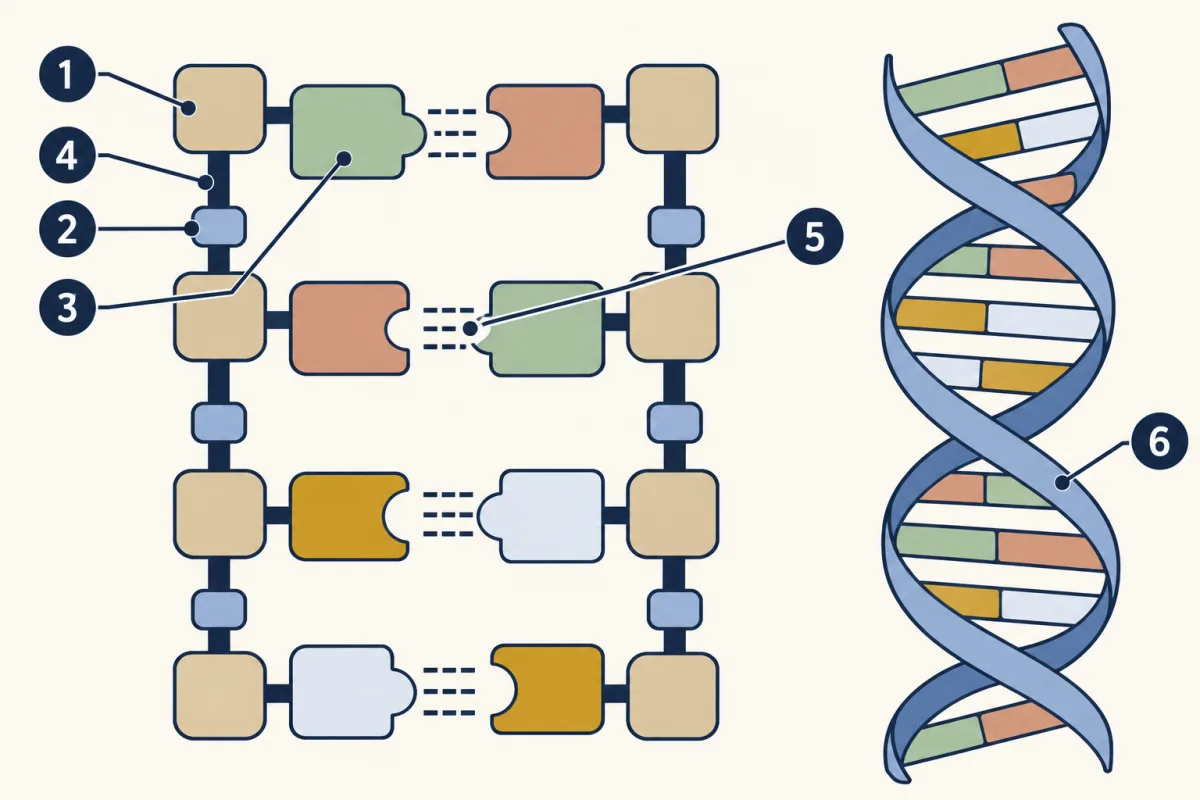
- sugar
- phosphate
- base
- covalent bond
- hydrogen bond
- double helix
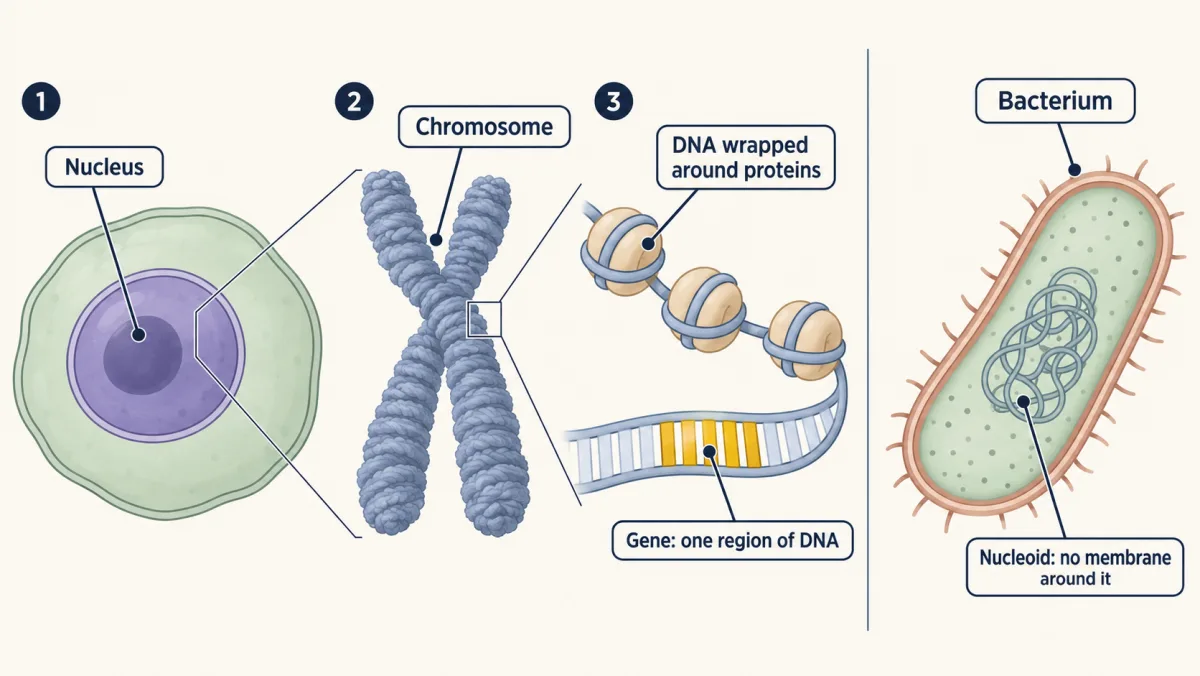
A chromosome is one long DNA molecule wound around proteins, and a gene is one stretch of it. Bacteria keep their DNA in a nucleoid with no membrane around it. AI-generated illustration -
Explain: copying DNA one strand at a time
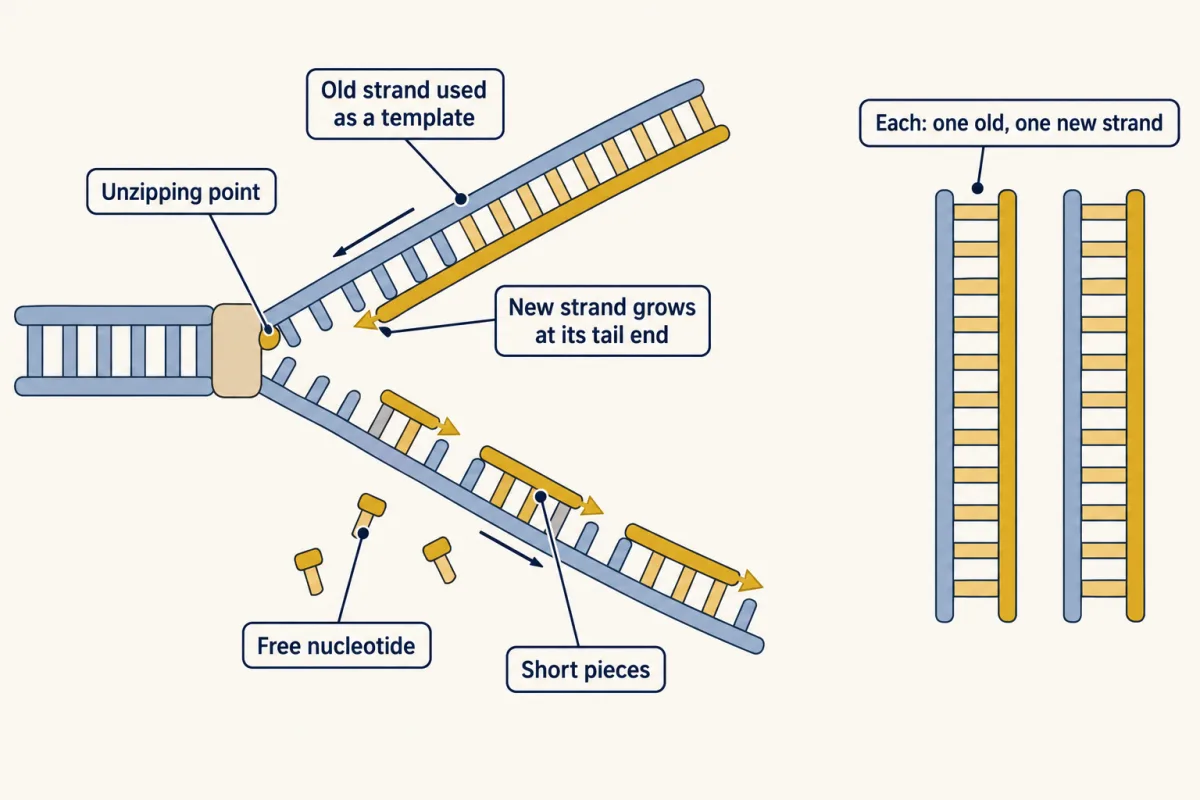
DNA polymerase adds only at a new strand's arrowhead and the fork opens a little at a time, so one new strand follows the fork and the other is built in short pieces that another enzyme joins. Each finished molecule keeps one old strand. AI-generated illustration -
Elaborate: do the bases really pair up?
-
Evaluate: check your thinking
-
Going deeper
Where this lesson fits
Before thisReview first
- What Am I Made Of?This course · Lesson 2
You need to know nucleic acids are long chains of nucleotides, and what covalent bonds are, from there.
- Enzymes at WorkThis course · Lesson 3
Unzipping and copying are done by enzymes, so you need to know what an enzyme does.
After thisStudy next
- From DNA to ProteinThis course · Lesson 18
The base order you copied here is the code that is read to build a protein.
- Meiosis and VariationThis course · Lesson 19
Copied chromosomes are then shuffled and divided into gametes, so you use the copying idea there.
- How the DNA Model Was BuiltThis course · Lesson 17
It shows how evidence like base-pair counts was used to build and test the double helix model.
Suggested by an AI model from the lessons themselves, then checked. How we use AI