Genetics and Molecular Biology · Skim version
Complementation and Gene Function: From Beadle and Tatum to Benzer
Read the full lesson → Skim the whole course →
The guiding idea
Two pure-breeding white-eyed flies can have red-eyed offspring. What does that tell you about their genes?
Rescue tells you whether two mutations share a function, and brackets a pathway block between supplied compounds.
From the film: When Two Mutants Rescue Each Other
- For recessive mutants, rescue in trans usually means different genes.
- Check each mutation against wild type before interpreting a complementation test.
- Mutations that fail to complement form a group that usually marks one gene.
- Dominant mutations make the test uninformative, and known recessive exceptions can mislead it.
From the film: Reading a Pathway Backward
- A usable supplement rescues only by entering after the blocked step.
- More rescuing intermediates place a block earlier in a simple linear pathway.
- A rescue class can contain several genes that act between the same supplied compounds.
- Growth rescue requires the supplied compound to enter the cell and join the pathway.
-
The complementation test: put two mutations in one cell
-
Beadle and Tatum: one mutant, one blocked step
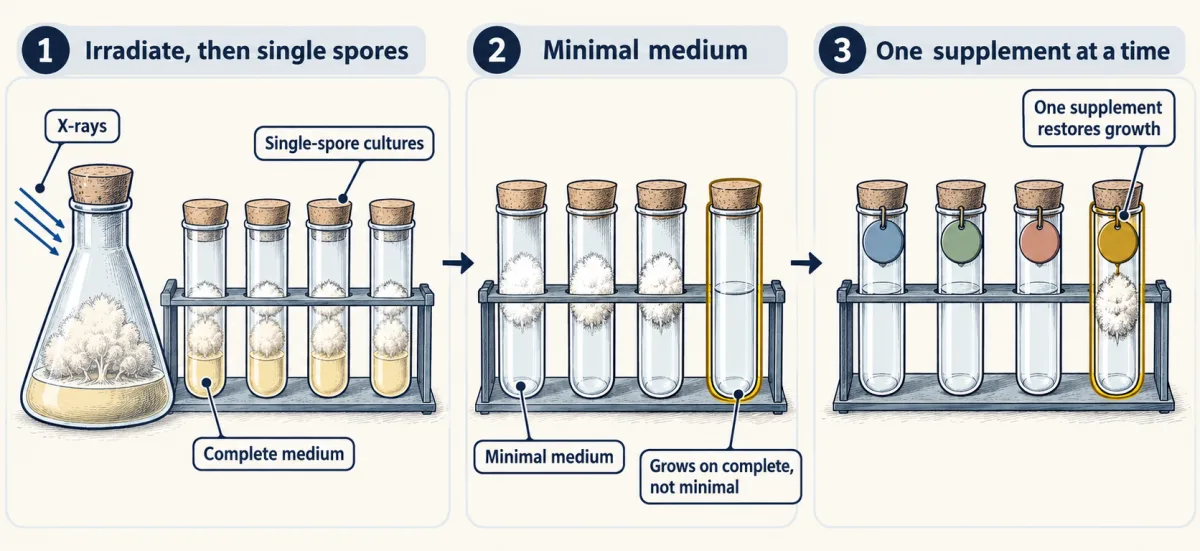
Beadle and Tatum kept irradiated Neurospora alive on complete medium and tested each culture on minimal medium; for a mutant, the single supplement that restored growth named the lost synthesis. AI-generated illustration -
Ordering a pathway from rescue data
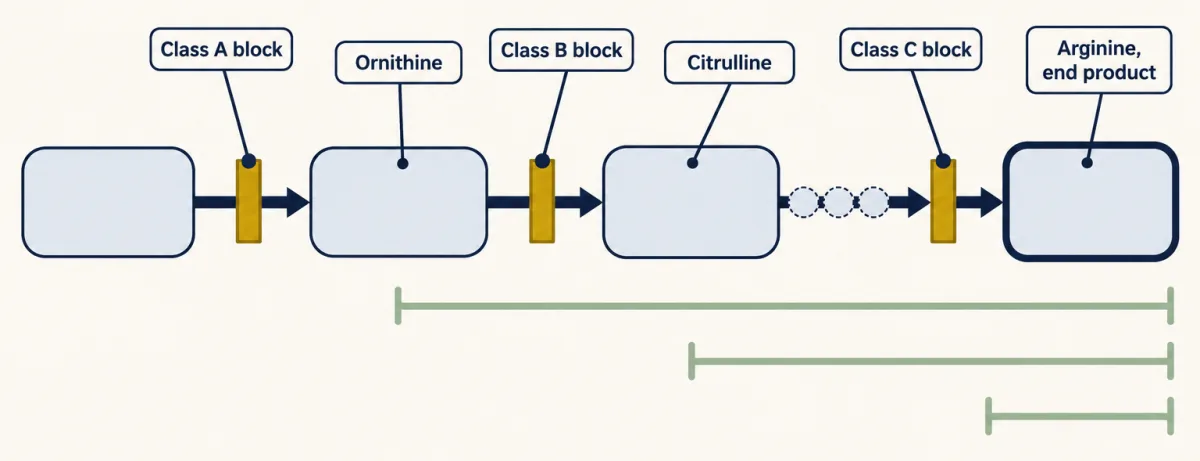
A supplement rescues a mutant only if it enters the pathway after the block, so the three rescue classes give the order precursor, ornithine, citrulline, arginine. AI-generated illustration -
Benzer: function versus fine structure
-
Going deeper
Where this lesson fits
Before thisReview first
- Mendel's Peas: Segregation and Independent AssortmentThis course · Lesson 1
You need segregation and recessive alleles from there to see why a trans diploid can be wild type.
- Extending Mendel: Dominance, Multiple Alleles and Gene InteractionThis course · Lesson 4
Its gene-interaction crosses, such as white peas giving purple hybrids, show the rescue idea that complementation relies on.
- Linkage and Recombination MappingThis course · Lesson 8
You need to know that recombination separates sites on a chromosome to tell it apart from complementation.
After thisStudy next
- Bacterial and Phage Genetics: Conjugation, Transduction and TransformationThis course · Lesson 11
Phage crosses and selective hosts build on Benzer's rII work, which this lesson only introduces.
- Mutation: Where Variation Comes FromThis course · Lesson 14
Benzer's many rII mutants and the one-gene, one-step idea lead into how mutations arise.
- The Genetic Code and TranslationThis course · Lesson 18
Benzer's fine-structure work leads to how a gene's sequence specifies a protein through the genetic code.
Suggested by an AI model from the lessons themselves, then checked. How we use AI