Organismal Biology · Skim version
Circulation and the Heart
Read the full lesson → Skim the whole course →
The guiding idea
An adult human holds about 5 litres of blood, yet at rest each side of the heart pumps about that much every minute. Where does it all go?
Both sides of the heart pump the same flow, yet the left side makes far more pressure, because at a given flow the pressure a circuit costs depends on its resistance.
From the film: One Flow, Two Pressures
- At rest, both sides of a mammal's heart pump about the same flow, because blood goes round the two circuits in turn.
- Averaged over many beats, pressure drop = flow × resistance: at a given flow, the harder a circuit is to push through, the bigger the drop.
- The body's circuit resists far more than the lungs', so the left ventricle must make much higher pressure than the right.
- In a teleost fish, one ventricle pushes blood through the gills and then the body, so the body gets the lower pressure that is left.
- At the same flow, the harder circuit costs more pressure.
From the film: Harvey's Arithmetic
- Harvey's ligatures, bands tied on the arm, showed that blood enters a limb by arteries and leaves by veins.
- Even a deliberately small guess per beat, times the beats in half an hour, is more blood than the whole body contains.
- So the same blood must go round: it circulates rather than being made and used up.
- Cardiac output is heart rate times stroke volume, the blood one ventricle ejects per beat.
- The SA node and autonomic nerves set the rate; filling, contraction strength and the pressure the ventricle pushes against change the stroke volume.
-
Bulk flow, open and closed
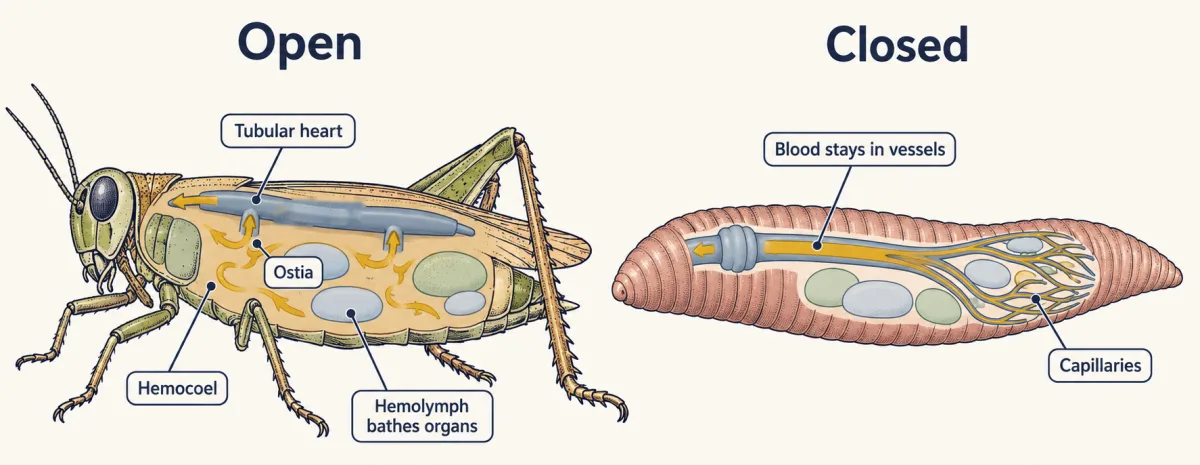
In an open system, hemolymph leaves the vessels and bathes the organs directly in the hemocoel; in a closed system, such as an earthworm's, blood stays in vessels and exchange happens across capillary walls. AI-generated illustration -
Through the mammalian heart, valve by valve
-
One circuit or two
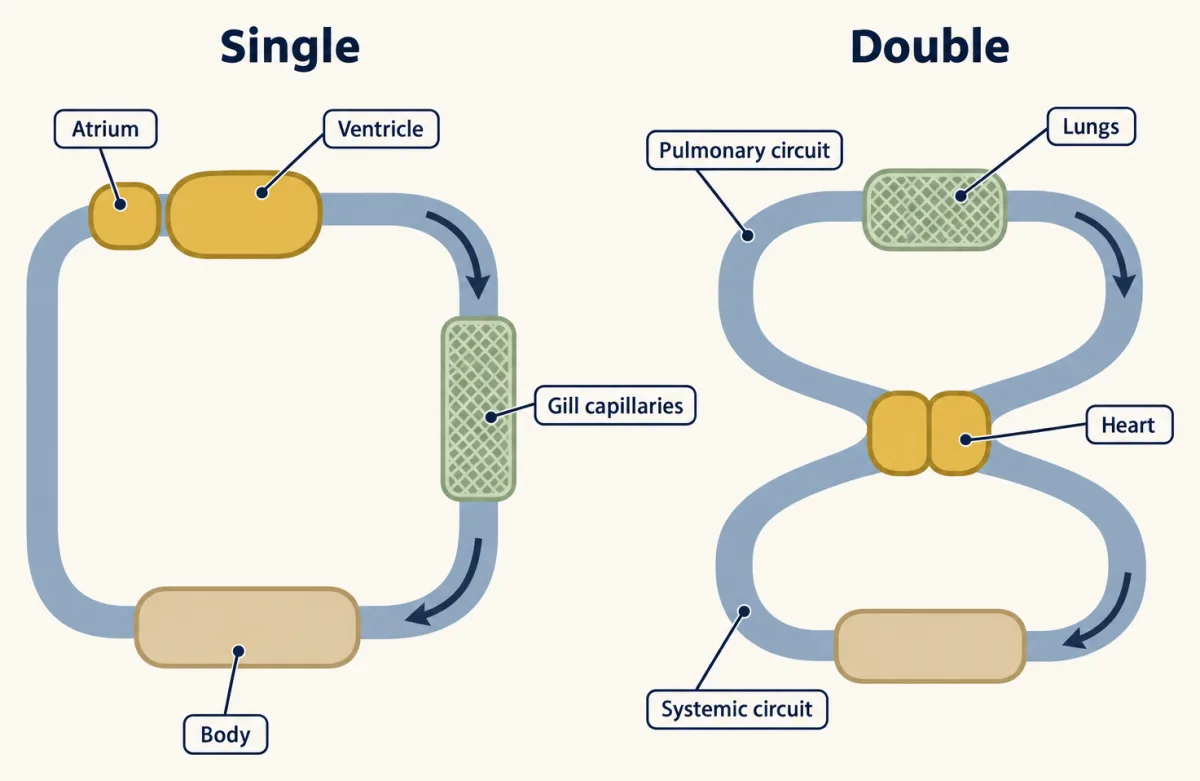
In single circulation, as in a teleost fish, blood passes through the heart once per loop, so the gills and the body share one push. In double circulation it passes through twice; where the two pumps are fully separate, as in birds and mammals, the lungs and the body each get their own pressure. AI-generated illustration -
Harvey’s numbers, redone
-
The rate dial: pacemaker and conduction
-
The stroke volume dial: filling, contractility and load
-
Going deeper
Where this lesson fits
Before thisReview first
- Size, Scale and SurfaceThis course · Lesson 2
You need its point that diffusion fails over long distances to see why large animals need bulk flow.
- Tissues, Organs and HomeostasisThis course · Lesson 6
Heart rate and output are controlled by feedback loops, which that lesson introduces.
- What an Organism Has to DoThis course · Lesson 1
It sets up the problem of moving oxygen and nutrients to cells that this lesson's pump solves.
After thisStudy next
- Blood Vessels, Blood and LymphThis course · Lesson 11
It applies pressure drop = flow × resistance to the vessels themselves, showing why narrow vessels carry slow flow.
- Carrying Oxygen and Carbon DioxideThis course · Lesson 13
It follows the oxygen that the circulation delivers, using cardiac output in the Fick principle.
- Gas Exchange and BreathingThis course · Lesson 12
It covers the lung and gill circuits that the heart pumps blood through.
Suggested by an AI model from the lessons themselves, then checked. How we use AI