Physiology · Skim version
Capillary Exchange, Lymph and Edema
Read the full lesson → Skim the whole course →
The guiding idea
Adults born with almost no plasma albumin usually have only mild swelling. What keeps their tissues from flooding?
Why does fluid leave a capillary all along its length, and how does it get home?
-
Push, hold-back and conductance
-
Why the venous end does not reabsorb
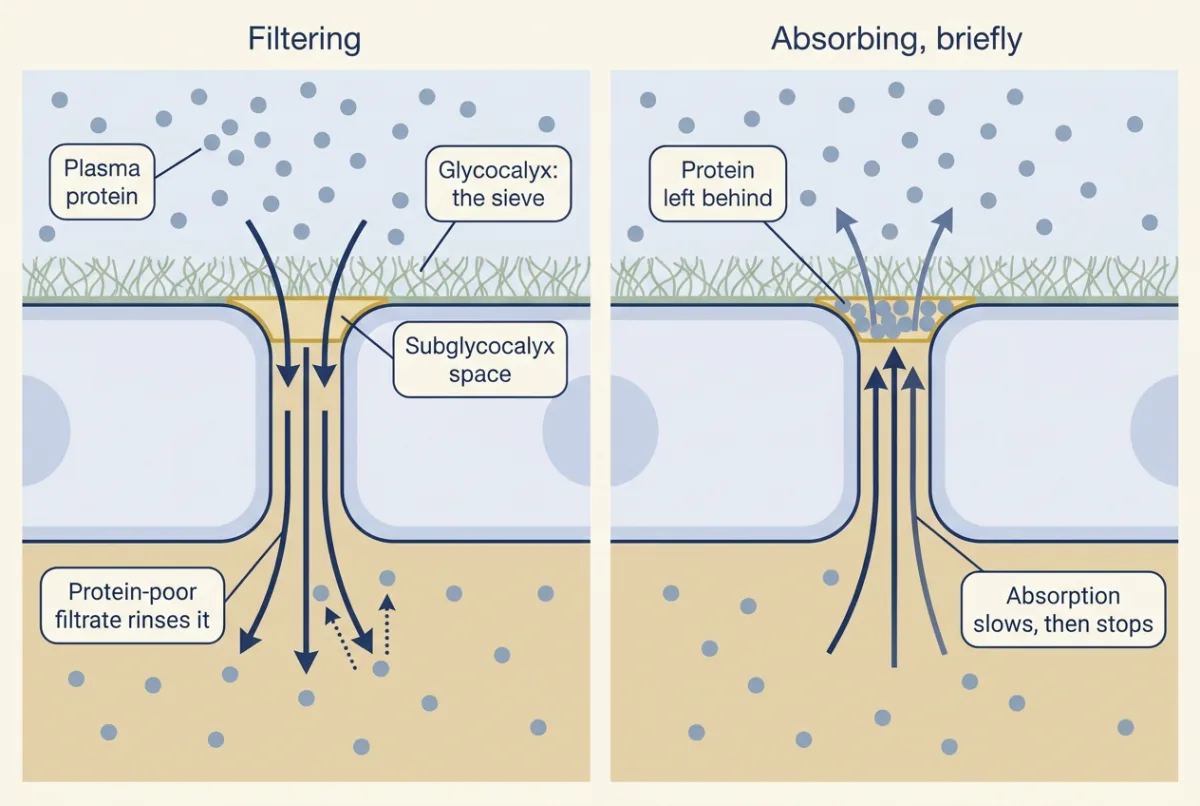
Filtering rinses protein out of the thin film beneath the glycocalyx and keeps the hold-back strong; absorbing leaves protein behind in that film, so absorption weakens its own hold-back and stops. Whether the glycocalyx or the junctions beneath it is the main barrier to protein is still argued, and the evidence comes mostly from animal vessels. AI-generated illustration -
Where the fluid goes: lymph
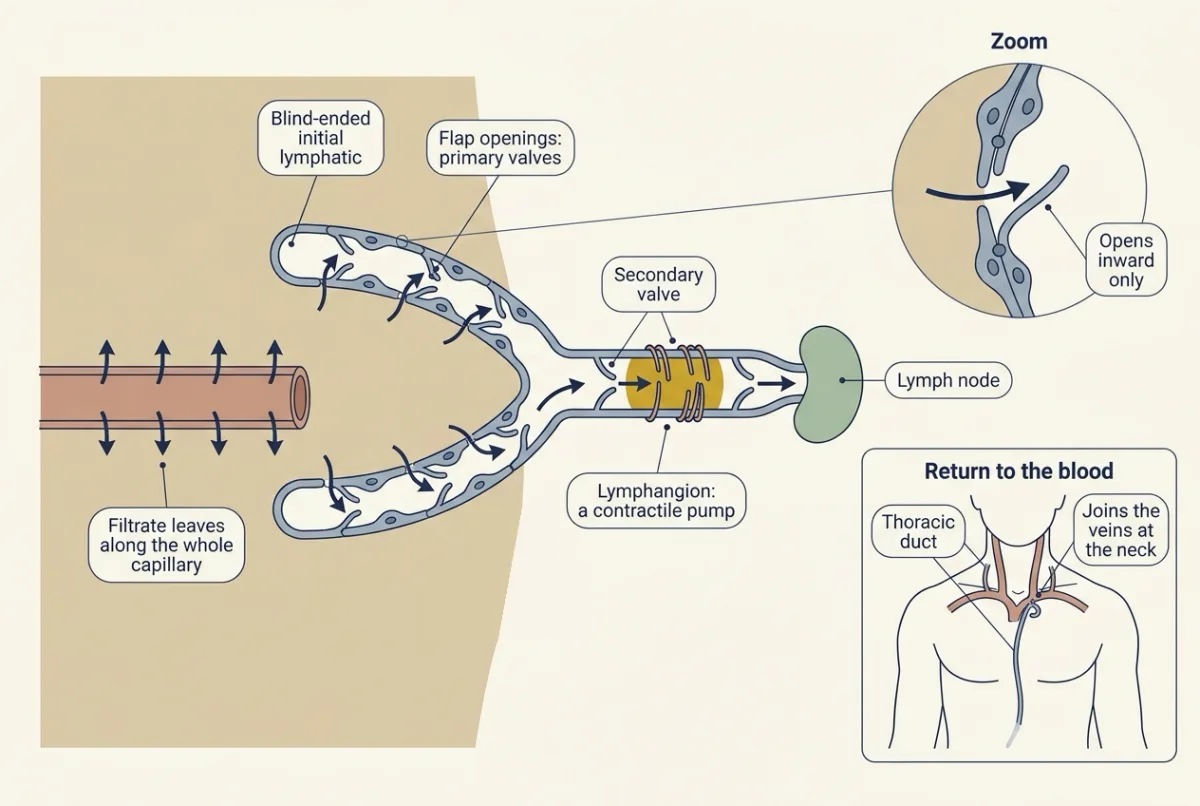
Fluid filtered all along the capillaries enters blind-ended lymphatics through flaps that open only inward, is pumped onward by valved lymphangions and squeezed by surrounding tissue, and returns to the blood at the neck; lymph nodes on the way are thought to return part of it to blood sooner, an estimate resting mainly on animal studies. AI-generated illustration -
Worked problem: one muscle, three states
-
Four ways to make edema, and what holds it back
-
Back to the opening: life without albumin
-
Going deeper
Where this lesson fits
Before thisReview first
- Body Water and Its CompartmentsThis course · Lesson 1
You need the split of body water between blood plasma and tissue fluid to follow where filtered fluid goes.
- Resistance, Compliance and Local Blood FlowThis course · Lesson 8
Capillary pressure is placed by the ratio of pre- to postcapillary resistance, which that lesson explains.
After thisStudy next
- Regulating Arterial PressureThis course · Lesson 10
Autotransfusion after blood loss uses the transient absorption described here to refill the blood volume.
- Lymphoid Organs and Immune TrafficThis course · Lesson 25
It follows lymph into the nodes, where part of the fluid is absorbed back into blood.
- Absorption, the Liver and Enterohepatic CirculationThis course · Lesson 24
It covers the gut's lacteals carrying fat as lymph and the intestinal capillaries that absorb steadily.
Elsewhere on the siteFilms, simulations and method films in other courses
- Starling forces along a capillarySimulation · Organismal Biology
Starling forces along a capillary shows the same push and hold-back balance in a simpler first treatment.
Suggested by an AI model from the lessons themselves, then checked. How we use AI