Cell Signaling · Skim version
cAMP and Protein Kinase A
Read the full lesson → Skim the whole course →
The guiding idea
Adrenaline stays outside a liver cell, so how can enzymes inside respond?
cAMP levels reflect the balance of synthesis and breakdown; PKA responses depend on which targets are nearby.
From the film: The Messenger Level: Made and Erased
- cAMP levels reflect the balance of synthesis and breakdown.
- Adenylyl cyclase makes cAMP from ATP, while phosphodiesterase converts it to 5′-AMP.
- Gs stimulates adenylyl cyclase, while Gi inhibits some forms of the enzyme.
- When breakdown is first order, the level settles where synthesis and breakdown match; faster breakdown gives a lower plateau and a briefer signal.
From the film: PKA: The Target Sets the Response
- PKA responses depend on which targets are nearby.
- Regulatory subunits block PKA catalytic sites until cAMP relieves the inhibition.
- Different cells offer PKA different target proteins, so the same pathway can produce different responses.
- Within one cell, anchoring and local cAMP dynamics help direct PKA toward selected targets.
-
Finding the messenger in broken cells
-
How much cAMP accumulates?
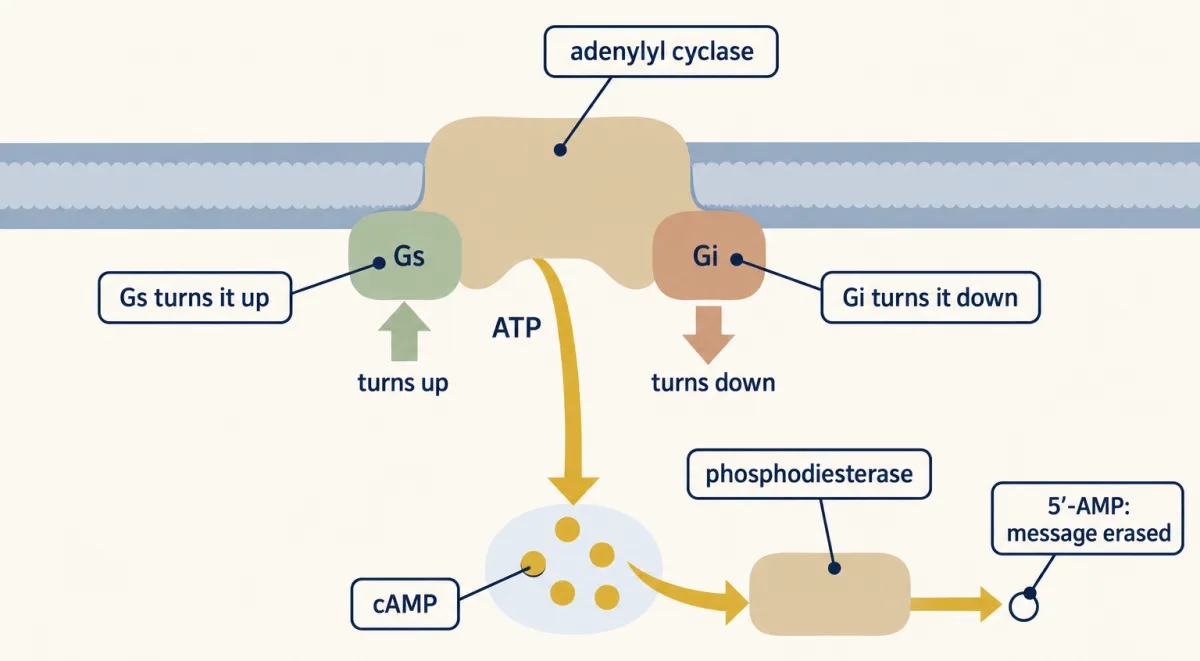
The cAMP level settles where synthesis matches breakdown: Gs raises synthesis, Gi lowers it for some cyclase forms, and phosphodiesterase removes cAMP. AI-generated illustration -
How cAMP relieves PKA inhibition
-
Different cells offer different targets
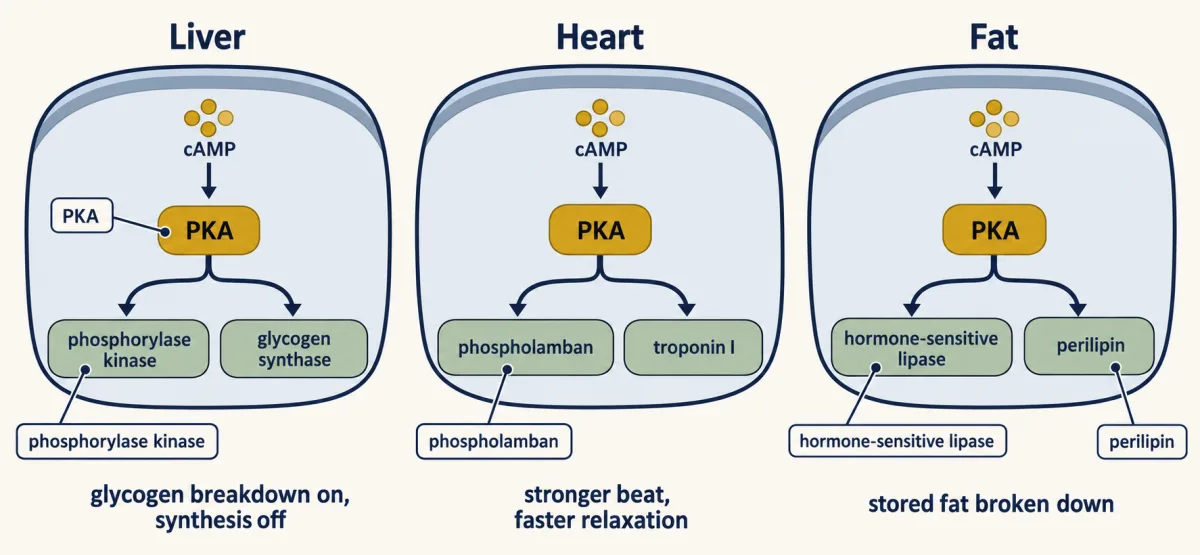
The same cAMP–PKA relay produces different responses because liver, heart and fat cells place different targets within the kinase's reach. AI-generated illustration -
Different addresses within one cell
-
Going deeper
Where this lesson fits
Before thisReview first
- GPCRs and Trimeric G ProteinsThis course · Lesson 12
You need to know how a receptor activates Gs and Gi, which set the cyclase rate here.
- Phosphorylation: Kinases and PhosphatasesThis course · Lesson 6
PKA is a kinase, so you need how kinases and phosphatases switch proteins on and off.
- Adaptors, Docking Proteins and ScaffoldsThis course · Lesson 10
The AKAP anchoring that keeps PKA beside its substrate builds on how scaffolds hold signaling proteins.
After thisStudy next
- Turning the Signal Off: Arrestins, RGS Proteins and PhosphodiesterasesThis course · Lesson 16
It takes the phosphodiesterase drain further, showing how cAMP and the receptor are shut off.
- Signaling to the Nucleus: CREB, AP-1 and Immediate Early GenesThis course · Lesson 32
It follows PKA's catalytic subunits into the nucleus to phosphorylate CREB and switch on genes.
- The Shape of a Signal: Size, Duration, Frequency and PlaceThis course · Lesson 35
It develops how duration and place of a cAMP signal give different answers in one cell.
Suggested by an AI model from the lessons themselves, then checked. How we use AI