Cell Signaling · Skim version
Binding: Affinity, Occupancy and Dose–Response
Read the full lesson → Skim the whole course →
The guiding idea
Naloxone reverses a morphine overdose without reacting with morphine at all. What are the two drugs competing for?
A drug or hormone acts by occupying a receptor, and how much it occupies follows one equation.
-
A drug acts at a site it has to occupy
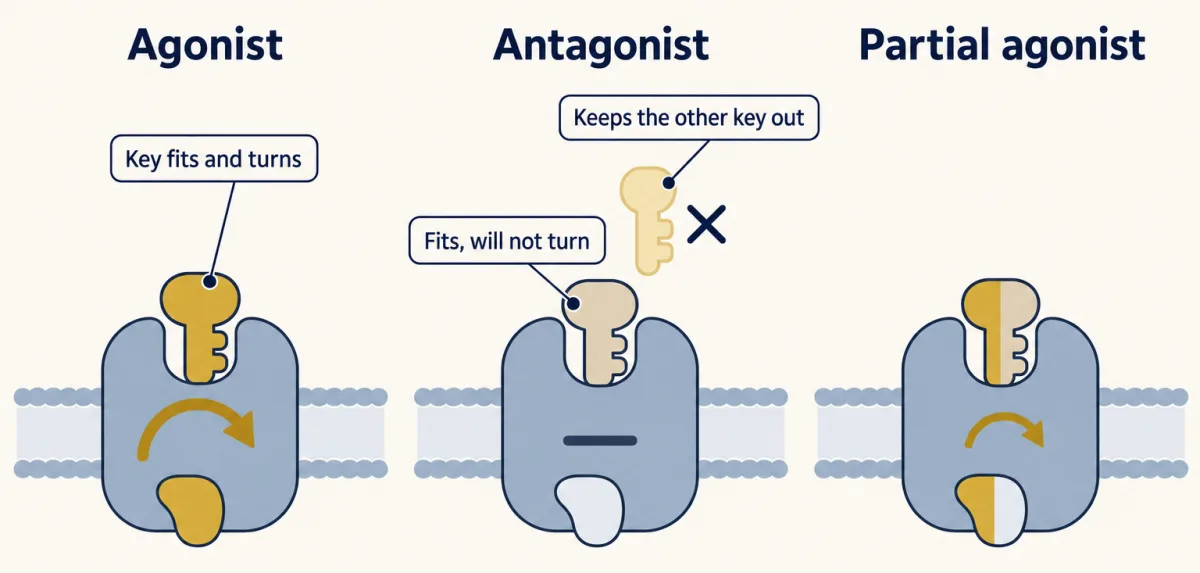
Binding and activation are separate. In this lock-and-key analogy, a full agonist activates the receptor, a neutral competitive antagonist occupies the pocket without adding activation and excludes a competing agonist, and a partial agonist activates more weakly. Whether an agonist produces a full or partial tissue response depends on the drug and the tissue, including receptor reserve. The drawing is qualitative. Inverse agonists, which reduce background activity, are not shown. AI-generated illustration -
Occupancy follows mass action
-
Measuring occupancy directly
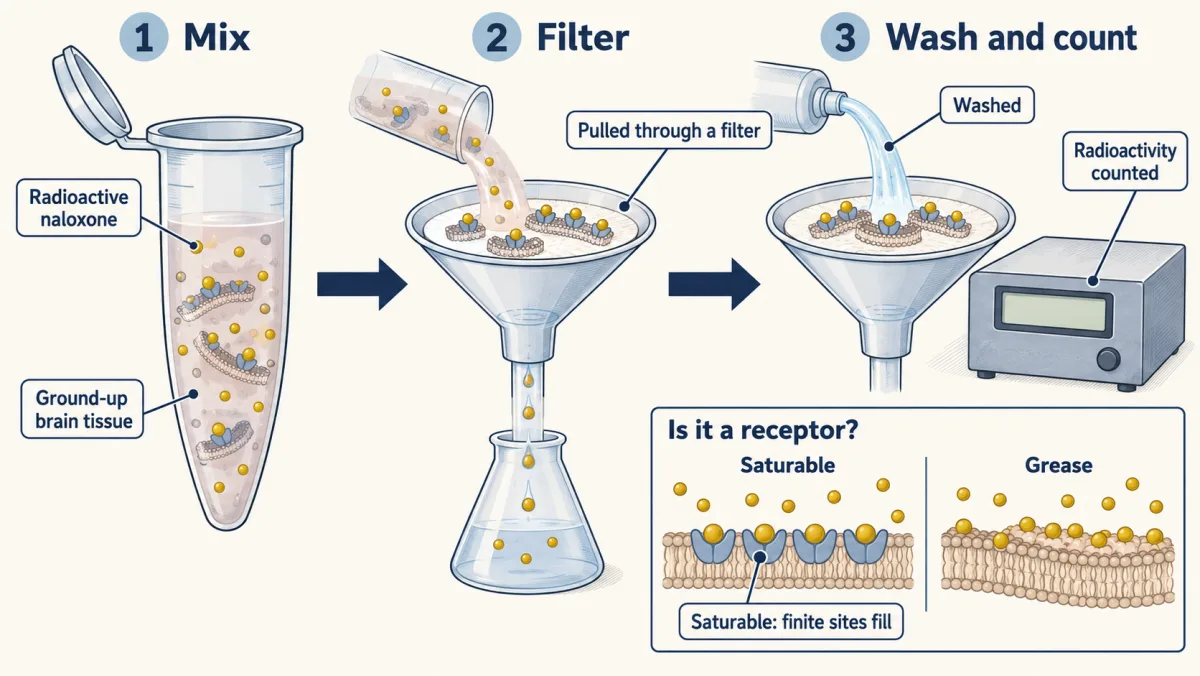
In 1973 Pert and Snyder mixed radioactive naloxone with ground-up brain, filtered it, washed the filter and counted the radioactivity that stayed (in practice by liquid scintillation counting of the filter). A finite set of sites that fills up is one sign of a receptor, whereas sticking to grease keeps rising; counts include nonspecific sticking, so counting alone does not identify a receptor. AI-generated illustration -
Response is not occupancy
-
The gap between the curves: receptor reserve
-
Blocking the receptor: the shape of the shift names the blocker
-
Back to the opening question
-
Where the idea stops
-
Going deeper
Where this lesson fits
Before thisReview first
- Enzyme Kinetics: The Michaelis–Menten ModelBiochemistry · College: going further
The occupancy hyperbola here is the same saturation curve as Michaelis–Menten, so you need Km and saturation from there.
- Protein Binding and Allostery: How Hemoglobin Loads and Delivers OxygenBiochemistry · College: going further
You need binding curves, Kd and cooperativity from there to read why steep curves signal interacting sites.
After thisStudy next
- A Field Guide to ReceptorsThis course · Lesson 4
It uses antagonist affinities and potency orders to tell receptor types apart, as Ahlquist did.
- GPCRs and Trimeric G ProteinsThis course · Lesson 12
It follows how an occupied receptor drives a G protein, the amplification step behind receptor reserve.
- Circuits: Amplification, Feedback, Adaptation and SwitchesThis course · Lesson 5
It takes the amplifier between occupancy and response further, with gain, feedback and switches.
Suggested by an AI model from the lessons themselves, then checked. How we use AI