Developmental Neuroscience · Skim version
Pruning Without Dying: Axons That Cut Themselves Back
Read the full lesson → Skim the whole course →
The guiding idea
How does a neuron cut off one branch with caspases, the enzymes of cell death, and still live?
Where support is lost decides what is lost: in NGF-dependent sympathetic neurons, axons that lose NGF alone degenerate while the neuron lives, but a neuron that loses it everywhere dies.
From the film: Where Support Is Lost
- Where support is lost decides what is lost.
- In NGF-dependent sympathetic neurons in culture, axons that lose NGF while the cell body keeps it degenerate and the neuron lives.
- A neuron that loses NGF everywhere dies, and its axons go with it.
- Pruning and death share caspases but are wired differently.
From the film: Same Knives, Two Routes
- After local NGF deprivation in mouse sympathetic neurons, axons degenerate and the cell bodies live; after global deprivation the neurons die.
- In this study, caspase-6 was needed for local axon pruning, and Apaf-1 was needed for death of the whole neuron.
- The two routes share enzymes such as caspase-9 and caspase-3 but are wired differently.
- XIAP and the proteasome keep caspases off in the cell body, guarding the part that must live.
From the film: Who Loses, and When It Commits
- Sympathetic axons compete for limited target-derived NGF, and a branch left with too little is weakened and removed.
- On axons with weak TrkA signalling, BDNF acting through p75 caused degeneration, and the winning neurons made the BDNF.
- A deprived axon passes through a latent phase, then spheroids, then catastrophic fragmentation.
- The laboratory's model is that spheroids gate the commitment to catastrophe, but it is not a settled mechanism.
-
Lose support here, lose the branch here
-
Building, then sculpting
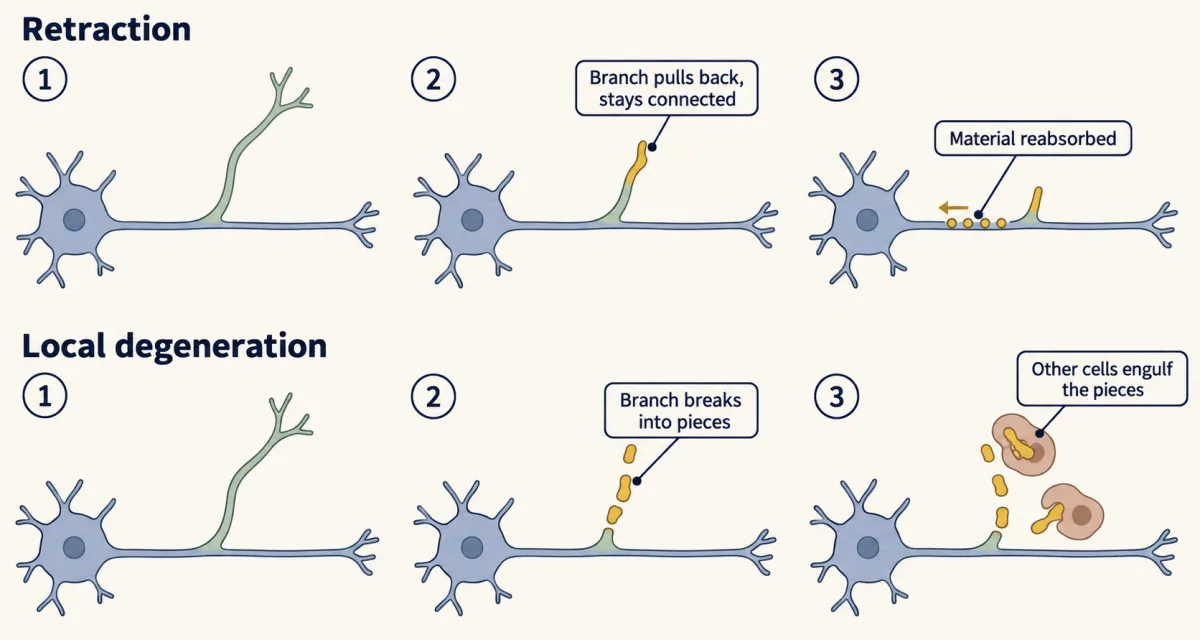
Pruning removes a branch from a neuron that survives. In retraction the branch pulls back toward the cell body, much of its material returning to the cell, though some retracting branches also shed pieces that glia engulf. In local degeneration it breaks into pieces in place and other cells engulf them. AI-generated illustration -
One neuron, two ways to lose an axon
-
Guarding the part that must live
-
Winners and losers: who loses a contest
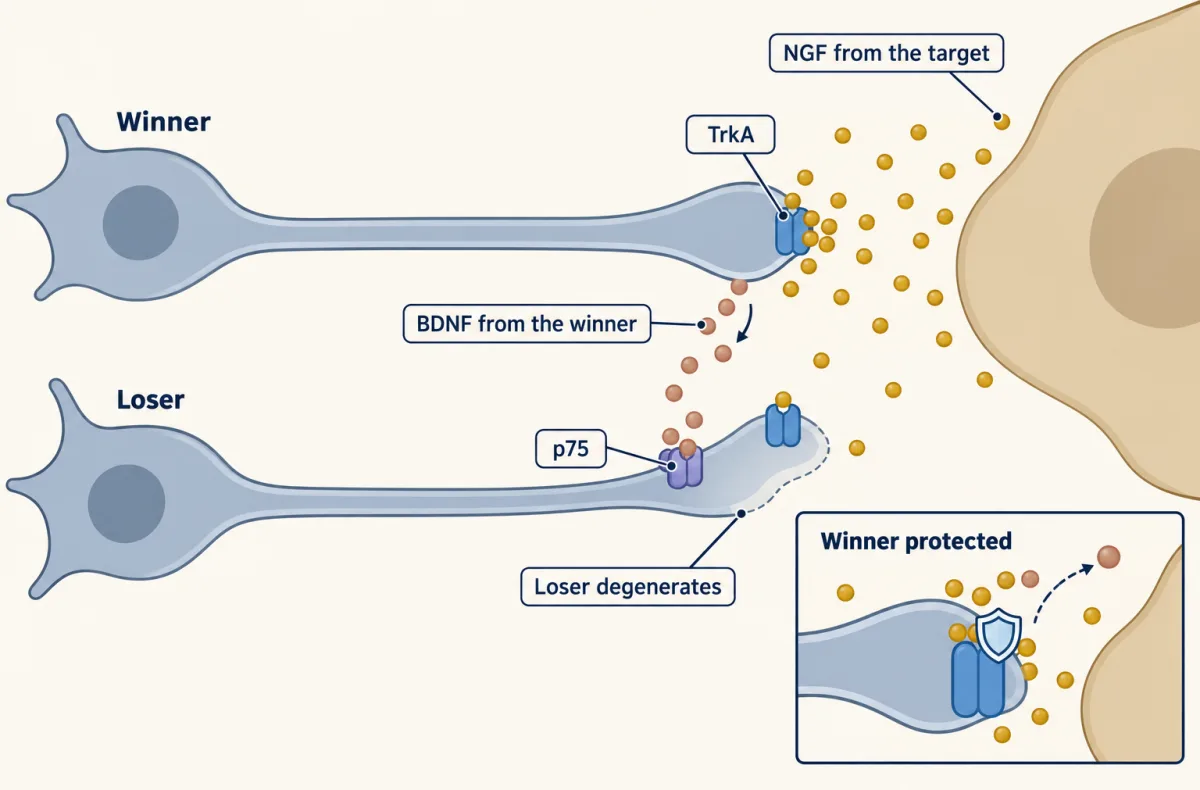
Sympathetic axons compete for target-derived NGF. A winning axon takes more NGF through TrkA and also releases BDNF; on an axon with weak TrkA signalling, BDNF acting through p75 causes degeneration. The shield symbolizes strong TrkA signalling, not a physical barrier, and particle counts are schematic. AI-generated illustration -
When a deprived axon commits
-
When a program, not support, picks the branch
-
Going deeper
Where this lesson fits
Before thisReview first
- The Neurotrophic Hypothesis TestedThis course · Lesson 29
You need the idea that neurons compete for limited target-derived NGF to follow why a branch is weakened and removed.
- Neurotrophins, Trk Receptors and p75This course · Lesson 30
The loser-removal step uses p75 acting against weak TrkA signalling, so you need how these receptors work.
- The Death Machinery in NeuronsThis course · Lesson 31
Pruning is set against whole-neuron death, so you need the caspase and apoptosome routes from there.
After thisStudy next
- Synapse Elimination: One Muscle Fiber, One AxonThis course · Lesson 37
Removal of excess axon inputs by competition, here at a muscle fiber, continues the pruning-by-competition idea.
- Microglia and Complement Prune SynapsesThis course · Lesson 41
It shows how other cells engulf and remove synapses and pieces of neurons during pruning.
Elsewhere on the siteFilms, simulations and method films in other courses
- Sealed or TornFilm · Cell Biology
It shows how a cell's own caspases dismantle it, the apoptosis routes that axon pruning reuses locally.
- Cell death assaysMethod film
The lesson's caspase-dependent axon degeneration versus neuron death is read with annexin V, TUNEL and similar assays.
Suggested by an AI model from the lessons themselves, then checked. How we use AI