Neuroscience · Skim version
Attention, Executive Control and Decisions
Read the full lesson → Skim the whole course →
The guiding idea
On average, a parietal neuron's firing climbs toward a similar level just before a monkey announces its choice. In one study, silencing that area left the choice no worse. What was the neuron doing?
Adding up noisy signals makes them more reliable, because the signal adds in step while independent noise partly cancels, and brains use this to turn weak evidence into choices.
From the film: Adding Up Noisy Evidence
- Adding up noisy evidence makes it more reliable, because the signal adds in step while independent noise partly cancels.
- Watching four times as long makes the running total only about twice as reliable, because noise grows with the square root of the samples.
- Waiting longer buys accuracy and costs time, so a brain that adds up evidence needs a rule for when to stop.
From the film: A Ramp to a Bound
- In a drift-to-bound model, evidence accumulates until the running total reaches a bound, and stronger motion reaches it sooner.
- In monkey LIP neurons, averaged firing ramps more steeply for stronger motion and reaches about the same rate just before the eye movement.
- Moving the bounds farther away makes choices slower and more accurate, so the bound sets the trade between speed and accuracy.
From the film: Visible Is Not the Same as Needed
- A recording shows what activity goes with a choice, and only changing the activity can test whether the choice depends on it.
- In monkeys, silencing MT impaired motion discrimination, but silencing LIP produced no measurable impairment in the tasks tested.
- A null result cannot rule out compensation by other areas, and other studies found deficits, so which areas a decision needs remains open.
-
The task and the puzzle
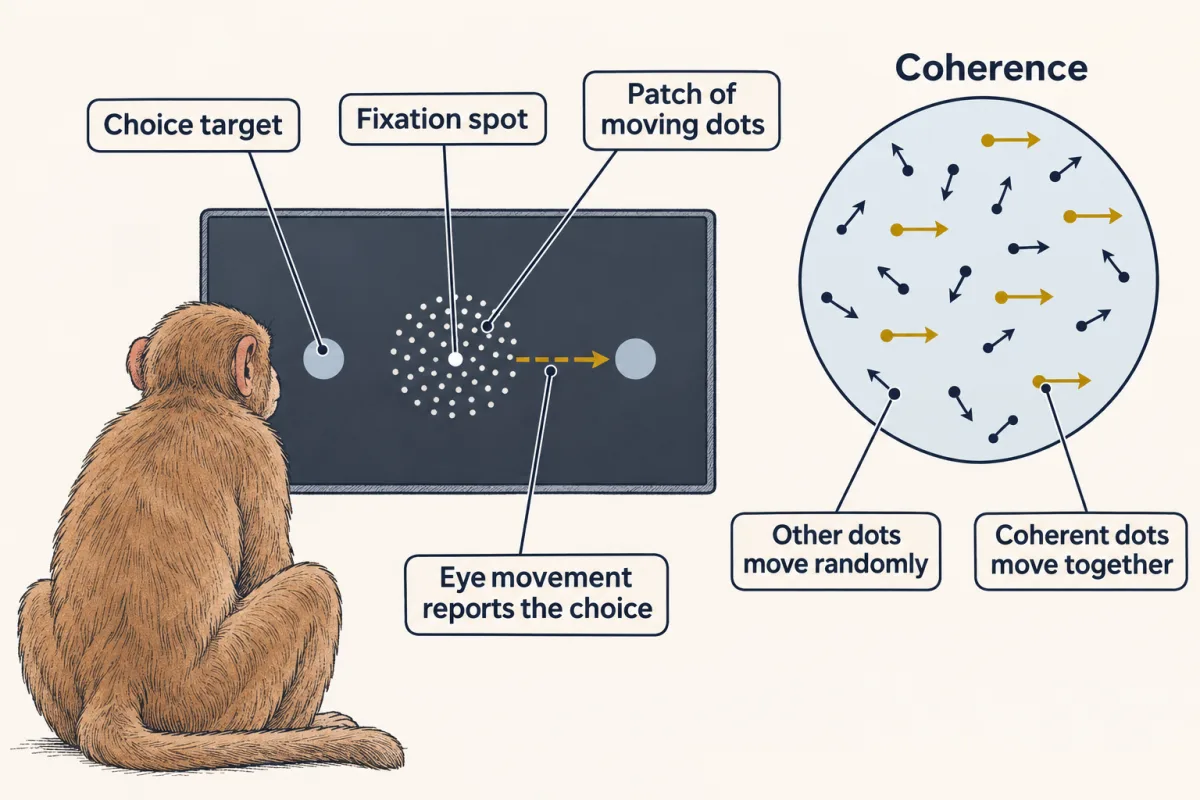
Only some of the dots move together, and the monkey reports their direction with an eye movement to one of two choice targets. AI-generated illustration -
Adding up evidence: a ramp to a bound
-
Attention: a stronger signal, less shared noise
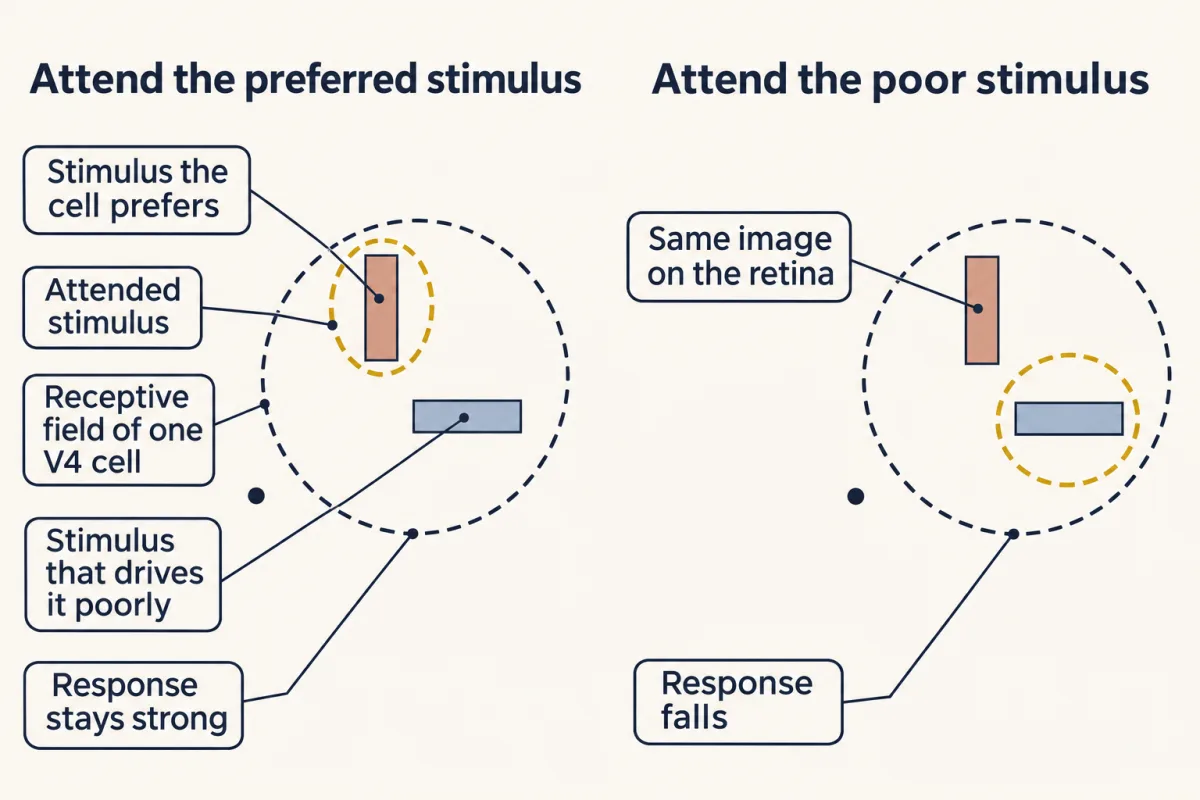
With the image on the retina unchanged, moving attention to the stimulus a V4 cell responds to poorly made its response fall (Moran and Desimone, 1985). AI-generated illustration -
Holding the goal: prefrontal cortex
-
When the best correlate is not necessary
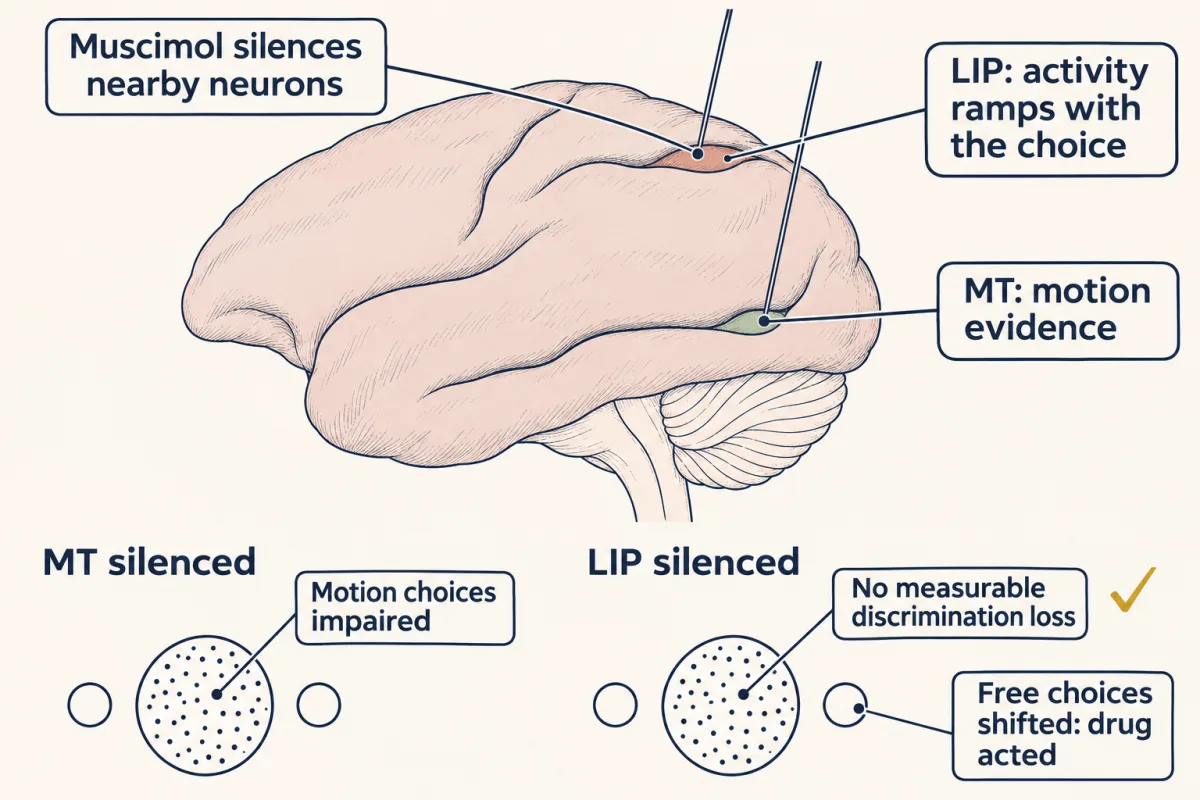
Silencing MT impaired motion choices, but silencing LIP, whose activity ramps with the choice, left discrimination with no measurable loss even though free choices shifted to show the drug had acted (Katz and colleagues); other studies disagree. AI-generated illustration -
Going deeper
Where this lesson fits
Before thisReview first
- Principles of Sensory CodingThis course · Lesson 9
You need how neurons' firing rates encode stimulus features, such as MT direction tuning, to follow the evidence that gets added up.
- Integration, Inhibition and NeuromodulationThis course · Lesson 7
Summing many inputs, including inhibition, is the neural version of the adding-up rule used here.
- Visual CortexThis course · Lesson 11
V4, receptive fields and MT motion areas build on how visual cortex is organized and tuned.
After thisStudy next
- When Mature Neurons Fail: NeurodegenerationThis course · Lesson 26
It repeats the question of reading absolute against relative effects in noisy outcome data, taking this lesson's evidence logic further.
- Designing a Causal Circuit ExperimentThis course · Lesson 28
It takes the correlate-versus-necessary question further, using causal tests such as silencing and light in circuits.
Elsewhere on the siteFilms, simulations and method films in other courses
- Weighting two senses by reliabilitySimulation · Sensory Systems
It uses the same reliability-weighted adding of noisy evidence, with each sense weighted by its variance.
- Which Sense Do You Believe?Film · Sensory Systems
It shows how noisy signals are combined by their reliability, the same arithmetic as adding up evidence.
Suggested by an AI model from the lessons themselves, then checked. How we use AI