Organismal Biology · Skim version
Animal Development
Read the full lesson → Skim the whole course →
The guiding idea
A frog egg divides into thousands of cells without growing at all. How does each cell come to its fate?
The egg is divided, not grown: cleavage shares one fixed egg among many smaller cells, so each cell inherits its own slice, and gastrulation then moves cells next to new neighbours whose signals help set their fate.
From the film: Divided, Not Grown
- After fertilization, cleavage divides the egg into many smaller cells, called blastomeres, without any growth.
- In the ideal case of equal divisions with no growth, five divisions make 32 cells, each about a third as wide as the egg.
- Material that stays put in one region of the egg goes only to the cells cut from that region: that is what a cell inherits.
- Yolk changes how the egg divides: a frog egg divides completely, a chick egg only in a disc on top of the yolk.
- Following a coloured region of an egg shows which cells inherit it, not whether it causes their fate.
From the film: New Neighbours
- At gastrulation, cells move from the surface to the inside and sort into three germ layers: ectoderm, mesoderm and endoderm.
- Embryos combine movements to bring cells inside: a sheet bending in, a sheet rolling over an edge, and single cells moving inward.
- Moving inside puts cells next to new neighbours, whose signals can change what they become; this is induction.
- A graft of the newt's dorsal blastopore lip, the organizer, recruited host cells into a second body axis; pigment contrast between the pale donor and dark host showed which cells were the host's.
- Most embryos studied closely use both inherited factors and signals between cells.
-
One sperm, one egg: blocks to polyspermy
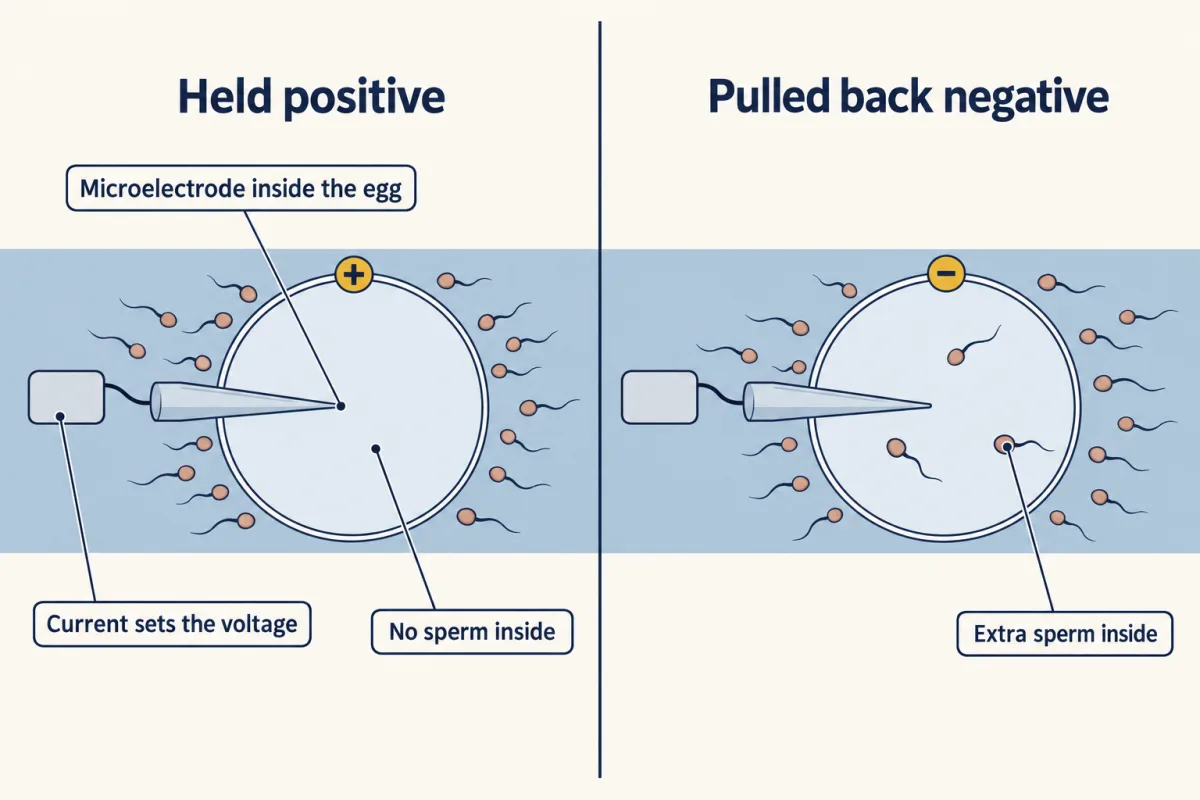
Clamping the egg's voltage showed that this sea urchin's fast block depends on voltage: eggs held positive resisted sperm, and eggs pulled back negative after the first sperm often let extras in. AI-generated illustration -
Cleavage: dividing without growing
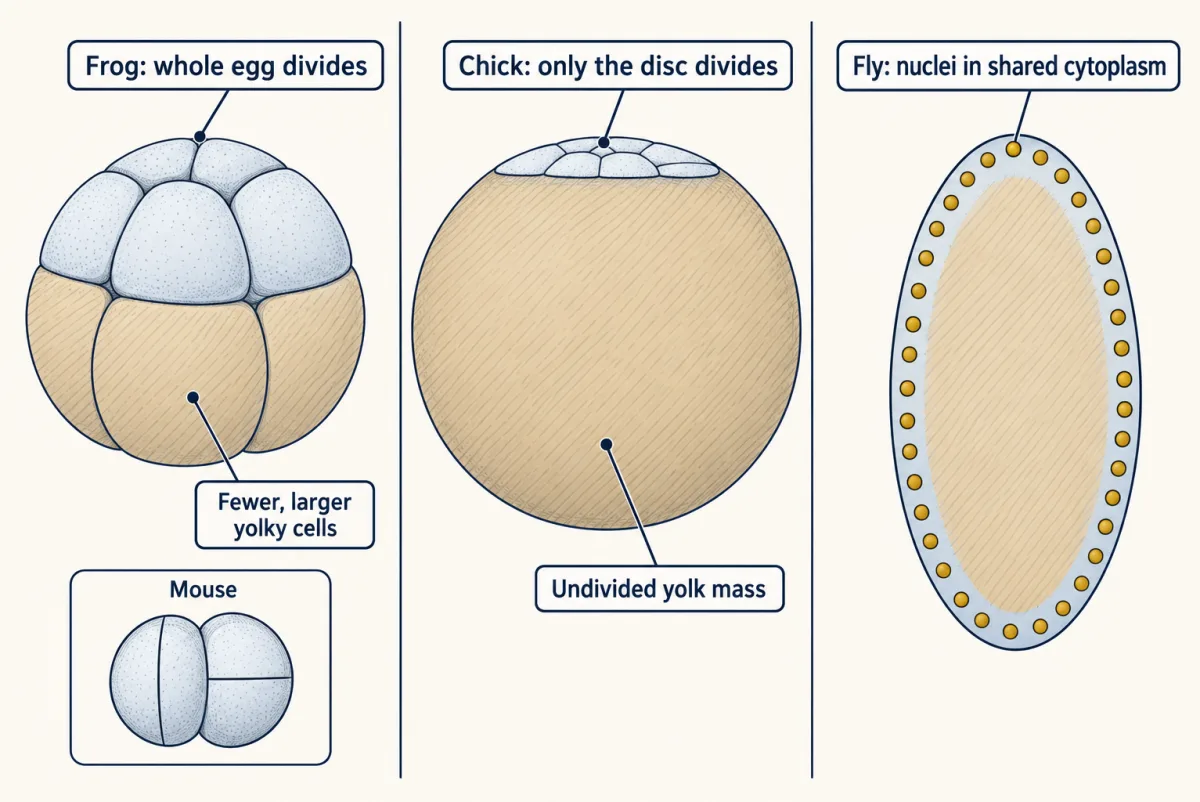
How much of the egg divides tracks the yolk; in the mouse (inset), one cell divides along the egg's axis and its partner across it. AI-generated illustration -
Gastrulation and the germ layers
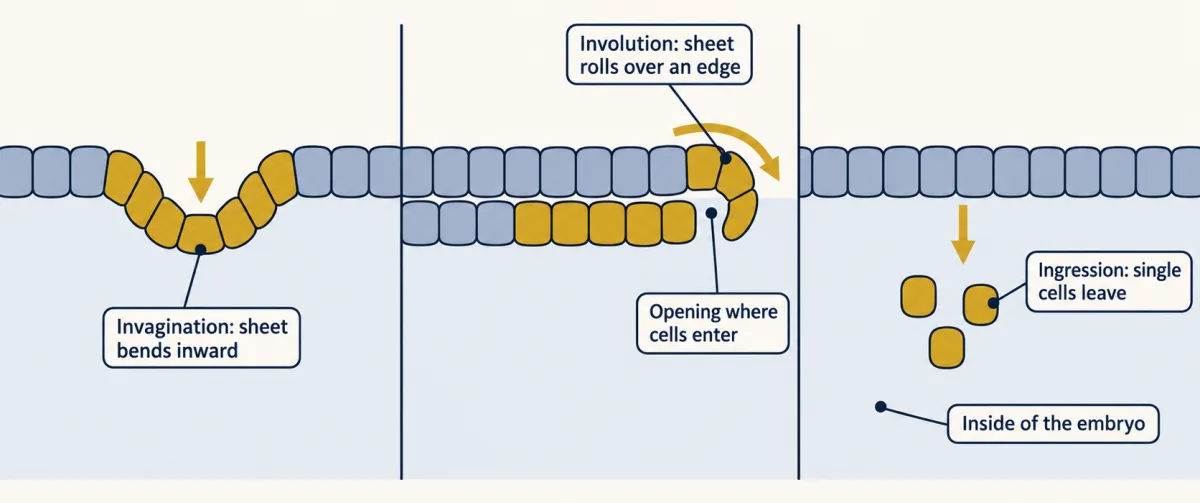
Embryos combine these movements: sea urchins start the gut by invagination, frog cells involute over the blastopore lip, and chick and mammal cells ingress through the primitive streak. AI-generated illustration -
Inherited or told: how a cell gets its fate
-
Going deeper
Where this lesson fits
Before thisReview first
- How Cells DivideLife Science · Grade 7
Each cleavage division is a mitosis, so you need to know how one cell becomes two.
- The Cell Cycle and MitosisBiology · High school
Cleavage is repeated cell cycles with no growth, so you need the cycle and its phases.
- Animal ReproductionThis course · Lesson 20
It shows how eggs and sperm are made, which is where fertilization starts.
After thisStudy next
- Plant Body and GrowthThis course · Lesson 22
It contrasts this animal embryo with plants, where growth and new cells continue from fixed growing tips.
- Double Fertilization: How a Flower Makes a SeedThis course · Lesson 26
It follows another fertilization that starts an embryo, with its own double fertilization and seed.
Suggested by an AI model from the lessons themselves, then checked. How we use AI