Press play to start at .
One Ratio, Two Keepers
From the film
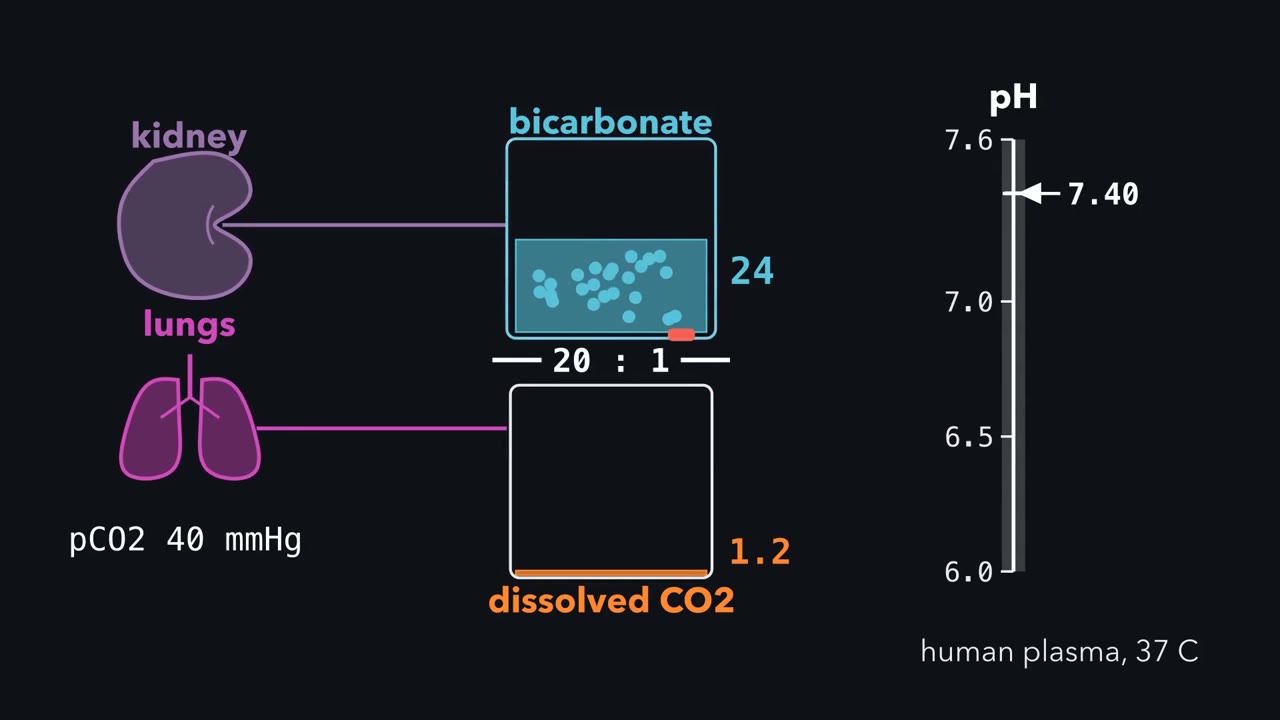
- pH follows one ratio, bicarbonate over dissolved carbon dioxide: 24 over 1.2, or 20 to 1, at pH 7.4.
- Double both terms and pH does not move; change one alone and it does.
- Sealed in a bottle the pair is a poor buffer; open to the lungs, which breathe the new carbon dioxide away, it buffers roughly twentyfold better.
- Buffering is not removal: bicarbonate spent on an acid that cannot be breathed off is gone until the kidney makes more.
- Taking back filtered bicarbonate makes no new base; the spent base is repaid only by making new bicarbonate through excreting acid, mostly as ammonium.
Read the transcript of “One Ratio, Two Keepers”
Film transcript: One Ratio, Two Keepers
Tap a sentence to play from there.
- 0:00 An adult's plasma at rest holds only about 40 nanomoles of free hydrogen ions per litre. Metabolism adds acid every day, yet pH stays near 7.4.
- 0:14 What holds it there?
- 0:18 Picture pH as the reading of a fraction.
- 0:22 On top, bicarbonate, the base: 24 millimoles per litre.
- 0:27 Below, dissolved carbon dioxide, the acid: 1.2.
- 0:32 That is 20 to 1.
- 0:34 In human plasma, pH is 6.1 plus the log of that ratio.
- 0:41 Log 20 is 1.3, so pH is 7.4.
- 0:45 Double both terms, and pH does not move.
- 0:50 Halve the top alone, and pH falls to 7.1.
- 0:54 pH follows the ratio, not either number.
- 0:58 A puzzle: the pair's pK is 6.1, well below 7.4.
- 1:04 Seal bicarbonate in a bottle and add acid.
- 1:08 Each proton turns a bicarbonate into carbon dioxide.
- 1:13 The small bottom term grows fast, and pH crashes.
- 1:17 Closed, this would be a poor buffer.
- 1:20 So how can the same pair be the main buffer of the fluid outside your cells?
- 1:30 Because the body is open.
- 1:33 The lungs breathe the new carbon dioxide away.
- 1:37 So the bottom term stays put, and only the top shrinks.
- 1:41 Measure buffering as acid needed per unit fall in pH.
- 1:46 Open, the pair manages about 55 millimoles per litre.
- 1:51 Sealed, about 2.6: roughly twentyfold.
- 1:55 Here is the one idea.
- 1:58 pH follows one ratio, bicarbonate over dissolved carbon dioxide.
- 2:04 The lungs hold the bottom, starting within minutes.
- 2:08 The kidney sets the top, over days.
- 2:11 But buffering is not removal.
- 2:14 Sulfuric acid from sulfur-containing amino acids cannot be breathed off.
- 2:20 Its protons stay in the body.
- 2:22 The bicarbonate they spent is gone until the kidney makes more.
- 2:27 Human kidneys have two jobs.
- 2:30 They filter about 4,000 millimoles of bicarbonate a day, roughly eighty times the day's acid. Job one is to take it back: one vanishes from the tubule, one appears in the blood. No new base is made.
- 2:46 Job two repays the debt.
- 2:49 Making new bicarbonate, by excreting acid, is the only way.
- 2:54 Some acid leaves riding on phosphate.
- 2:57 Most leaves as ammonium, made from glutamine.
- 3:01 So the ratio holds, and an ordinary pair guards the blood.
- 3:06 Breathing clears the new carbon dioxide within minutes, and the kidney repays the spent base over days.
Acid-base balance: the same idea, other levels
A level is a place to start, not a rank. If this loses you, the rung below teaches the same idea, told more simply.
College, upper level · the level you chose
Acid-Base Balance · this lesson
Bicarbonate to dissolved CO2 near 20 to 1 sets pH; lungs fast, kidney slow.
Physiology · about 31 min · 6 practice questions
Next door
- pH and buffers: Water, Weak Bonds, and the Generation of Order Buffers are the first defence that keeps blood pH steady, before the lungs and kidneys adjust it.
- Carrying carbon dioxide: Carrying Oxygen and Carbon Dioxide · Starting college Most carbon dioxide travels in blood as bicarbonate, the same partner that holds blood pH steady.
- Control of breathing: Carbon Dioxide Sets the Breath · 3:09 Breathing faster or slower changes how much carbon dioxide stays in blood, which moves its pH within minutes.
More films from this lesson
Continue in the lesson: Acid-Base Balance →
Free, with captions and a transcript. The lesson has the full text, the questions and the sources.
How this film was made. Narration: written from this lesson's text and read by an AI narrator voice (Kokoro, af_heart). Animation: AI-generated in code (Manim) by Claude, a schematic with no drawn molecular structures. Captions come from the narration script. See something wrong? Report it.