The Standoff
Read the transcript of “The Standoff”
Film transcript: The Standoff
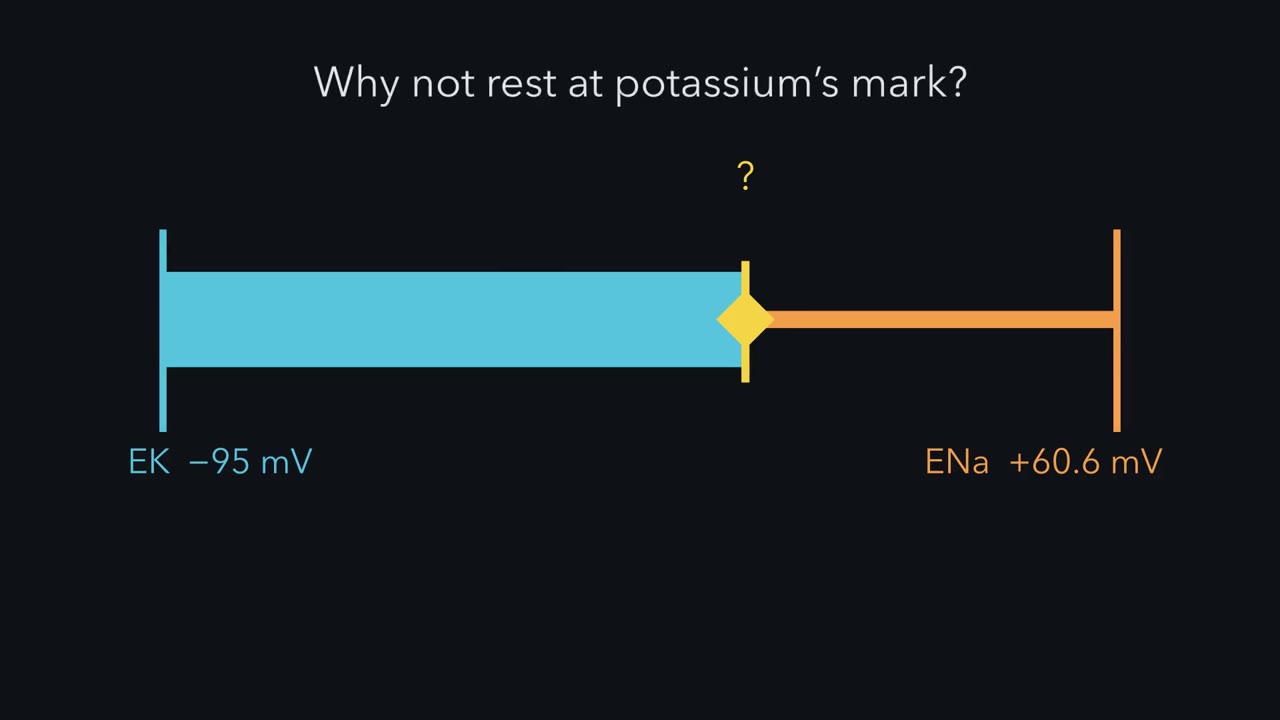
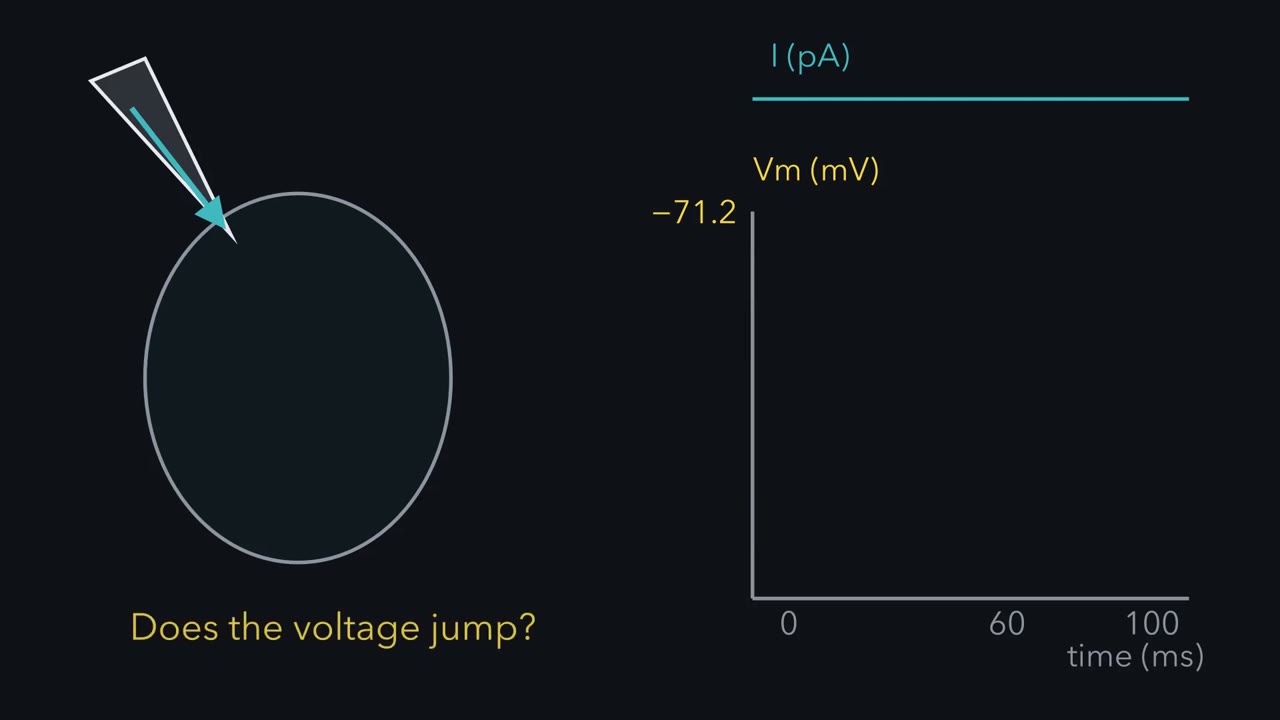
In a resting neuron, potassium leaks out and sodium leaks in, all the time. So why does the voltage hold still? Here is a made-up neuron, resting at about minus −71 mV. Potassium current leaves it all the time, about 200 pA. Sodium current comes in, about the same amount. Neither ion is at equilibrium. Yet the voltmeter needle does not move. Start with one term. Each ion has an equilibrium potential. It is the voltage where the electrical force on the ion balances its concentration gradient. There, the ion has no net push. Now picture a voltage scale. Potassium's equilibrium potential sits near the left end, at minus −95 mV. Sodium's sits near the right end, at about plus +60 mV.
A marker on the scale shows the membrane potential, the inside minus the outside. The gap between the marker and an ion's own mark is the driving force. Its sign gives the direction of the current. Its size gives the strength. Tie a rope from the marker to each ion's mark. The rope's pull is that ion's current. More open channels make a thicker rope. That is conductance, how open the ion's path is. And a rope pulls harder the farther the marker sits from its mark. So current equals conductance times driving force: By convention, outward current, positive charge leaving, counts as positive. Our cell rests above potassium's mark. Which way does potassium flow through its open channels?
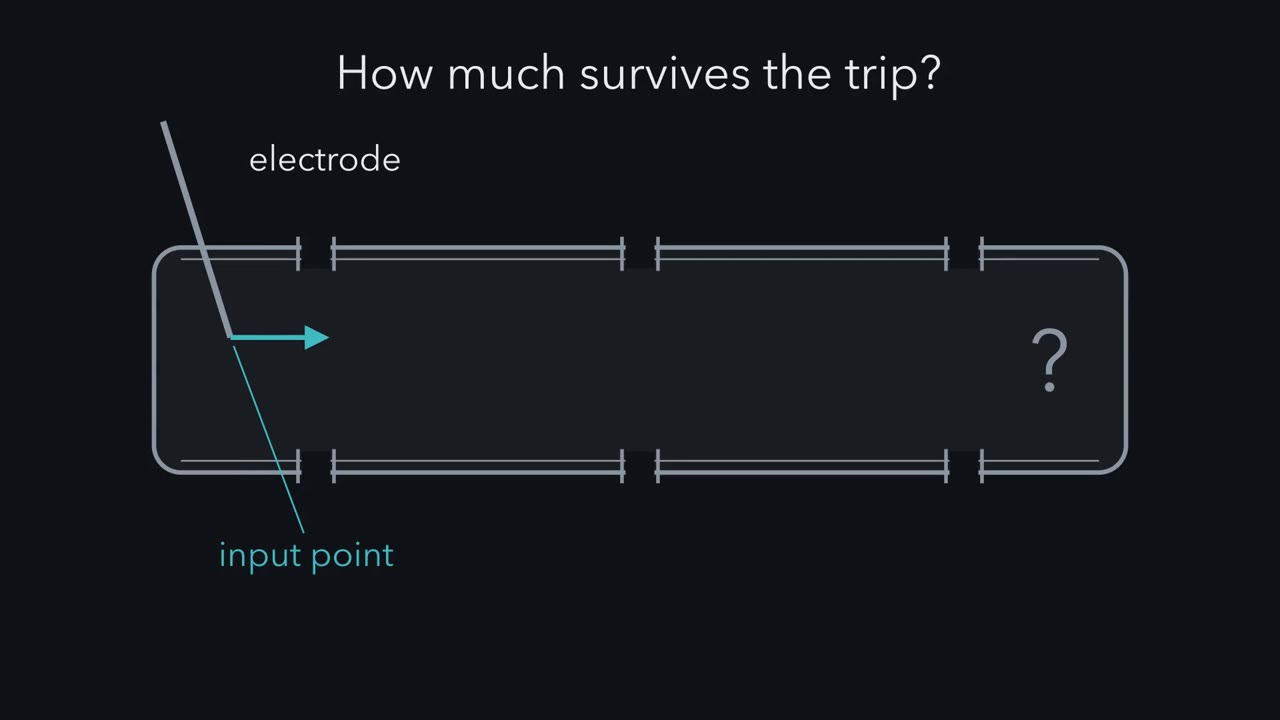
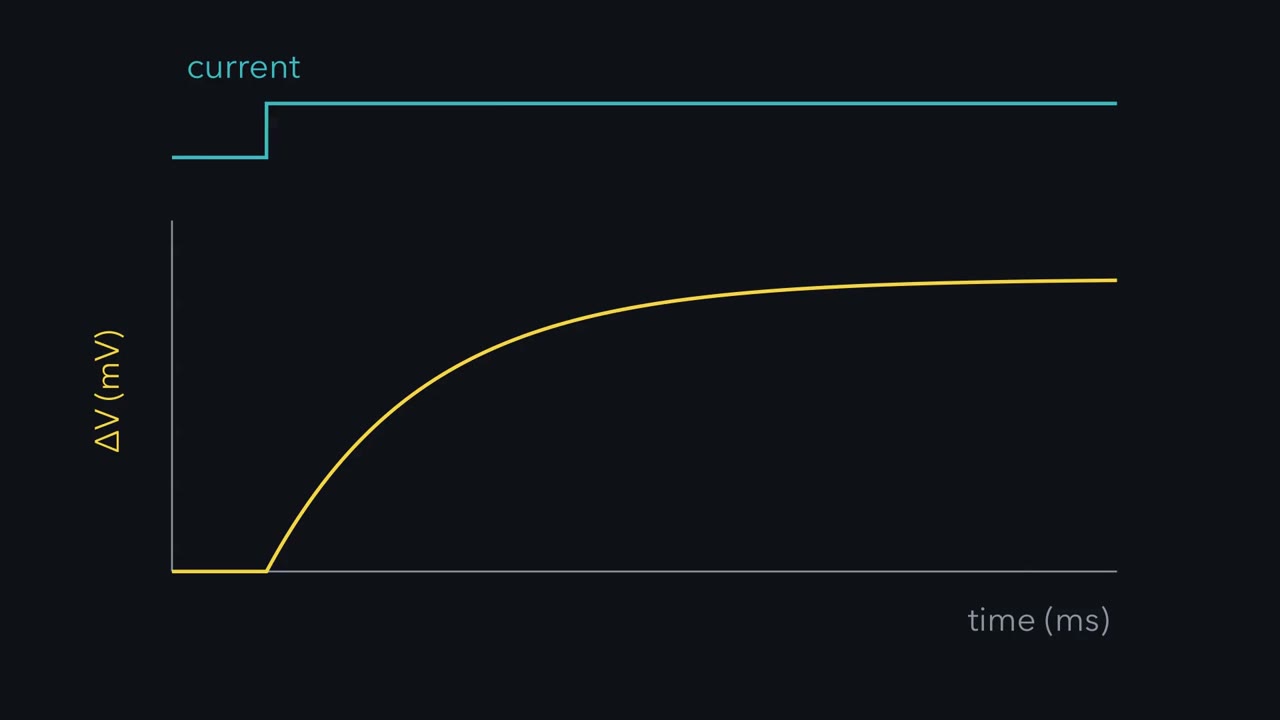
Outward. The driving force on potassium is positive, so positive charge leaves. Sodium is the opposite. The marker sits far below sodium's mark, so sodium is pushed in, hard. Potassium has much more conductance, but a short stretch. Sodium has less conductance, but a long stretch. The two currents come out equal and opposite, about 200 pA each way. That is what rest means. Zero net current, not zero current for each ion. Two puzzles remain. Why does the cell rest here, and not somewhere else? And what if we push a little current in? How big a change, how fast, and how far does it reach?
One rule answers both. Each ion's open channels pull the voltage toward that ion's equilibrium potential. Rest means the currents cancel, not that they stop.
In a resting neuron potassium leaks out and sodium leaks in all the time. Why does the voltage hold still?
Continue in the lesson: The Resting Membrane and Passive Signals →
2:55 · Free, with captions and a transcript. The lesson has the full text, the questions and the sources.
More films from this lesson
How this film was made. Narration: an AI narrator voice (Kokoro, af_heart) reading narration written from this lesson's text. Animation: AI-generated in code (Manim) by Claude, a schematic with no drawn molecular structures. Captions come from the narration script. See something wrong? Report it.