Adding Inputs in Time and Space
Read the transcript of “Adding Inputs in Time and Space”
Film transcript: Adding Inputs in Time and Space
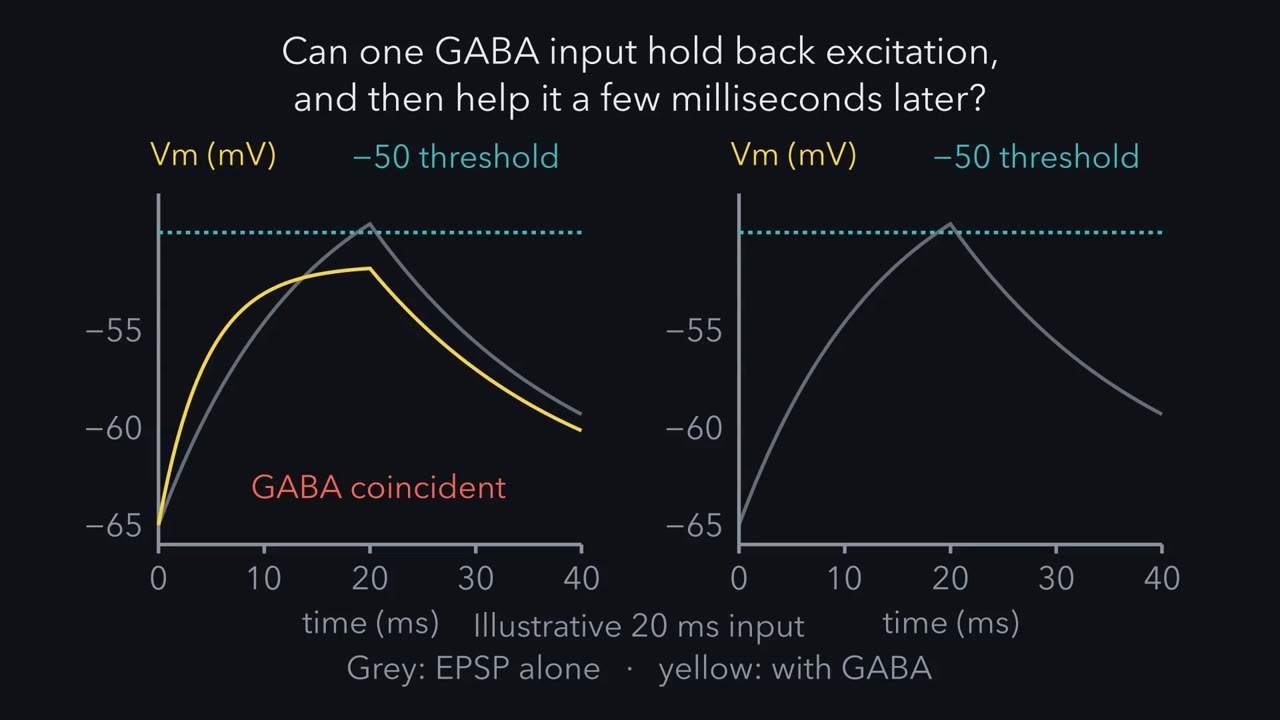
Two inputs arrive 10 ms apart. Does the second start from rest, or from what the first left behind? When conductances change, the marker does not jump to the new balance point. It moves there gradually. Changing the voltage means moving charge onto or off the membrane's capacitance. That takes time. The membrane time constant, τ, says how long. It is the time to get 63% % of the way to a new voltage. τ equals the capacitance divided by the total open conductance. In our cell, that is 20 ms. Because τ uses the total conductance, in this passive model every synapse that opens shortens it. So an EPSP has a shape. For a brief, fast input in our cell, it rises while synaptic current flows, over a few milliseconds.
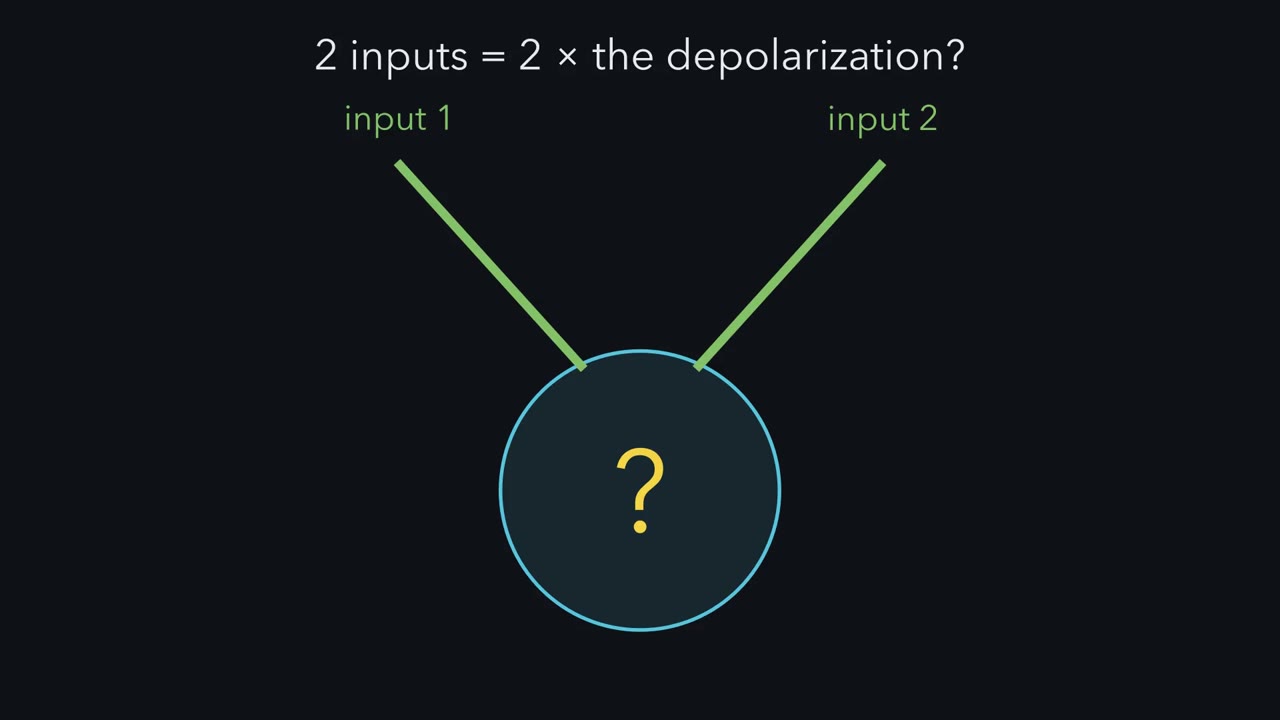
Once that current fades, the voltage decays back toward rest, with the resting time constant. If a second EPSP arrives before the first has gone, it starts from the first one's tail. That is temporal summation. Two brief, idealized pulses arrive 10 ms apart. Each jumps the voltage by 2 mV. Cell A has a τ of 20 ms. Cell B's is 10 Which ends higher?
Cell A. After 10 ms, its first EPSP has decayed only to about 61%. percent. The second lands on top of that. Cell B's first EPSP has fallen to about 37%. So cell A ends a little over 3 mV, and cell B under 3 A longer τ leaves a longer tail, and that means more summation. Remember cell B. It returns later in this lesson. Now distance. Most synapses sit on dendrites, not on the cell body. Current entering a dendrite flows toward the soma. But some leaks out across the membrane along the way. In a long, uniform passive dendrite, a steady voltage change shrinks by the same fraction over each equal stretch. The length constant, λ, is the distance over which it falls to 37%.
percent. Put a synapse half a length constant from the soma. About 61% percent of its steady depolarization arrives. A brief EPSP loses more, because capacitance along the way also filters it. Adding inputs at different places is spatial summation. For the same local change, inputs near the soma, or on dendrites with a long λ, lose less. Time and distance decide how much of each input is still there when the cell decides. The balance point decides what they add up to.
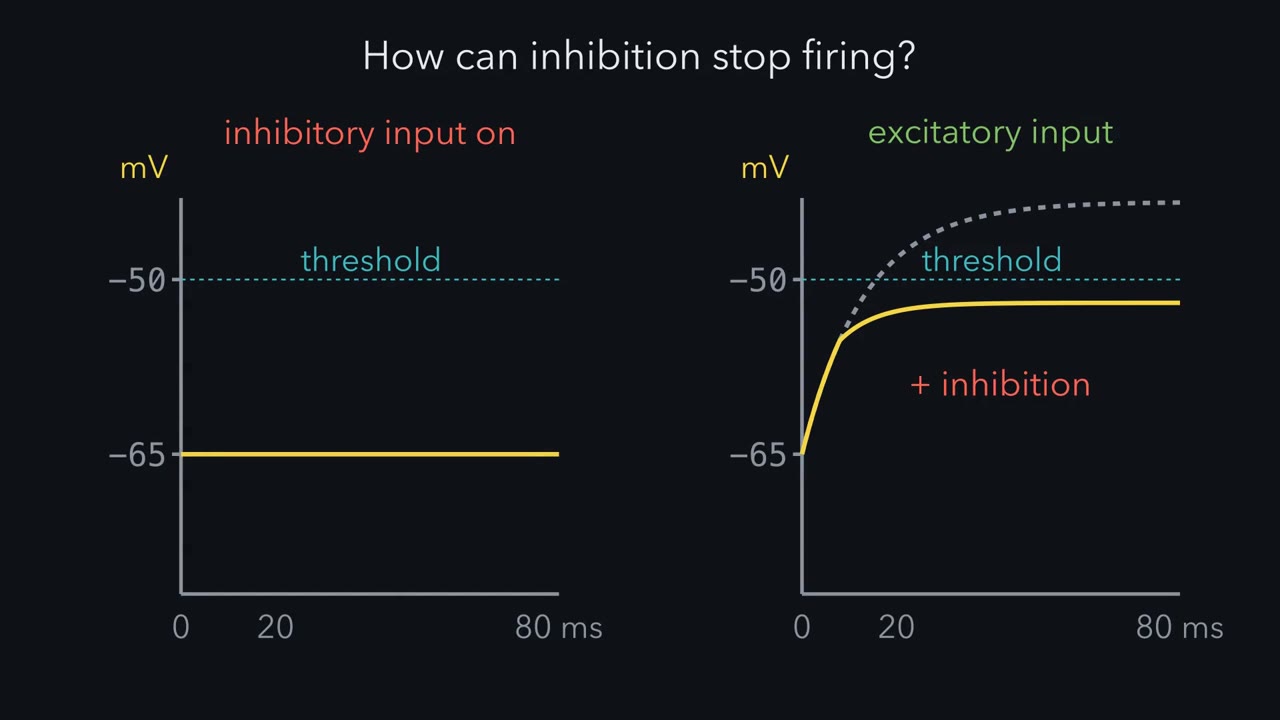
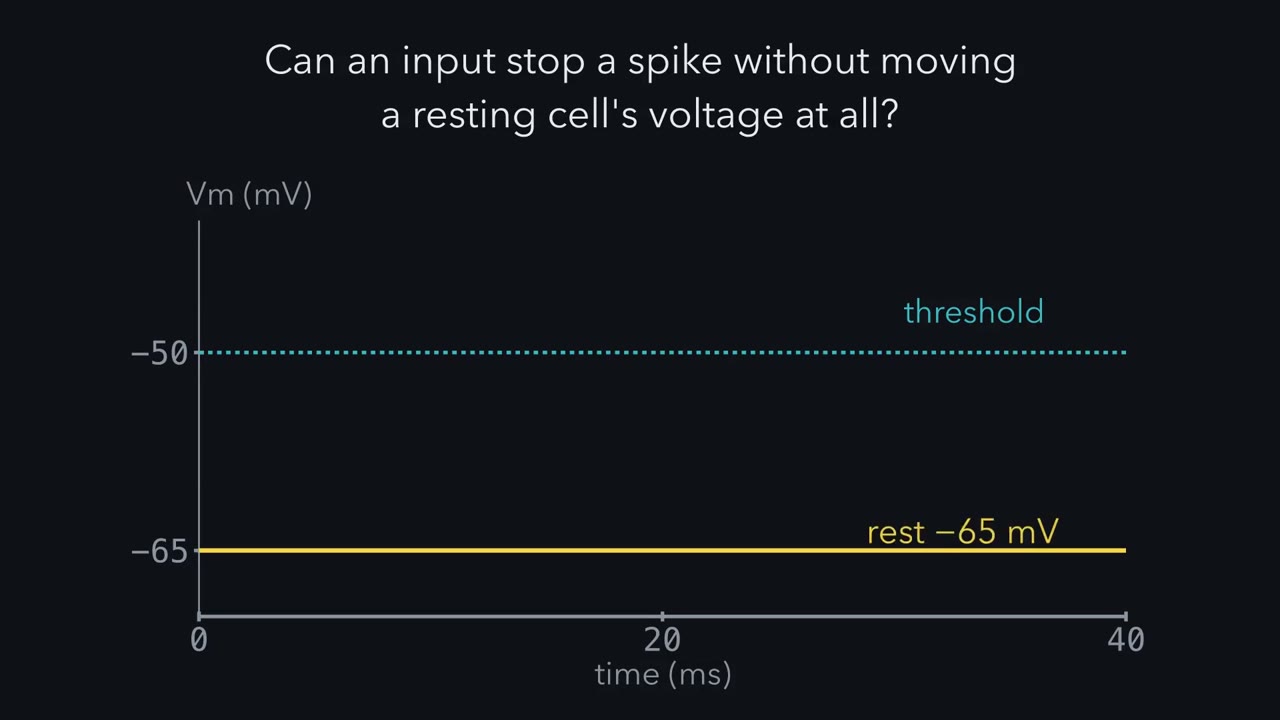
An inhibitory input can leave a resting cell's voltage unchanged and still stop it from firing. How?
Continue in the lesson: Integration, Inhibition and Neuromodulation →
3:07 · Free, with captions and a transcript. The lesson has the full text, the questions and the sources.
More films from this lesson
How this film was made. Narration: an AI narrator voice (Kokoro, af_heart) reading narration written from this lesson's text. Animation: AI-generated in code (Manim) by Claude, a schematic with no drawn molecular structures. Captions come from the narration script. See something wrong? Report it.