Branches and Modulators Change the Ropes
Read the transcript of “Branches and Modulators Change the Ropes”
Film transcript: Branches and Modulators Change the Ropes
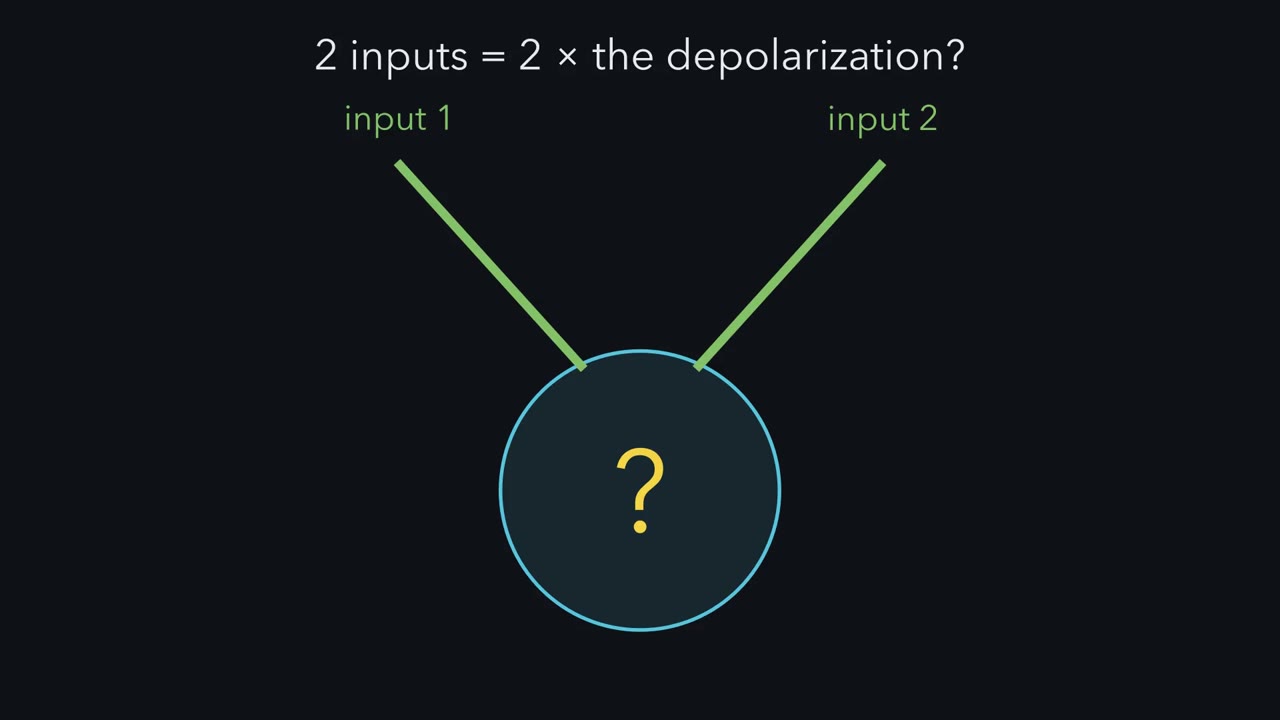
What happens when a rope grows stronger with voltage, or a modulator changes the ropes themselves? A real neuron is not one compact patch. Each patch of dendrite has its own ropes, and passes current to its neighbours. So the patches set each other's voltages. The length constant and the capacitance shrink and smooth what reaches the soma. Polsky, Mel and Schiller stimulated two sites on thin dendrites of rat neocortical pyramidal neurons. First each alone, then both together. Picture their comparison as a graph. Along the bottom, the response expected if the two inputs simply added. Up the side, the response actually measured. A point on the 45 degree line means linear addition.
Inputs far apart, or on different branches, fell on the line. They summed linearly. Nearby inputs on one thin branch summed sigmoidally. The response rose slowly, then steeply, then levelled off. So location set the combination rule. The result supports the idea that thin branches act as separate integrating subunits. The steep phase is generally attributed to local regenerative events. NMDA receptors are thought to take part. Once glutamate and a co-agonist have bound, an NMDA receptor is a rope that thickens as the marker rises. Depolarization pushes out the magnesium ion that blocks it. Over the right voltage range, it thickens faster than its driving force shrinks.
Then its pull grows. Now modulators. A fast synapse adds a rope briefly. A modulator can instead change the ropes the cell already has. In sympathetic neurons, Gq-coupled M1 muscarinic receptors close KCNQ potassium channels. These carry the M-current. In cells expressing these channels, depleting the membrane lipid PIP2 alone was enough to suppress the current. So the lipid itself can regulate the channel. Closing these channels removes a potassium rope. What happens to the response to the same current step?
In a passive approximation, closing a potassium conductance raises the resting voltage a little and shrinks the bottom line. The same sustained current step then gives a larger steady change, and takes longer to reach the same fraction of it. Closing them increases excitability. The neuron fires more to the same input. Dopamine on D1 receptors is the harder case. In mouse striatal neurons, firing to the same injected current rose. It rose within hundreds of milliseconds. After one bout of stimulation, it stayed raised for at least 10 minutes. With synaptic receptors blocked and drift controlled, the cell's own conductances or active currents must have changed.
A spike count cannot say which channel. Branches can make a rope grow with voltage. Modulators change the ropes themselves. The rule tells you what kind of change to look for.
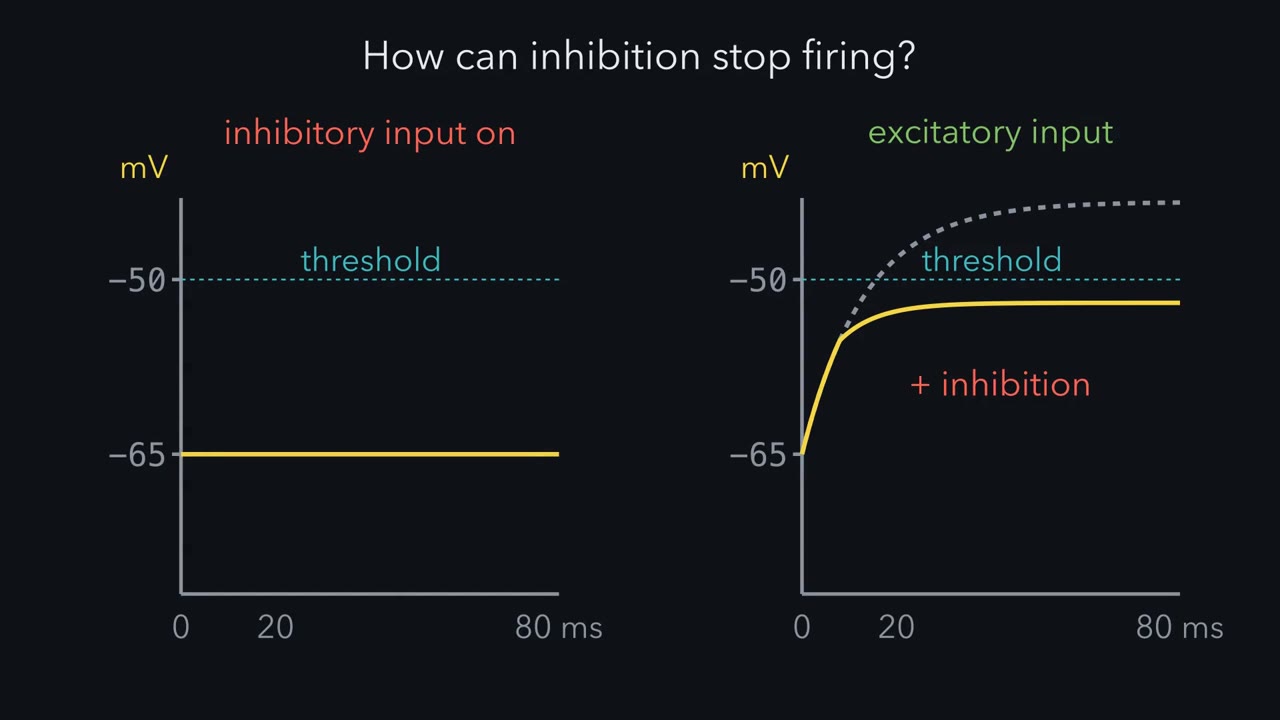
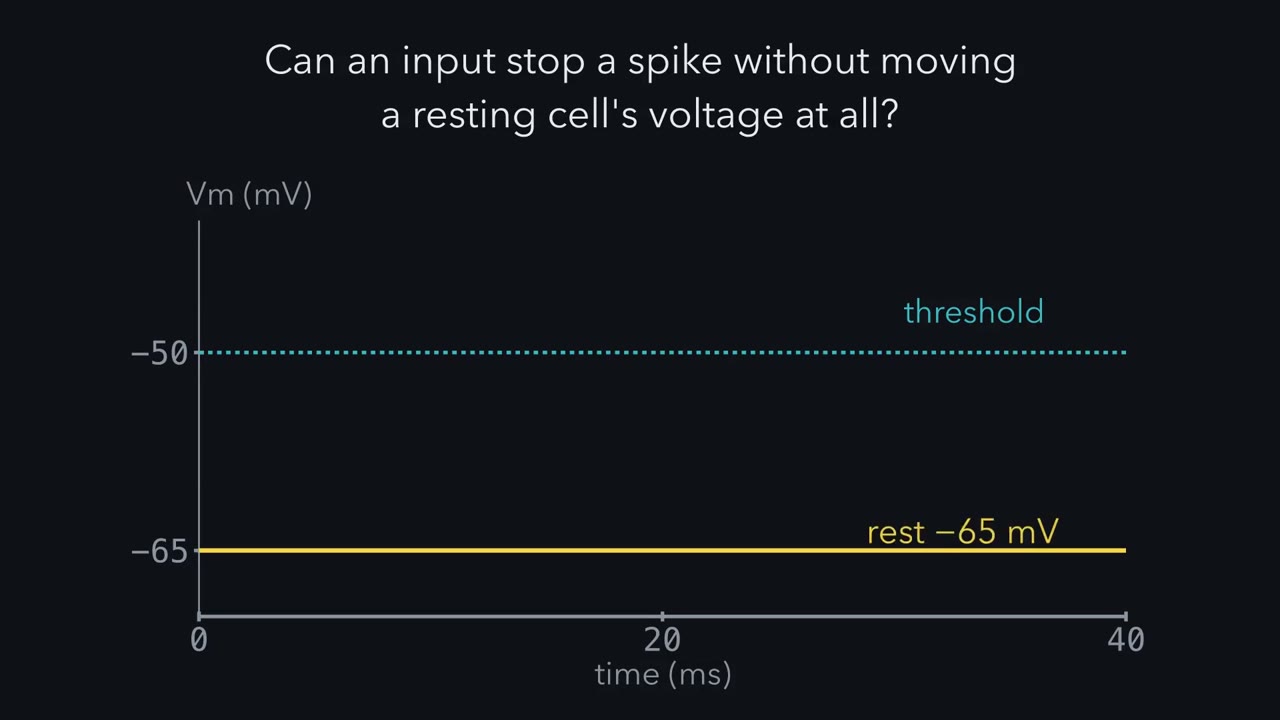
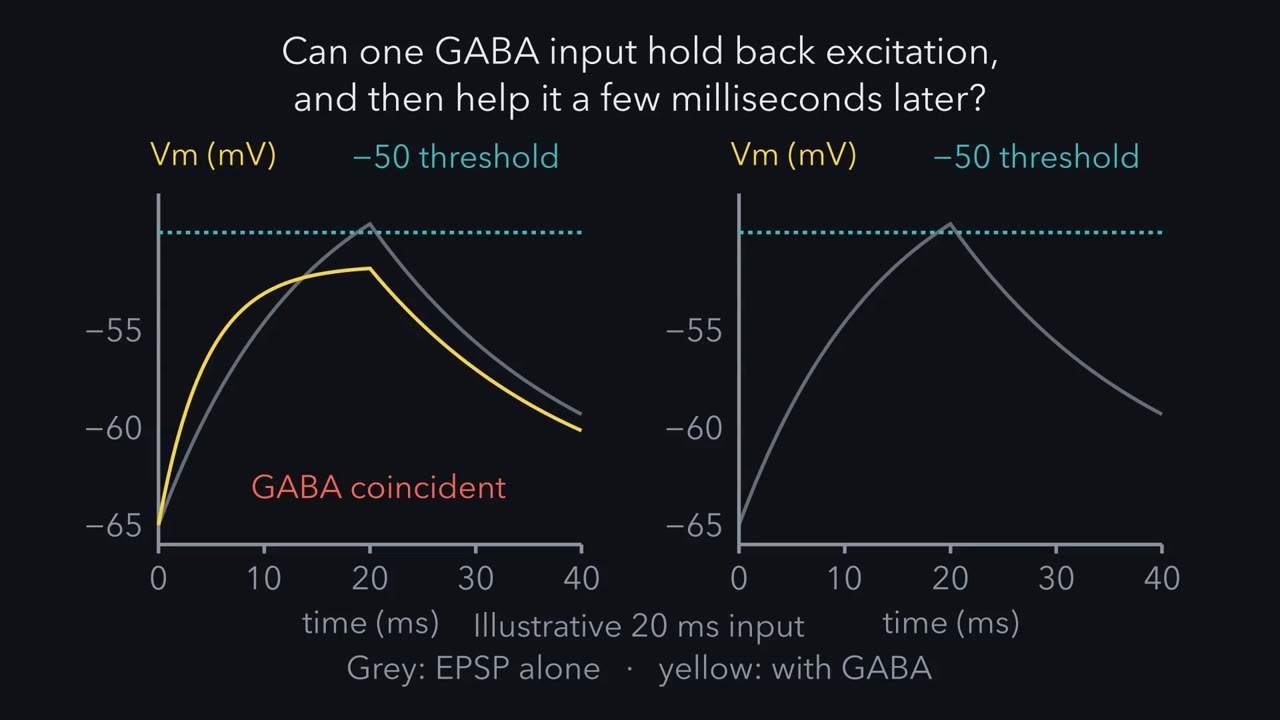
An inhibitory input can leave a resting cell's voltage unchanged and still stop it from firing. How?
Continue in the lesson: Integration, Inhibition and Neuromodulation →
3:29 · Free, with captions and a transcript. The lesson has the full text, the questions and the sources.
More films from this lesson
How this film was made. Narration: an AI narrator voice (Kokoro, af_heart) reading narration written from this lesson's text. Animation: AI-generated in code (Manim) by Claude, a schematic with no drawn molecular structures. Captions come from the narration script. See something wrong? Report it.