Less Than Double
Read the transcript of “Less Than Double”
Film transcript: Less Than Double
If one input depolarizes a cell, do two identical inputs depolarize it twice as much? Take our cell. The leak is 10 nS, tied at minus −65 mV. Threshold is minus −50 All the values here are illustrative. The cell is passive, and its voltage is the same everywhere. Voltages above threshold are passive predictions, with the spike switched off. Open a steady excitatory input of 5 nS, tied at 0 mV. The passive prediction is near minus −43 mV. That is about 22 mV of depolarization, above threshold. A real cell with this threshold would fire on the way. It gets there with a shorter time constant, about 13 ms, because the total conductance grew. Now open a second, identical input at the same time.
Does the depolarization double, to about 43 mV? No. The passive prediction is about −32.5 mV. That is about one and a half times as much, not twice. To see why, measure the voltage from rest. Then the leak drops out of the average. The leak is tied at rest, so its top-line term is zero. But the leak is still in the bottom line, and still carries current. Each top-line term is a synapse's conductance, times how far its rope's end sits from rest. The bottom line is still the total conductance. Two inputs double the top line. But they also enlarge the bottom line. With one input, the top is 325, over 15. With two, the top doubles to 650, but the bottom also grows, to 20.
So the second input dilutes the first. That is the same effect, seen as ropes. The marker is nearer 0 mV, so each AMPA rope's driving force has shrunk. This is sublinear summation. Inputs sharing one small patch of membrane show it most. Notice where the surprise lived: in the bottom line, the total conductance. Each new input adds to the total conductance. So the voltage settles at a weighted average, not a sum of millivolts. Small inputs nearly add. Large ones fall short.
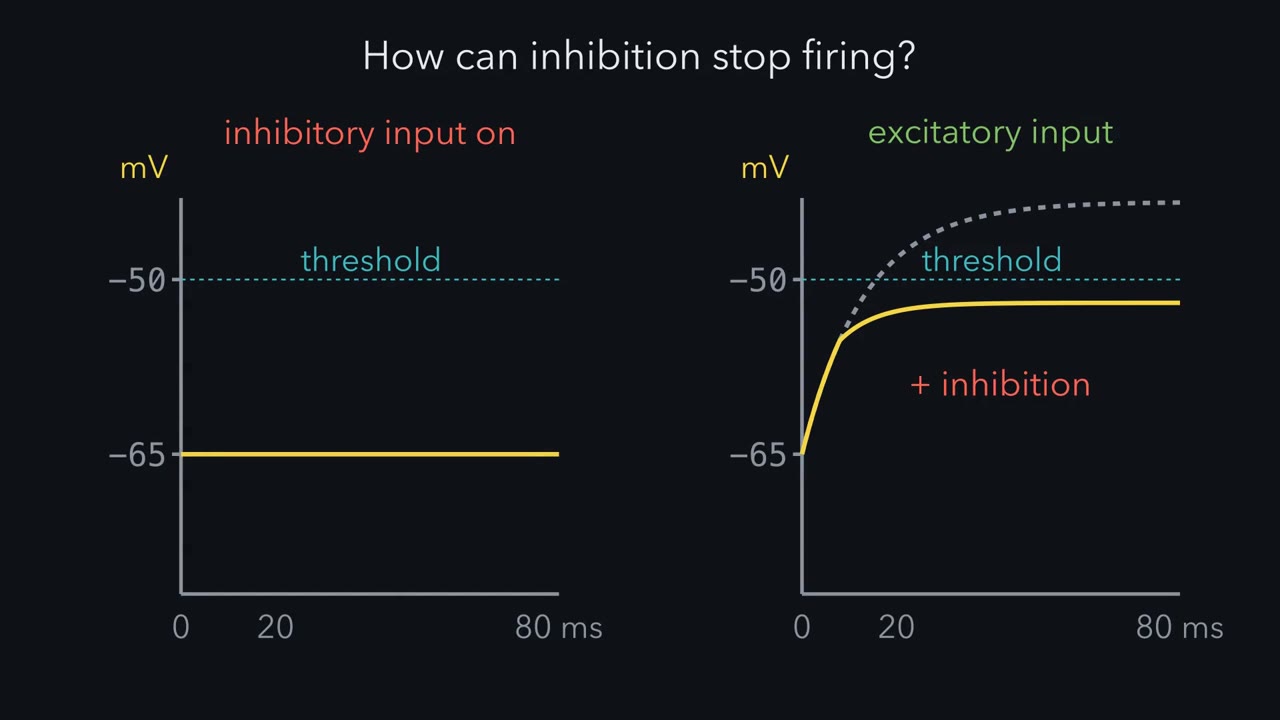
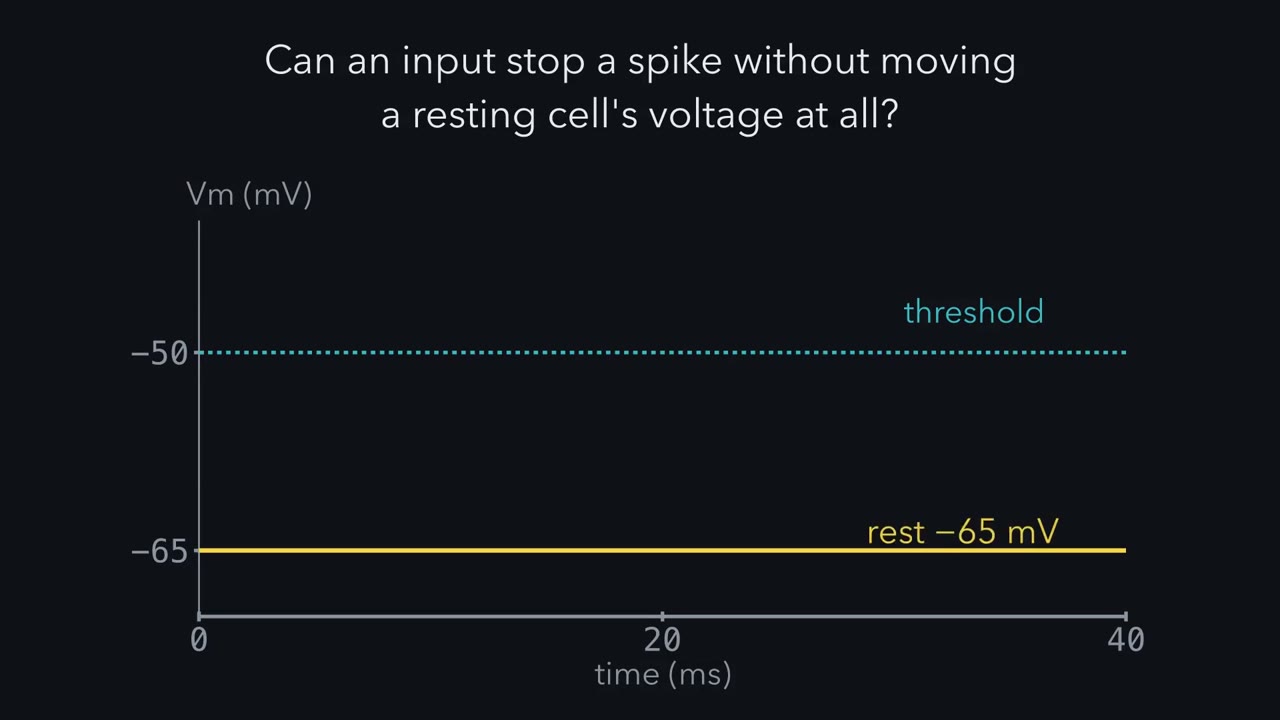
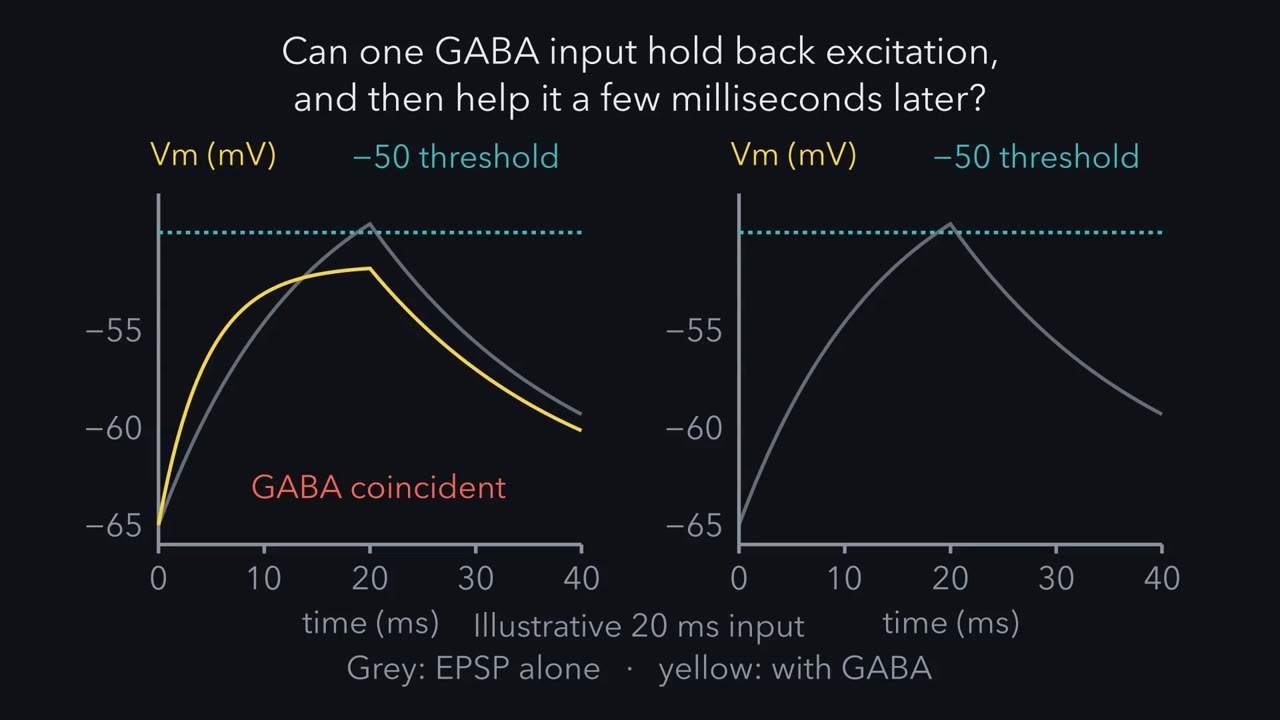
An inhibitory input can leave a resting cell's voltage unchanged and still stop it from firing. How?
Continue in the lesson: Integration, Inhibition and Neuromodulation →
2:42 · Free, with captions and a transcript. The lesson has the full text, the questions and the sources.
More films from this lesson
How this film was made. Narration: an AI narrator voice (Kokoro, af_heart) reading narration written from this lesson's text. Animation: AI-generated in code (Manim) by Claude, a schematic with no drawn molecular structures. Captions come from the narration script. See something wrong? Report it.