Inhibition That Moves Nothing at Rest
Read the transcript of “Inhibition That Moves Nothing at Rest”
Film transcript: Inhibition That Moves Nothing at Rest
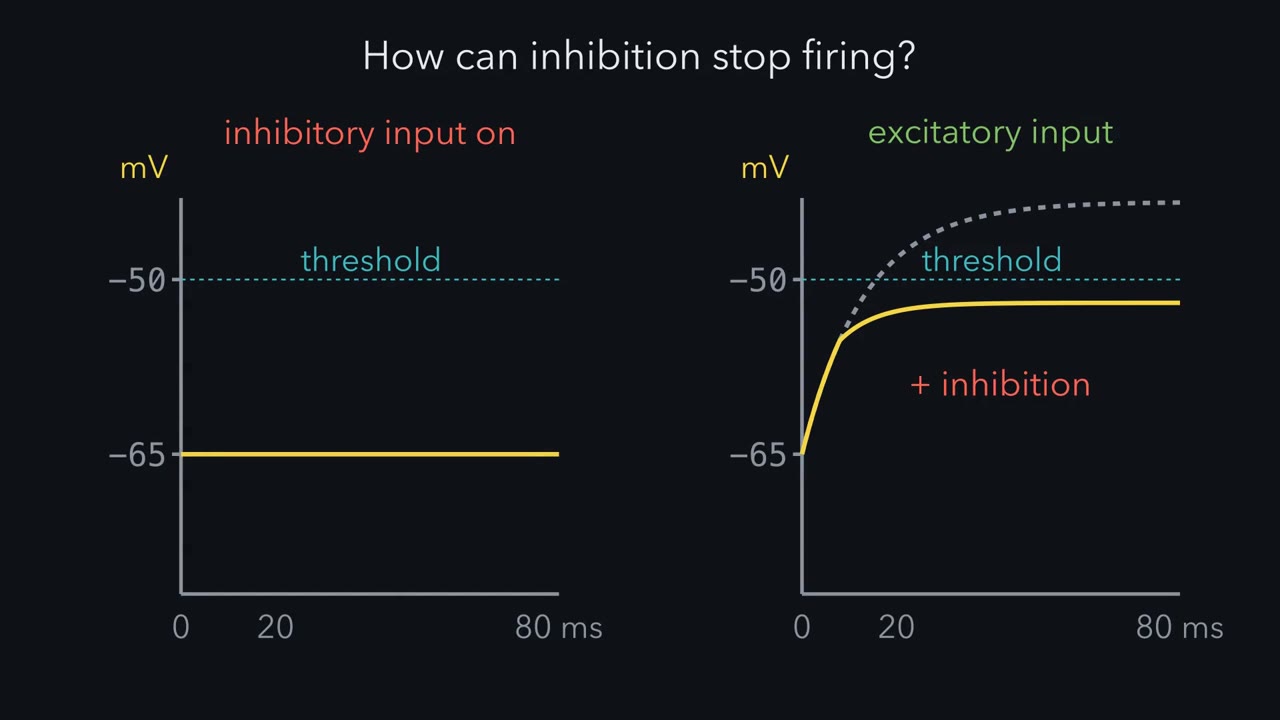
Can an input stop a spike without moving a resting cell's voltage at all? Our cell starts at rest. Alone, the 5 nS excitatory input would carry it toward minus −43 past threshold. It would fire on the way. Now meet an inhibitory rope of 10 nS. It is tied exactly at rest, minus −65 mV. First, what does this rope do to a resting cell?
Nothing. Its rope is tied exactly where the marker sits, so it pulls on nothing. The trace stays at minus −65 Now start again from rest, and switch on the excitation and the shunt together. Where does the marker head? Toward minus −52 mV. That is below threshold, so the cell never fires. The shunt's top-line term is zero, so it adds nothing to the top. It acts through the bottom line, the total conductance. The depolarization falls from about 22 mV to 13 This is shunting inhibition. It moves nothing at rest. It shows itself when something else tries to move the voltage. Then it cuts that movement. The shunt is a rope tied where the marker already sits.
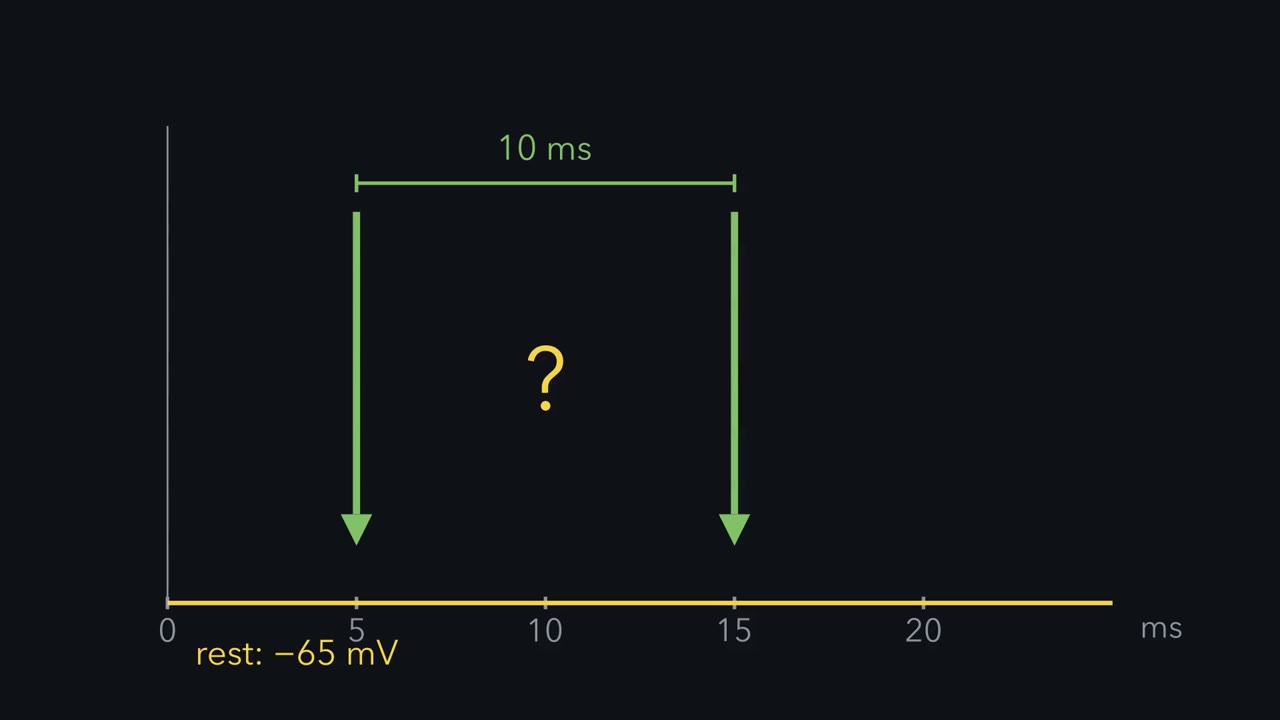
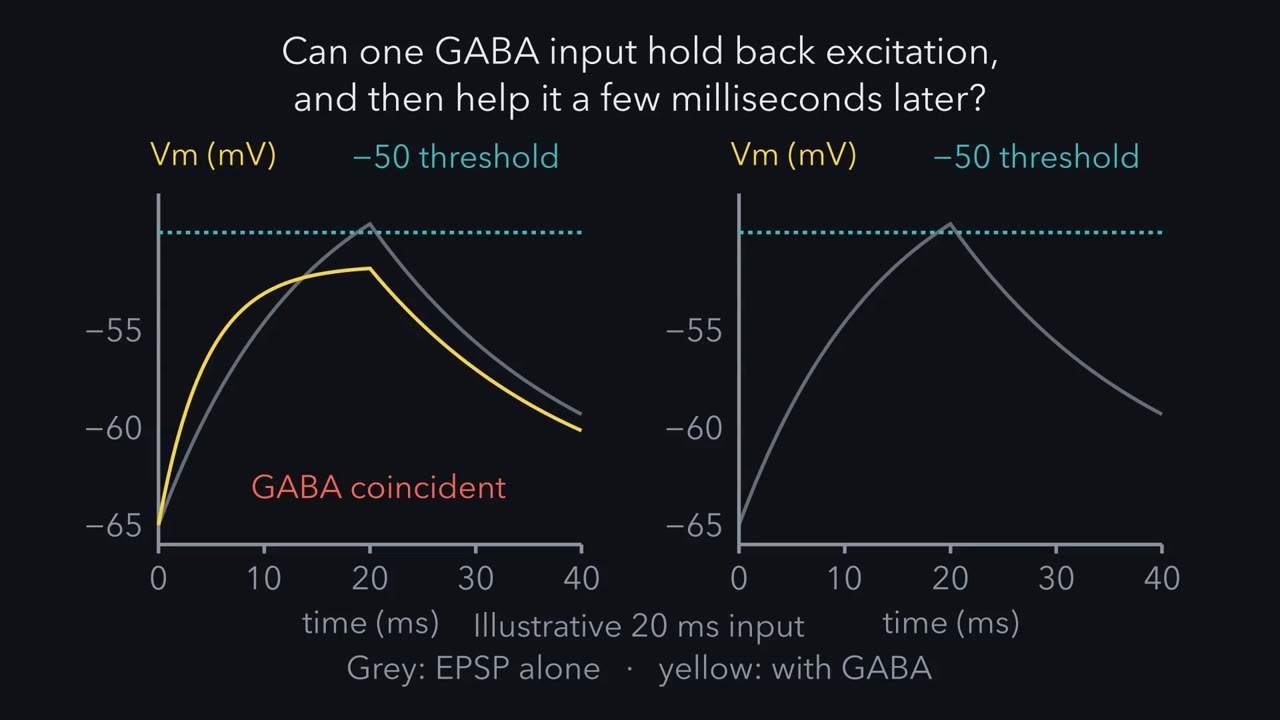
It holds the marker back whenever another rope drags it away. Electrically, the shunt lowers input resistance. Excitation moves the voltage less, whether it is a synaptic conductance or injected current. It changed only the bottom line. The shunt does a second thing. It shortens the time constant. Now switch off the excitation, and let the cell return to rest. With the leak and the shunt open, τ is 10 ms. That is half the leak's 20 That is cell B from the summation chapter. Give it two brief pulses again, 10 ms apart. Less of the first is left for the second to ride on. In this idealized case, each jump stays the same size. Only the tail is shorter.
A real synaptic current flows for a millisecond or more. While it flows, the shunt drains charge, so the peak is smaller too. A shunt tied at rest moves nothing at rest. It shows itself as smaller EPSPs and less summation.
An inhibitory input can leave a resting cell's voltage unchanged and still stop it from firing. How?
Continue in the lesson: Integration, Inhibition and Neuromodulation →
2:42 · Free, with captions and a transcript. The lesson has the full text, the questions and the sources.
More films from this lesson
How this film was made. Narration: an AI narrator voice (Kokoro, af_heart) reading narration written from this lesson's text. Animation: AI-generated in code (Manim) by Claude, a schematic with no drawn molecular structures. Captions come from the narration script. See something wrong? Report it.