Press play to start at .
The OFF Switch Decides
From the film
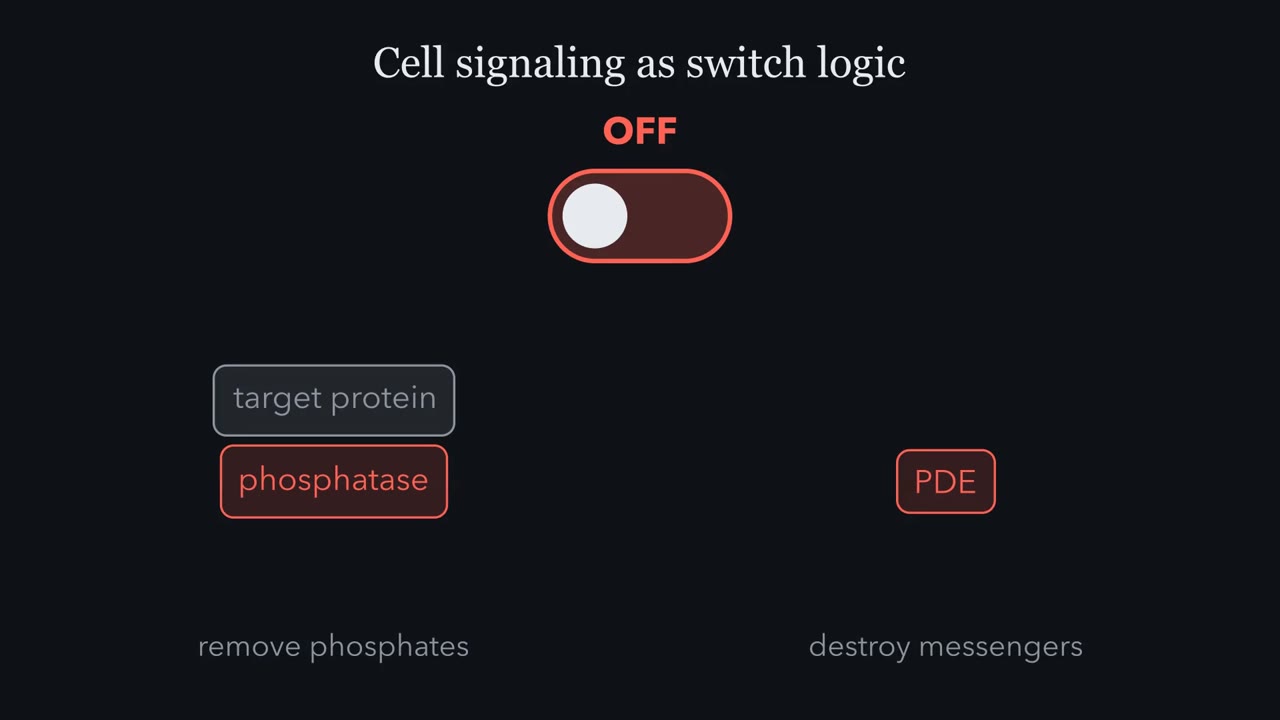
- Every switch in a signaling relay is pushed ON by one reaction and pulled OFF by another.
- An enzyme step's gain is how fast it works times how long it stays ON, so its OFF reaction sets the gain.
- The gains multiply down the chain, and once the signal leaves, the response fades at about the pace of the slowest OFF step.
- Cholera toxin stops Gs alpha cutting its GTP, so Gs is locked ON and cyclic AMP never stops.
- A switch also sticks ON when it stops needing its ON signal, as PKA does in some cases of Cushing's syndrome.
Read the transcript of “The OFF Switch Decides”
Film transcript: The OFF Switch Decides
Tap a sentence to play from there.
- 0:00 The first film carried epinephrine's signal to PKA.
- 0:05 Now picture cholera toxin in a gut cell.
- 0:08 It switches nothing ON.
- 0:11 It breaks one OFF reaction.
- 0:13 So why can that kill within hours?
- 0:19 Take one switch, Gs alpha.
- 0:22 The receptor pushes it ON, swapping GDP for GTP.
- 0:27 Its own GTPase pulls it OFF, a built-in timer.
- 0:32 How much is ON is a contest between them.
- 0:35 While Gs alpha holds GTP, its cyclase makes cyclic AMP.
- 0:41 In round numbers, 10 a second for about 10 seconds makes about 100.
- 0:47 So an enzyme's gain is its speed, times how long it stays ON.
- 0:52 Slow the timer, and the same cyclase makes more.
- 0:56 Each switch down the row has its own ON and OFF arms.
- 1:00 And the gains multiply.
- 1:03 In teaching numbers, one epinephrine molecule ends as tens of millions of glucose units. Real gains differ between cell types.
- 1:13 The one idea: every switch is pushed ON by one reaction and pulled OFF by another.
- 1:20 The OFF reaction sets how long each switch stays ON, and so how big the answer gets.
- 1:26 And once the signal leaves, the response fades at about the pace of the slowest OFF step.
- 1:32 Now cholera. The toxin chemically modifies Gs alpha, so it can no longer cut its GTP. Gs is locked ON.
- 1:43 Cyclic AMP never stops, and chloride and water pour into the intestine.
- 1:49 Severe dehydration can kill within hours.
- 1:53 Another stuck switch.
- 1:55 PKA sits clamped by regulatory subunits until cyclic AMP frees it.
- 2:02 In some cases of Cushing's syndrome, its active subunit cannot bind the clamp.
- 2:08 Every OFF enzyme still works.
- 2:11 With no cyclic AMP, is PKA ON or OFF?
- 2:20 ON. PKA escapes its clamp, and cortisol production runs with no hormone telling it to. Nothing is wrong with the OFF enzymes here.
- 2:32 The switch no longer needs its ON signal.
- 2:35 So a switch sticks ON when it loses its OFF reaction, or stops needing its ON signal. The contest can also tip the other way.
- 2:46 Weaken an ON arm, as in insulin resistance, and the response is too small.
- 2:52 So the OFF reactions decide how big a cell's answer is, and how long it lasts.
- 2:58 When one fails, the answer runs on without the signal.
Cell signaling: the same idea, other levels
A level is a place to start, not a rank. If this loses you, the rung below teaches the same idea, told more simply.
Graduate · the level you chose
Signals and How Far They Travel
Five modes sorted by reach: contact, autocrine, paracrine, synaptic, endocrine.
Cell Signaling · about 27 min · 3 practice questions
College, upper level · the level you chose
Signal-Transduction Pathways: How Cells Compute With Molecular Switches · this lesson
One epinephrine molecule frees millions of glucose units through five parts in order.
Biochemistry · about 32 min · film 2:42 · 8 practice questions
Next door
- Diffusion: Transport Across Membranes · College: the core How far a signal molecule can spread, and how fast, sets whether it reaches a neighbour or a distant cell.
- Homeostasis and feedback: Correction, Threshold and Gain · 2:58 Many body signals exist to hold a level steady, and they work by feeding the result back to the sender.
- Gene regulation: When Are the lac Genes High? · 3:41 · College: the core Many signals end at the nucleus, where they change which genes a cell switches on or off.
More films from this lesson
Continue in the lesson: Signal-Transduction Pathways: How Cells Compute With Molecular Switches →
Free, with captions and a transcript. The lesson has the full text, the questions and the sources.
How this film was made. Narration: an AI narrator voice (Kokoro, af_heart) reading narration written from this lesson's text. Animation: AI-generated in code (Manim) by Claude, a schematic with no drawn molecular structures. Captions come from the narration script. See something wrong? Report it.