Films · Genetics and Molecular Biology
When Are the lac Genes High?
Read the transcript of “When Are the lac Genes High?”
Film transcript: When Are the lac Genes High?
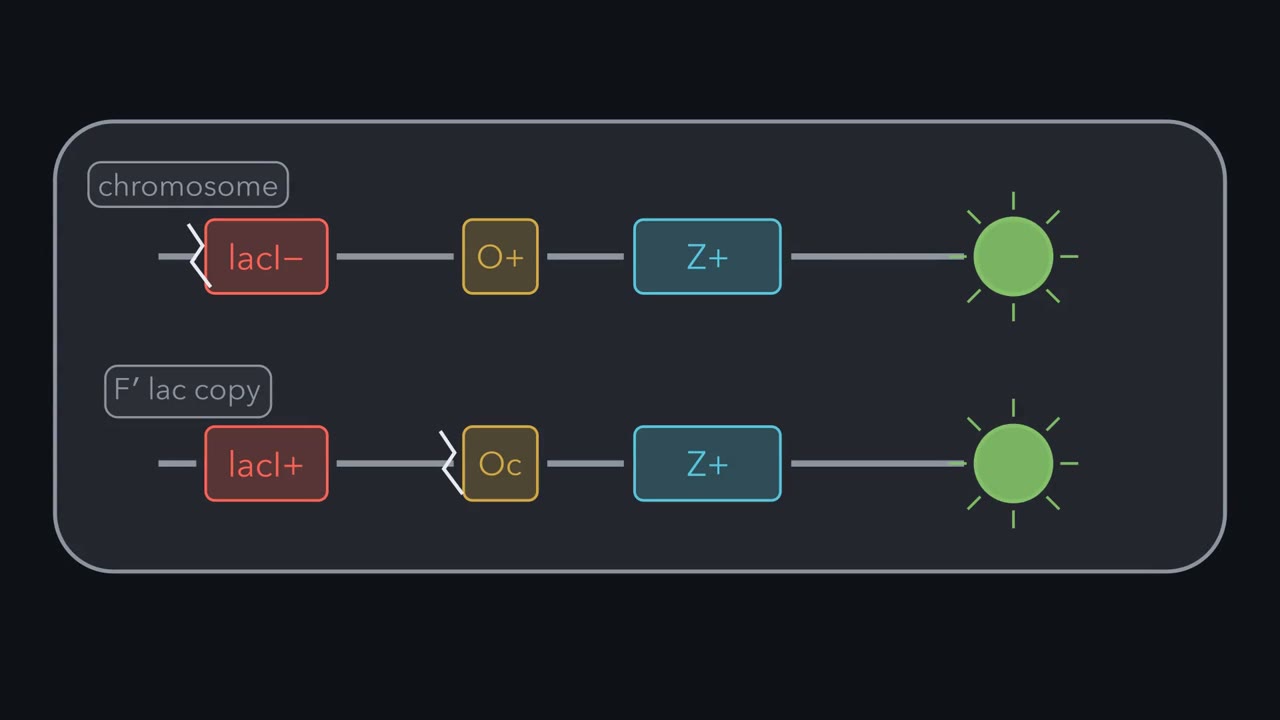
Why does a bacterium offered glucose and lactose postpone the lactose genes? Follow one promoter inside a single cell. Two signals must line up before its output becomes high. The rail carries the lacZ, lacY, and lacA genes after one promoter. Polymerase can copy them into one messenger RNA. Together, these genes form one operon and produce one messenger with three coding regions. But a red repressor clamp grips the operator beside that promoter. The clamp blocks transcription. Yellow lactose crosses the membrane through permease. β-Galactosidase turns a little lactose into allolactose, the natural inducer. Lactose itself is not the inducer; conversion matters.
Allolactose reshapes the clamp and lowers its affinity for the operator. The clamp loosens, so polymerase can move. This creates a loop. Permease and β-galactosidase help produce the signal that increases their own production. The loop can amplify a small beginning into stronger production when conditions allow. Basal leak supplies a few starting proteins. So the switch is not perfectly binary. Removing the brake is only one input. The promoter is weak by itself. Teal CAP, carrying cyclic AMP, docks upstream. It contacts polymerase and helps transcription start. The activator does not remove repressor. Each regulator has a different job. This is positive control.
Glucose changes both inputs. In the classic account, cyclic AMP is lower when glucose is plentiful. How much this matters in living cells is debated. Glucose uptake also makes a transport protein block permease. Less lactose enters, so less allolactose releases the repressor. Now predict one case. Lactose is present, but glucose is also plentiful.
Will the expression meter reach high, or stop below it? Hold both signals in view. The output is reduced, not high and not necessarily absent. Some inducer may release the brake, but activation is weaker and lactose entry is inhibited. The two controls combine without becoming a perfect switch. Without lactose, the repressor keeps expression very low, even when glucose is scarce. With both sugars, expression is reduced. Only lactose with scarce glucose releases the brake and supplies strong activation together. This table predicts expression levels, not whether every cell behaves identically. The promoter is reading two conditions, not naming a preferred food by itself.
Keep the scope clear: this rule describes high expression in wild-type E. coli under the lesson's standard model. In the lab, a synthetic inducer can stand in for lactose.
Give E. coli glucose and lactose together and it uses the glucose first, pauses, then starts on lactose. How does one cell choose which genes to express, and when?
Continue in the lesson: The lac Operon: How Bacteria Regulate Genes →
3:41 · Free, with captions and a transcript. The lesson has the full text, the questions and the sources.
More films from this lesson
How this film was made. Narration: written from this lesson's text and read by an AI narrator voice (Kokoro, af_heart). Animation: AI-generated in code (Manim) by Claude, a schematic with no drawn molecular structures. Captions come from the narration script. See something wrong? Report it.