Films · Developmental Neuroscience
Drawing the Lines
Read the transcript of “Drawing the Lines”
Film transcript: Drawing the Lines
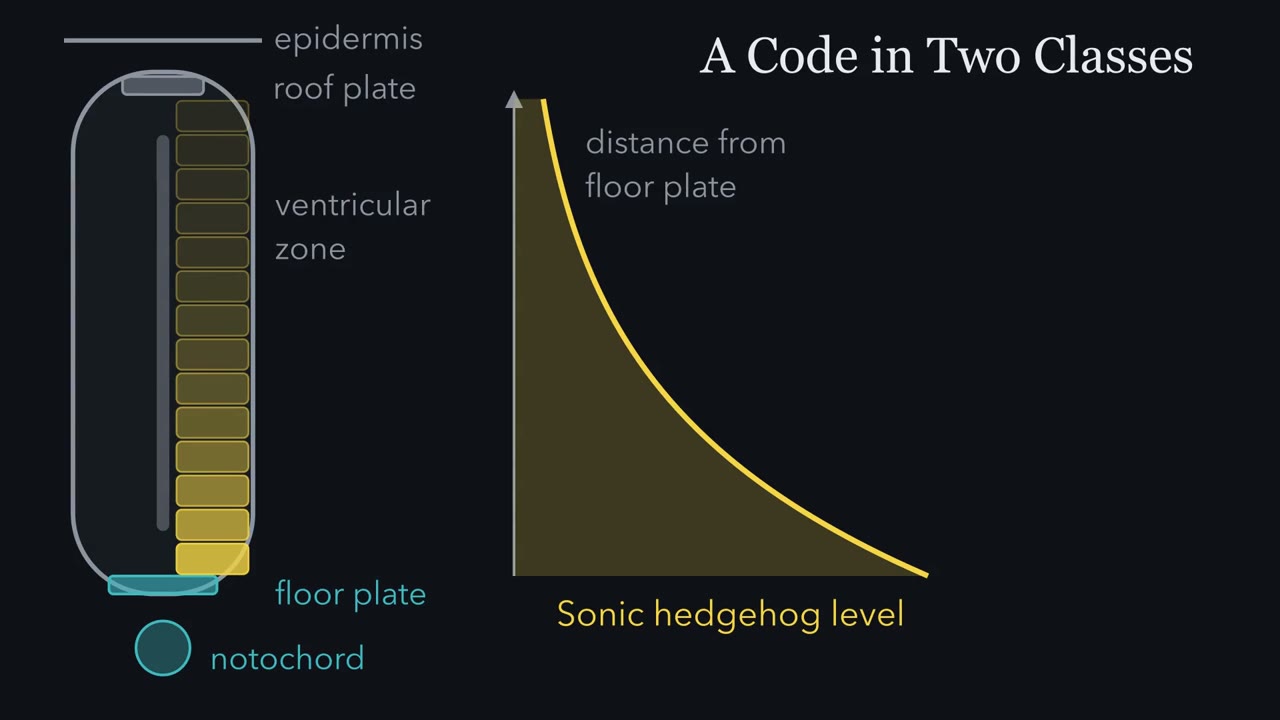
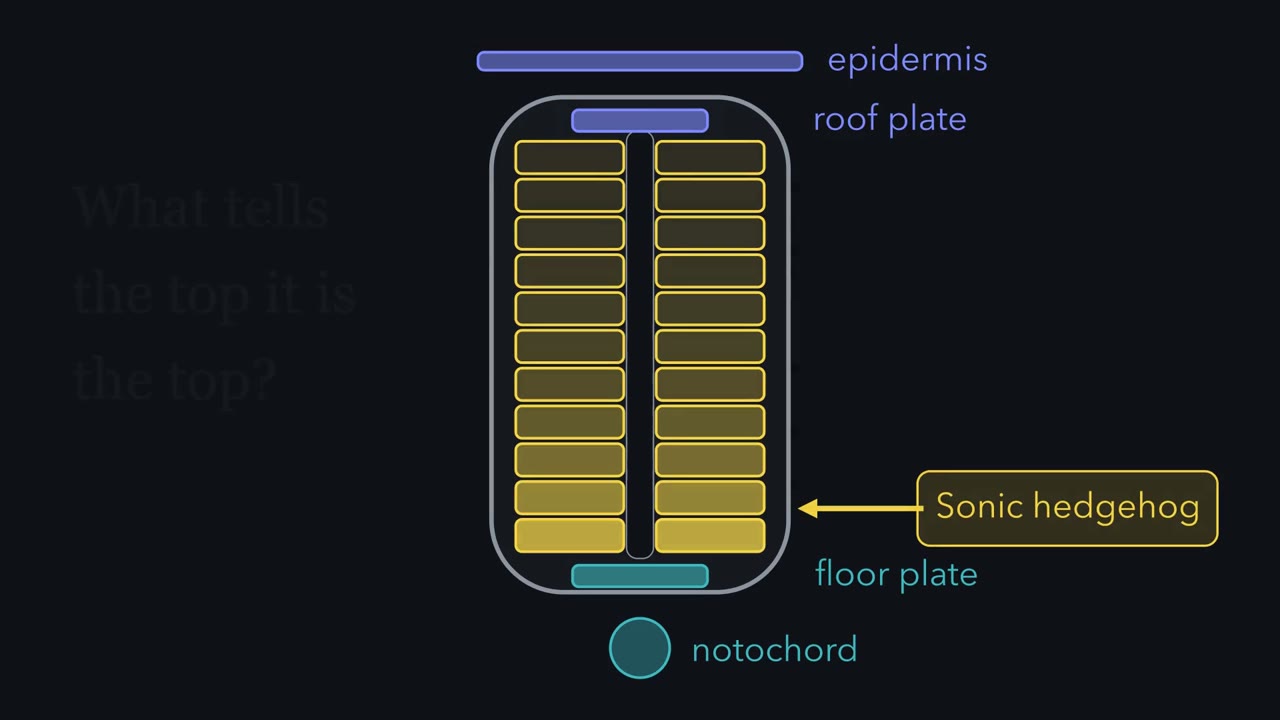
A smooth slope of signal should give a blur. Yet the domains have sharp borders. Why? Picture a cell whose output simply rises with the signal, the gentle curve of simple binding. Going from 10 % to 90 percent output then takes an 81-fold change in concentration. On an illustrative slope, that change spans about eighteen cells. Eighteen cells of in-between answers is a blur. In this simple model, a steeper, switch-like response narrows the blur to one or two cells. The cells are all still there. Fewer of them give in-between answers. The domains get their switch from the factors themselves. Factors on either side of a border repress each other.
This was tested by electroporation. DNA is pushed into cells on one side of the tube. The other side is the control. James Briscoe and colleagues showed that Pax6 and Nkx2.2 repress each other. They meet at the border between pMN and p3. Novitch, Chen and Jessell found the same for Irx3 and Olig2.
Predict. Force Nkx2.2 on in the motor neuron domain. What happens to those cells? Motor neurons are suppressed on that side. The cells make V3 neurons, the fate of the domain below. One factor in the wrong place moved the line for those cells. Nothing was done to the Shh source. Two factors that repress each other can form a switch with two stable states.
In simple models, they do so only when the repression is strong and cooperative. A weak loop makes no switch. In a strongly cross-repressive circuit, a cell near a border cannot hold both factors for long. It falls to one side, and the loop helps hold it there. That gives the network some memory. In 2012, Briscoe's group tested it in mouse embryos in culture. A short pulse of a drug that activates Smoothened left the borders close to normal. Continuous treatment shifted them. There is a limit here. Sharp is not the same as accurate. A large or lasting misreading can tip a cell to the wrong side. The switch may then hold the error. Placing borders accurately is a separate problem.
In models, reading over time, and reading two opposing slopes, can help. The takeaway: the slope sets roughly where each line falls. Pairs of repressors make each line sharp, and help hold it.
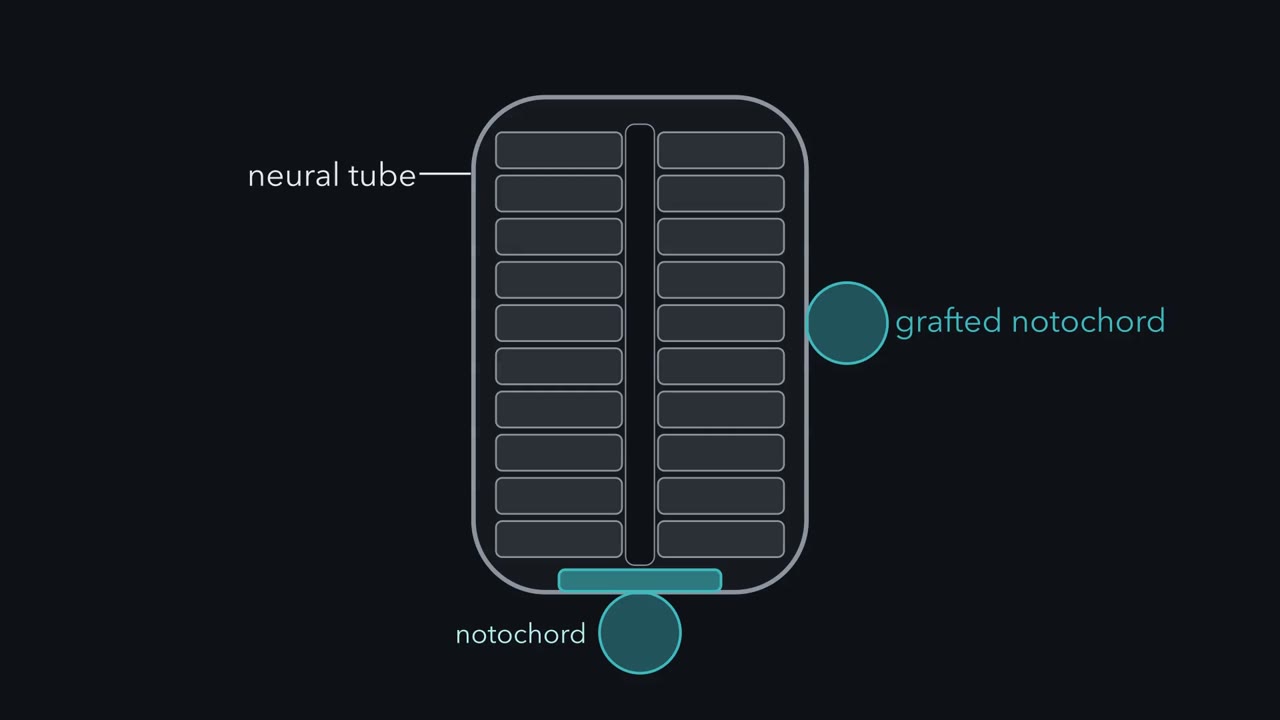
Graft a second notochord beside a chick neural tube, and the tube grows a second floor.
Continue in the lesson: Ventral to Dorsal: Sonic Hedgehog and BMP in the Neural Tube →
3:02 · Free, with captions and a transcript. The lesson has the full text, the questions and the sources.
More films from this lesson

How this film was made. Narration: an AI narrator voice (Kokoro, af_heart) reading narration written from this lesson's text. Animation: AI-generated in code (Manim) by Claude, a schematic with no drawn molecular structures. Captions come from the narration script. See something wrong? Report it.