Press play to start at .
Who Turns the Tap
From the film
- When a tissue works harder its arterioles relax and flow follows; several signals overlap, and no single one does it.
- Autoregulation holds a bed's flow relatively steady across a middle range of pressures: arterioles narrow as pressure rises and widen as it falls.
- Berne proposed that adenosine, formed as ATP breaks down when oxygen runs short, dilates coronary arterioles; its role is not evident unless oxygen delivery is compromised.
- In every organ the arterioles are the tap; what differs is who turns it.
- The heart answers metabolism, the brain neural activity and carbon dioxide, working muscle its metabolites, and skin body temperature through nerves.
Read the transcript of “Who Turns the Tap”
Film transcript: Who Turns the Tap
Tap a sentence to play from there.
- 0:00 With mean arterial pressure held steady, each tissue sets its own flow by its arterioles. But who turns that tap?
- 0:10 And what does it listen to?
- 0:14 When a tissue works harder, its arterioles relax and flow follows.
- 0:20 No single signal does it; several overlap.
- 0:24 From the working tissue come adenosine, K+, CO2, H+ and low O2.
- 0:31 The vessel lining, the endothelium, adds nitric oxide.
- 0:36 The same tap does a second job.
- 0:39 It can hold flow steady when perfusion pressure changes, while the tissue's demand stays the same. This is autoregulation.
- 0:48 Plot pressure along the bottom, flow up the side.
- 0:53 At low pressures, flow rises with pressure.
- 0:57 Across a middle range, the line runs nearly level, though not perfectly flat.
- 1:02 Above that range, flow rises again.
- 1:05 Remember: flow equals pressure drop divided by resistance.
- 1:10 Across that middle range, pressure climbs but flow barely moves.
- 1:15 So what must the arterioles be doing?
- 1:23 is Narrowing. For flow to stay put while pressure rises, resistance must rise in proportion. When pressure falls, they widen.
- 1:34 One mechanism is the myogenic response: a small artery reacting to the pressure across its wall.
- 1:42 In the heart, flow tracks oxygen use.
- 1:46 In 1963, Robert Berne made cat and dog hearts short of oxygen.
- 1:52 Coronary resistance fell, and the muscle released breakdown products of adenosine.
- 1:57 He proposed that adenosine forms as ATP breaks down when oxygen supply falls short.
- 2:05 It diffuses to the arterioles and dilates them.
- 2:09 Later blockade studies in dogs found it a potent dilator.
- 2:14 But its role is not evident unless oxygen delivery is compromised.
- 2:19 Here is the one idea.
- 2:22 In every organ, the arterioles are the tap.
- 2:25 What changes from organ to organ is who turns it.
- 2:29 In the heart, metabolism turns it.
- 2:33 In the brain, active neurons raise local flow.
- 2:37 Carbon dioxide matters too: a rise dilates brain vessels, and a fall constricts them.
- 2:44 In working muscle, metabolites turn it.
- 2:48 In human studies, no single dilator explains much more than 20 to 30 percent of the rise. Working muscle also blunts sympathetic constriction.
- 2:59 In skin, nerves turn it.
- 3:02 Skin flow follows body temperature more than the skin's own metabolism.
- 3:08 In human whole-body heating, it has been estimated to reach 6 to 8 L per min.
- 3:14 The tap is the same everywhere.
- 3:17 The hand on it is not: pressure, the tissue's own chemistry, neurons, or nerves tuned to body heat.
Blood flow resistance: the same idea, other levels
A level is a place to start, not a rank. If this loses you, the rung below teaches the same idea, told more simply.
College, upper level · the level you chose
Resistance, Compliance and Local Blood Flow · this lesson
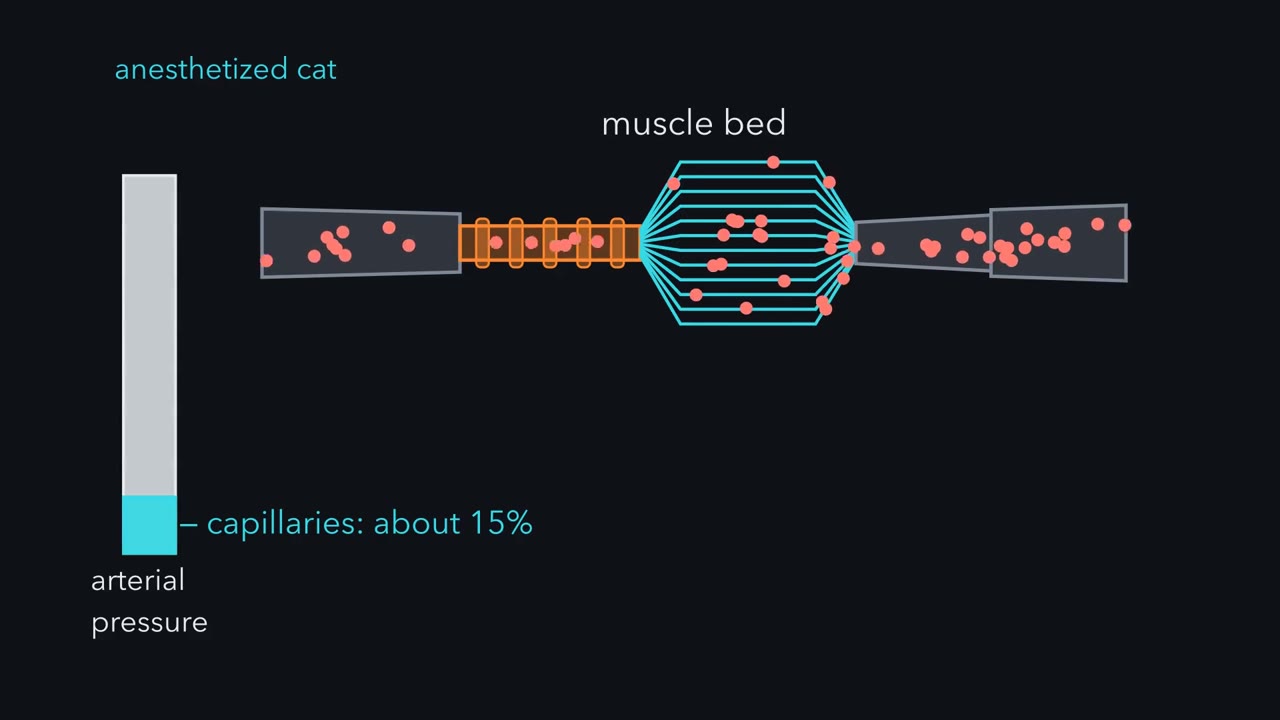
Only about 15 percent of pressure falls across capillaries in cat muscle.
Physiology · about 29 min · 4 practice questions
College, a first course · the level you chose
Blood Vessels, Blood and Lymph
Resistance climbs with the fourth power of narrowing: arterioles steer flow, capillaries run slow.
Organismal Biology · about 19 min · film 3:21 · 3 practice questions
Next door
- Capillary exchange: Capillary Exchange, Lymph and Edema Pressure left after the small arteries decides how much fluid is pushed out through the thin capillary walls.
- Cardiac output: Output Is Where the Curves Cross · 3:12 Total flow through all the vessels equals what the heart pumps, so resistance and heart output must agree.
More films from this lesson
Continue in the lesson: Resistance, Compliance and Local Blood Flow →
Free, with captions and a transcript. The lesson has the full text, the questions and the sources.
How this film was made. Narration: an AI narrator voice (Kokoro, af_heart) reading narration written from this lesson's text. Animation: AI-generated in code (Manim) by Claude, a schematic with no drawn molecular structures. Captions come from the narration script. See something wrong? Report it.