Press play to start at .
Filtering All the Way
From the film
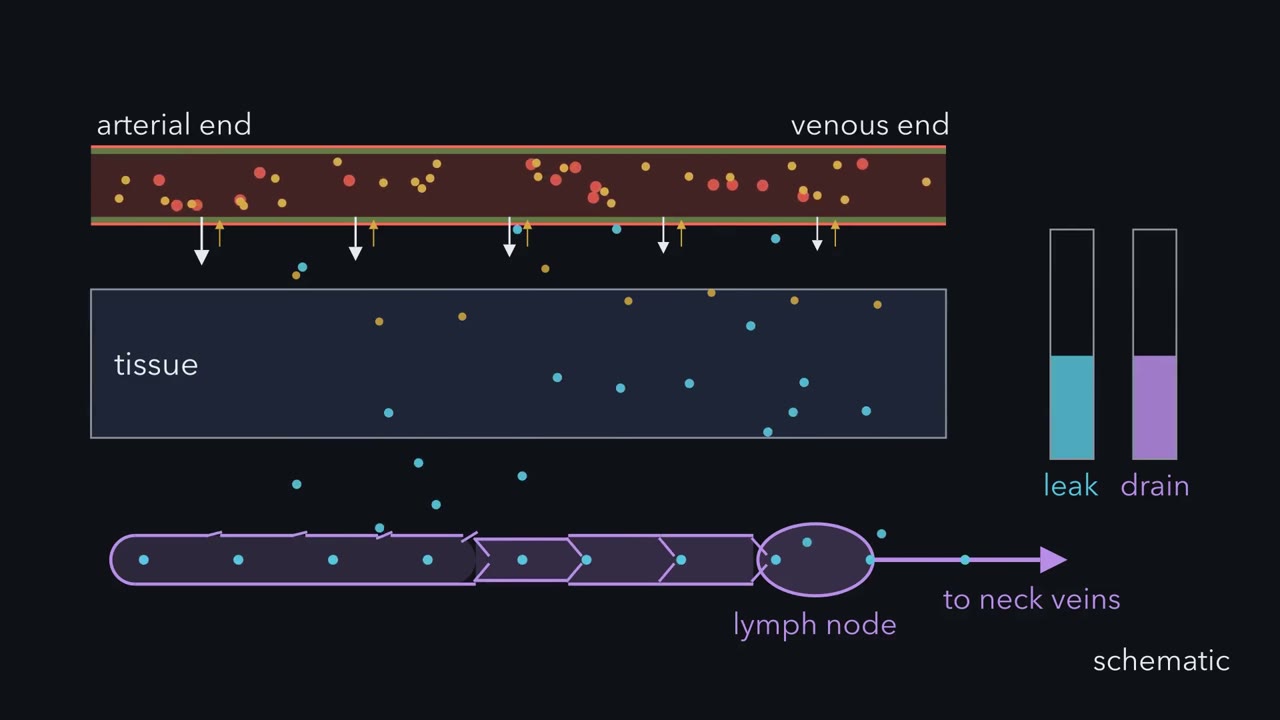
- Water crossing a capillary wall is pushed out by the pressure difference and held back by the protein difference.
- In resting muscle, a push of about 19 mmHg against a hold-back of about 18 leaves a net of 1, outward.
- The hold-back is set by the flow: filtering rinses protein from the thin film under the glycocalyx, and absorbing leaves protein behind there.
- So absorption switches itself off, and in a simple teaching model even the venous end filters a trickle.
- In most tissues in the steady state, plasma protein can slow filtration but cannot reverse it for long.
Read the transcript of “Filtering All the Way”
Film transcript: Filtering All the Way
Tap a sentence to play from there.
- 0:00 Day and night, fluid seeps from your smallest blood vessels into nearby tissue.
- 0:06 The textbook says most of it slips back in at the far end.
- 0:10 Does it?
- 0:14 Start with the push: pressure inside minus pressure outside.
- 0:19 In resting muscle, take 18 mmHg inside and about -1 outside.
- 0:27 The push is 19.
- 0:29 Now the hold-back.
- 0:31 Plasma proteins, mostly albumin, pull water toward the blood with about 26.
- 0:38 Protein just past the wall's sugary lining, the glycocalyx, pulls back with 6.
- 0:44 The wall lets a little albumin through, so that difference counts at about nine tenths: eighteen. Push nineteen, hold-back eighteen.
- 0:54 The net is one, outward.
- 0:56 Pressure falls along the capillary, from about 32 to 12.
- 1:01 Keep the hold-back at 18.
- 1:04 The arterial end nets 15 outward, the venous end 5 inward.
- 1:09 That's the textbook picture.
- 1:12 But that sum held the outside protein fixed.
- 1:16 Zoom in on one gap between lining cells.
- 1:19 The glycocalyx covers its mouth like a sieve, over a thin film of fluid.
- 1:25 When the vessel filters, nearly protein-free fluid streams out through the gap.
- 1:30 It rinses the film, so protein there stays low, and the hold-back stays strong.
- 1:36 Now reverse the stream.
- 1:39 When a vessel absorbs, water leaves the film for the blood, but the protein stays behind. It piles up, and the hold-back weakens.
- 1:49 Here is the one idea.
- 1:51 The hold-back is set by the flow itself.
- 1:55 Filtering keeps it strong.
- 1:57 Absorbing weakens it until absorption stops.
- 2:01 Now the venous end, where the push is only 13.
- 2:04 In the steady state, does it absorb, filter, or sit at exactly zero?
- 2:15 A trickle outward, about 0.3.
- 2:19 Absorbing would pile protein up and stop itself.
- 2:23 If water stopped moving, protein would seep out until the hold-back vanished.
- 2:28 At the arterial end, faster filtering rinses harder, so the hold-back grows.
- 2:34 The net there falls from 15 to about 12.
- 2:38 In this simple teaching model, every point filters.
- 2:42 Plotted, the textbook line runs straight into absorption.
- 2:46 The steady curve bends near 22 and flattens just above zero.
- 2:52 That shape is the hockey stick.
- 2:54 Single frog capillaries held at low pressure absorbed only briefly.
- 2:59 Then fluid movement fell to near zero, or slight filtration.
- 3:05 Nearly all this evidence is from animal vessels.
- 3:09 So in most tissues, the protein's pull can brake the outflow, but not turn it around for long. The leaked fluid needs another way home.
Capillary exchange: the same idea, other levels
A level is a place to start, not a rank. If this loses you, the rung below teaches the same idea, told more simply.
College, upper level · the level you chose
Capillary Exchange, Lymph and Edema · this lesson
Starling's reabsorbing venous end fails: filtration all along, set by Pc, Pi, albumin.
Physiology · about 28 min · 4 practice questions
College, a first course · the level you chose
Blood Vessels, Blood and Lymph
Push out minus pull in: Landis timed trapped red cells in frog capillaries.
Organismal Biology · about 19 min · film 3:14 · 3 practice questions
Next door
- Osmosis: Water Goes Where the Solute Stays · 3:16 Plasma proteins hold water in the blood by osmosis, which is the pull that balances the pressure pushing fluid out.
- Blood flow resistance: Resistance, Compliance and Local Blood Flow The pressure in the capillary comes from how much resistance the small arteries before it have used up.
More films from this lesson
Continue in the lesson: Capillary Exchange, Lymph and Edema →
Free, with captions and a transcript. The lesson has the full text, the questions and the sources.
How this film was made. Narration: written from this lesson's text and read by an AI narrator voice (Kokoro, af_heart). Animation: AI-generated in code (Manim) by Claude, a schematic with no drawn molecular structures. Captions come from the narration script. See something wrong? Report it.