Press play to start at .
Where the Pressure Goes
From the film
- Blood flows from high pressure to low, and flow through any stretch of vessel equals the pressure drop across it divided by its resistance.
- Along one tissue's vessels, which lie end to end, each segment's share of the pressure drop equals its share of the resistance.
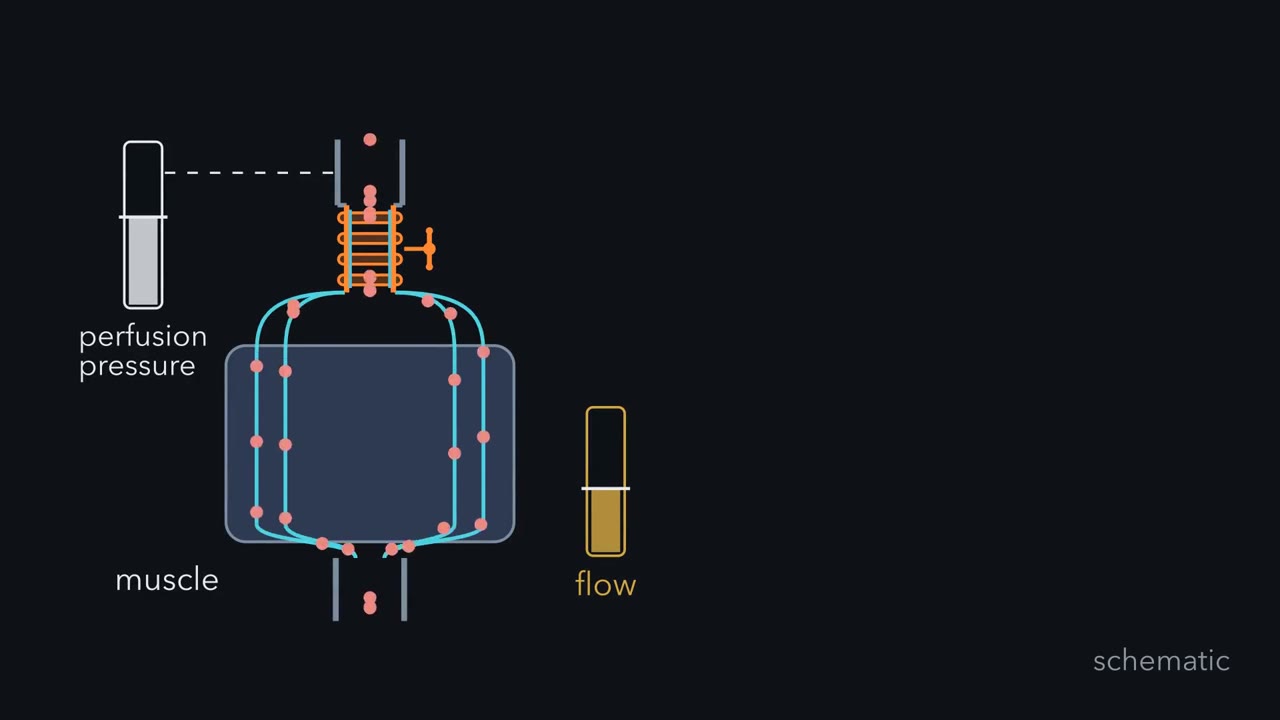
- In skeletal muscle the arterioles, not the capillaries, spend most of the pressure: capillaries are short and so many lie side by side that together they resist less.
- Arteriole walls are rings of smooth muscle, and resistance goes as one over the radius to the fourth power, so about 19 percent wider halves resistance.
- The heart and the reflexes hold mean arterial pressure nearly steady, and each tissue sets its own flow by setting the resistance of its own arterioles.
Read the transcript of “Where the Pressure Goes”
Film transcript: Where the Pressure Goes
Tap a sentence to play from there.
- 0:00 Take a thin thigh muscle in an anesthetized cat.
- 0:04 Only about 15 percent of arterial pressure is spent crossing its capillary bed.
- 0:11 Yet capillaries are its narrowest vessels.
- 0:14 So where does the rest go?
- 0:19 One rule runs everything here.
- 0:22 Blood flows from high pressure to low.
- 0:25 Through any stretch of vessel, flow equals the pressure drop across it, divided by its resistance.
- 0:32 Follow blood through the muscle: a small artery, an arteriole, many capillaries, a venule, a vein. They lie end to end, so the same flow passes every segment.
- 0:44 Then each segment's share of the pressure drop equals its share of the resistance.
- 0:50 Here are made-up round numbers, chosen so the capillaries match the cat.
- 0:55 90 mmHg drive blood across the bed.
- 0:59 The arterioles spend about 60 percent of it.
- 1:03 The capillaries spend about 15.
- 1:06 Why so little in the capillaries?
- 1:09 One capillary resists more than one arteriole.
- 1:14 But each is short, and so many lie side by side that together they resist less.
- 1:20 In muscle, that is a measured fact, not a law.
- 1:23 Now pull back. Most organs are fed side by side from the aorta and drain side by side. So each sees nearly the same driving pressure, from aorta to right atrium.
- 1:37 Here is the one idea.
- 1:40 The heart and the reflexes hold mean arterial pressure nearly steady.
- 1:45 Each tissue then sets its own flow, by setting the resistance of its own arterioles.
- 1:51 Arterioles can do this because their walls are rings of smooth muscle.
- 1:57 And by Poiseuille's law, resistance goes as one over the radius to the fourth power.
- 2:03 Let the muscle relax its arterioles.
- 2:06 It takes more flow, and the body's total resistance falls.
- 2:11 What happens to every other bed depends on whether the pressure is held.
- 2:16 But how far must they open?
- 2:19 To halve their resistance, how much wider must the arterioles get?
- 2:24 Twice as wide? Or much less?
- 2:33 Much less. About 19 percent wider doubles the radius to the fourth power, so resistance halves.
- 2:42 A small change in radius makes a large change in resistance.
- 2:46 So in muscle, most of the pressure is spent where the taps are.
- 2:51 Hold that pressure steady, and each tissue's own arterioles decide how much blood it gets.
Blood flow resistance: the same idea, other levels
A level is a place to start, not a rank. If this loses you, the rung below teaches the same idea, told more simply.
College, upper level · the level you chose
Resistance, Compliance and Local Blood Flow · this lesson
Only about 15 percent of pressure falls across capillaries in cat muscle.
Physiology · about 29 min · 4 practice questions
College, a first course · the level you chose
Blood Vessels, Blood and Lymph
Resistance climbs with the fourth power of narrowing: arterioles steer flow, capillaries run slow.
Organismal Biology · about 19 min · film 3:21 · 3 practice questions
Next door
- Capillary exchange: Capillary Exchange, Lymph and Edema Pressure left after the small arteries decides how much fluid is pushed out through the thin capillary walls.
- Cardiac output: Output Is Where the Curves Cross · 3:12 Total flow through all the vessels equals what the heart pumps, so resistance and heart output must agree.
More films from this lesson
Continue in the lesson: Resistance, Compliance and Local Blood Flow →
Free, with captions and a transcript. The lesson has the full text, the questions and the sources.
How this film was made. Narration: written from this lesson's text and read by an AI narrator voice (Kokoro, af_heart). Animation: AI-generated in code (Manim) by Claude, a schematic with no drawn molecular structures. Captions come from the narration script. See something wrong? Report it.