Press play to start at .
Receptor Timing: Add Up the Waits
From the film
- Onset time is roughly the sum of the waits at every step from binding to output, and the slowest step sets the pace.
- In a cell with many G proteins, current begins once a small fraction switches on, well before one protein's average wait.
- A nuclear receptor skips relay proteins yet can still take tens of minutes to hours because making new RNA and new protein is slow.
- A signal lasts until its slowest off step finishes: about a millisecond for the muscle channel, seconds for G proteins, and new proteins can outlast the hormone.
- High enzymatic gain can recover speed, potency differs from speed, and estradiol also has reported rapid actions at the cell surface.
Read the transcript of “Receptor Timing: Add Up the Waits”
Film transcript: Receptor Timing: Add Up the Waits
Tap a sentence to play from there.
- 0:00 A muscle channel opens almost at once; a heart receptor waits on a G protein.
- 0:07 Now watch estradiol, a fat-soluble hormone, slip through the membrane with no relay.
- 0:13 Why can that route still take hours?
- 0:19 Each step from binding to output must finish before the next starts.
- 0:24 Onset time is roughly the sum of those waits.
- 0:28 A muscle channel needs only binding and opening.
- 0:32 Each takes tens of microseconds, finishing well under a millisecond.
- 0:37 The heart route has four steps, and exchange, swapping GDP for GTP, is the slowest.
- 0:44 Alone, a G protein releases GDP 0.44 times a minute.
- 0:51 1 ÷ 0.44 is a mean wait of about 2.3 minutes.
- 0:56 Suppose the occupied receptor speeds release a thousandfold.
- 1:09 1 ÷ 7.3 gives a mean wait near 140 ms.
- 1:15 But a cell holds many G proteins.
- 1:18 Must it wait that long for current?
- 1:26 No. The fraction on by time t is 1 minus e to the minus 7 .3 t.
- 1:34 That reaches 10% percent at about 14 ms, and current can start.
- 1:40 Channels need several G protein pieces, a little extra delay.
- 1:45 So steps set when: waits add up, and the slowest sets the pace.
- 1:50 Now slower designs.
- 1:52 Single-pass kinase receptors cross the membrane once and carry a phosphate-attaching enzyme. A ligand pairs chains, or rearranges a pair, so the enzymes tag each other and recruit partners.
- 2:07 Those steps take seconds to minutes.
- 2:10 Now the puzzle. Estradiol slips inside and binds its nuclear receptor, skipping every relay. But its output is new RNA within minutes, then new protein over tens of minutes to hours. One slow step outweighs every skipped relay.
- 2:29 Duration follows the same rule: signals last until their slowest off step finishes.
- 2:36 Muscle current decays in about a millisecond once acetylcholine clears.
- 2:42 G proteins stay on for seconds until they split GTP.
- 2:45 New proteins can keep a gene program running after the hormone leaves.
- 2:52 This rule has limits.
- 2:55 High enzymatic gain can buy back speed, because multiplied output crosses a threshold sooner. Potency, how much ligand a route needs, is separate from speed.
- 3:07 And estradiol has reported rapid surface actions.
- 3:11 Design does more than count steps.
- 3:14 The slowest waits, on and off, set when a signal starts and how long it lasts.
Receptors: the same idea, other levels
A level is a place to start, not a rank. If this loses you, the rung below teaches the same idea, told more simply.
Graduate · the level you chose
A Field Guide to Receptors · this lesson
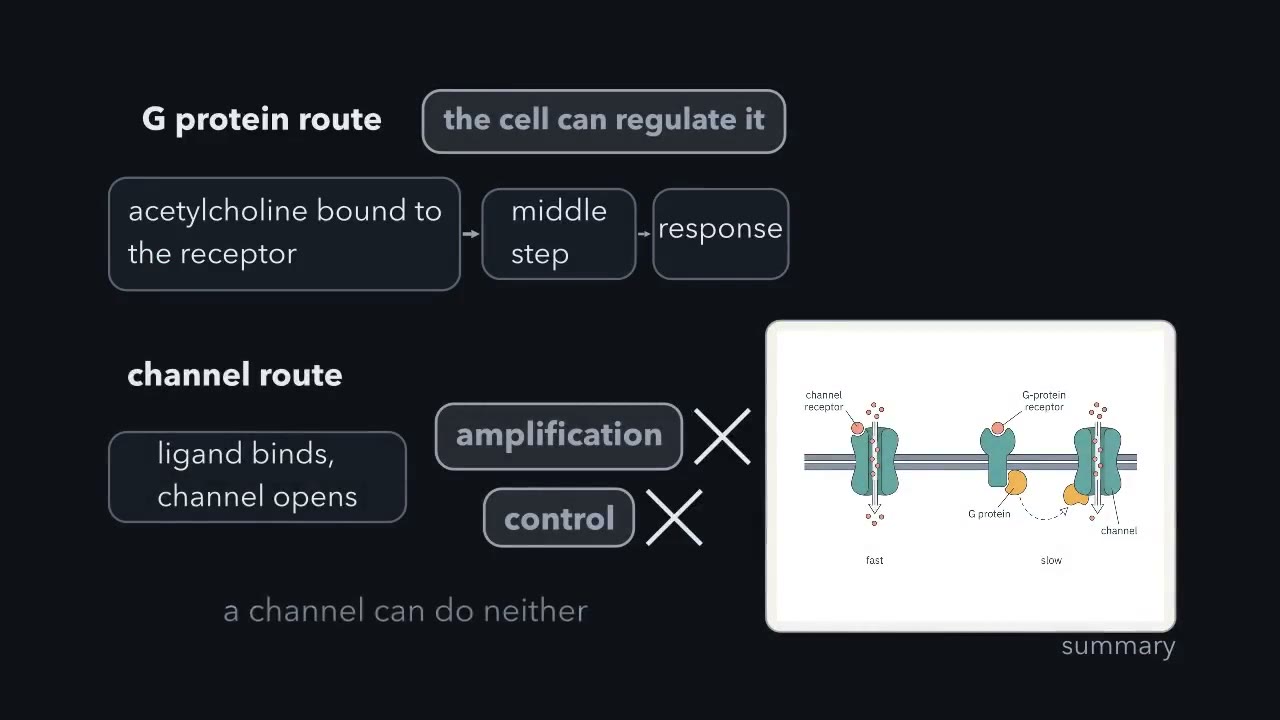
Four receptor designs sorted by speed: acetylcholine opens a channel in muscle, slows heart.
Cell Signaling · about 25 min · film 2:31 · 3 practice questions
Next door
- Ion channels: Open a Hole, Spend the Gradient · 3:31 Some receptors are themselves channels that open when the signal binds, as at a fast synapse.
- Sensory transduction: Nothing in Between, or Enzymes in Between · 2:41 Sensory cells use receptors to turn light, odour or touch into an electrical change.
- Nuclear receptors: One Protein, Two Grips: How Nuclear Receptors Wait · 3:21 Some receptors sit inside the cell and switch genes on directly once the hormone reaches them.
More films from this lesson
Continue in the lesson: A Field Guide to Receptors →
Free, with captions and a transcript. The lesson has the full text, the questions and the sources.
How this film was made. Narration: an AI narrator voice (Kokoro, af_heart) reading narration written from this lesson's text. Animation: AI-generated in code (Manim) by Claude, a schematic with no drawn molecular structures. Captions come from the narration script. See something wrong? Report it.