Nothing in Between, or Enzymes in Between
Read the transcript of “Nothing in Between, or Enzymes in Between”
Film transcript: Nothing in Between, or Enzymes in Between
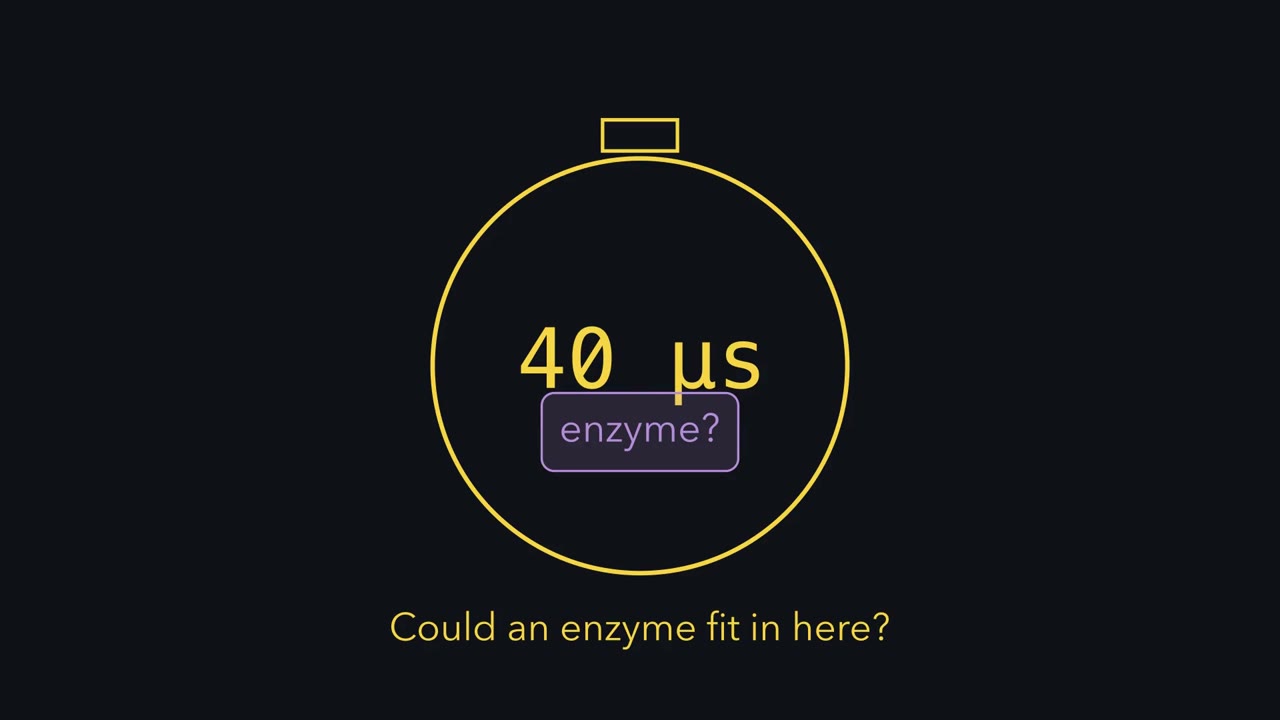
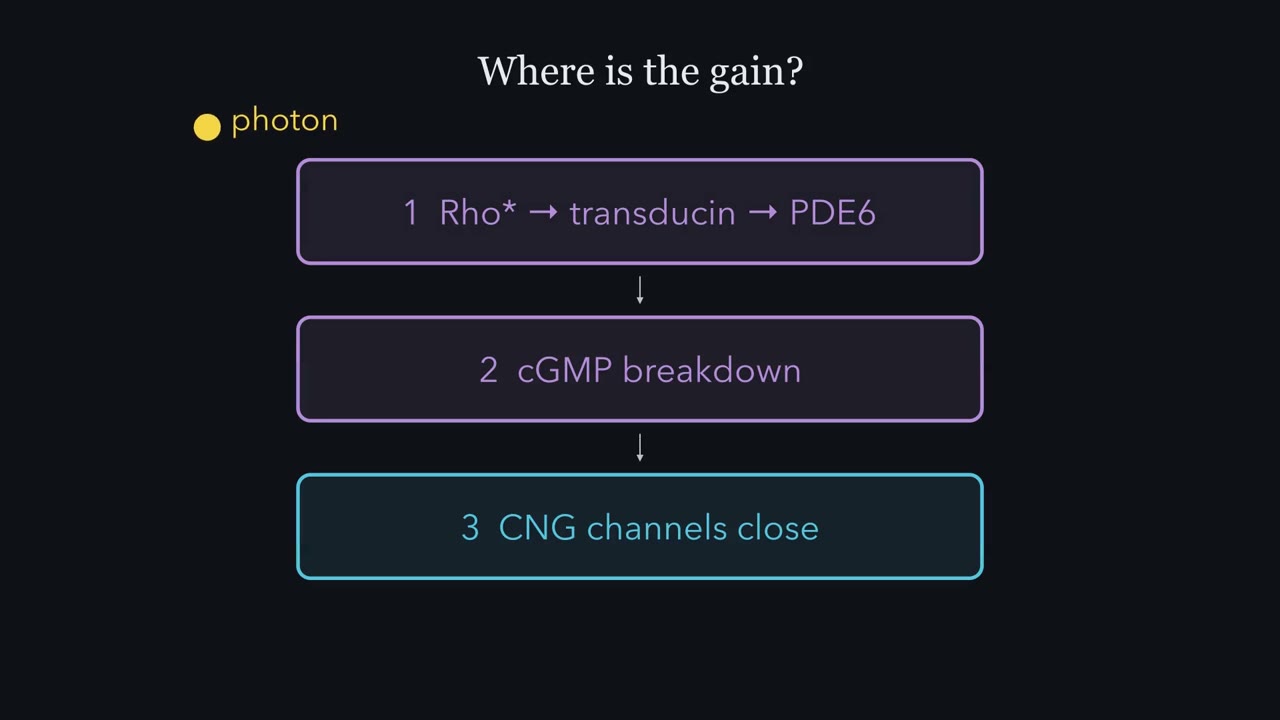
Why would a sensory cell accept being slow? A hair cell and a rod hold the answer. Every sensory cell turns a stimulus into a current. So the first question is what sits between the stimulus and the pore. In a hair cell, no enzyme. Bending the bundle pulls on tip links, and the pull opens transduction channels directly. In turtle hair cells, these channels can activate with a time constant as short as about 50 microseconds. In a rod, there is a ladder of enzymes. Light activates rhodopsin, then transducin, then PDE6. PDE6 breaks down cyclic GMP. Channels close, less positive charge enters, and the rod hyperpolarizes. A mouse rod's response to a single photon takes of order a tenth of a second or more to peak.
On one time axis, the two sit more than three orders of magnitude apart. But one is a channel time constant, and the other a whole cell's time to peak. Read the gap as scale. Predict. What does the rod get in return for being slow?
Gain. Enzymes keep working while active. In mouse rods, one absorbed photon removes about 2,000 cyclic GMP molecules. That is one reason a rod can signal a single photon. Low dark noise and a reproducible response are needed too. A direct channel has no enzyme cascade before the current. Force acts on the channel complex itself. The rod's price is time. Molecules must meet, and enzymes must turn over, before any channel changes. That is the one idea of this lesson. What sits between stimulus and pore sets what a sensory cell can do. The second question is how the signal leaves the cell. An olfactory neuron carries it on its own axon. A hair cell or a type II taste cell hands it to a separate afferent fibre instead.
Together, the two questions make a table of four boxes, and five examples fill it. Rods and cones do not fit neatly. They synapse inside the retina and send no axon to the brain. So ask two questions of every sensory cell. What sits between stimulus and pore? And how does the signal leave?
In turtle hair cells, transduction channels can activate with a time constant as short as about 50 microseconds. A rod's response to one photon takes of order a tenth of a second or more to peak, yet the rod can report that single photon. Why would a sensory cell accept being slow, and what exactly does a quoted speed measure?
Continue in the lesson: Five Ways to Turn a Stimulus into a Current →
2:41 · Free, with captions and a transcript. The lesson has the full text, the questions and the sources.
More films from this lesson
How this film was made. Narration: an AI narrator voice (Kokoro, af_heart) reading narration written from this lesson's text. Animation: AI-generated in code (Manim) by Claude, a schematic with no drawn molecular structures. Captions come from the narration script. See something wrong? Report it.