Press play to start at .
Who Winds the Spring?
From the film
- The oxidation of two carbons from aldehyde level to acid level releases about 50 kJ/mol, the main energy source.
- Storing the acetyl group as a thioester instead of free acetate costs about 31 of those 50.
- What is left, together with about 14 from losing CO2, gives about -33 kJ/mol overall and makes the gate one-way.
- Hydrolyzing acetyl-CoA releases about 31 kJ/mol, roughly as much as ATP, against about 21 for an oxygen ester.
- That is not energy stored in the bond: sulfur overlaps the carbonyl carbon poorly, so the thioester is poorly stabilized and its products are much more stable.
Read the transcript of “Who Winds the Spring?”
Film transcript: Who Winds the Spring?
Tap a sentence to play from there.
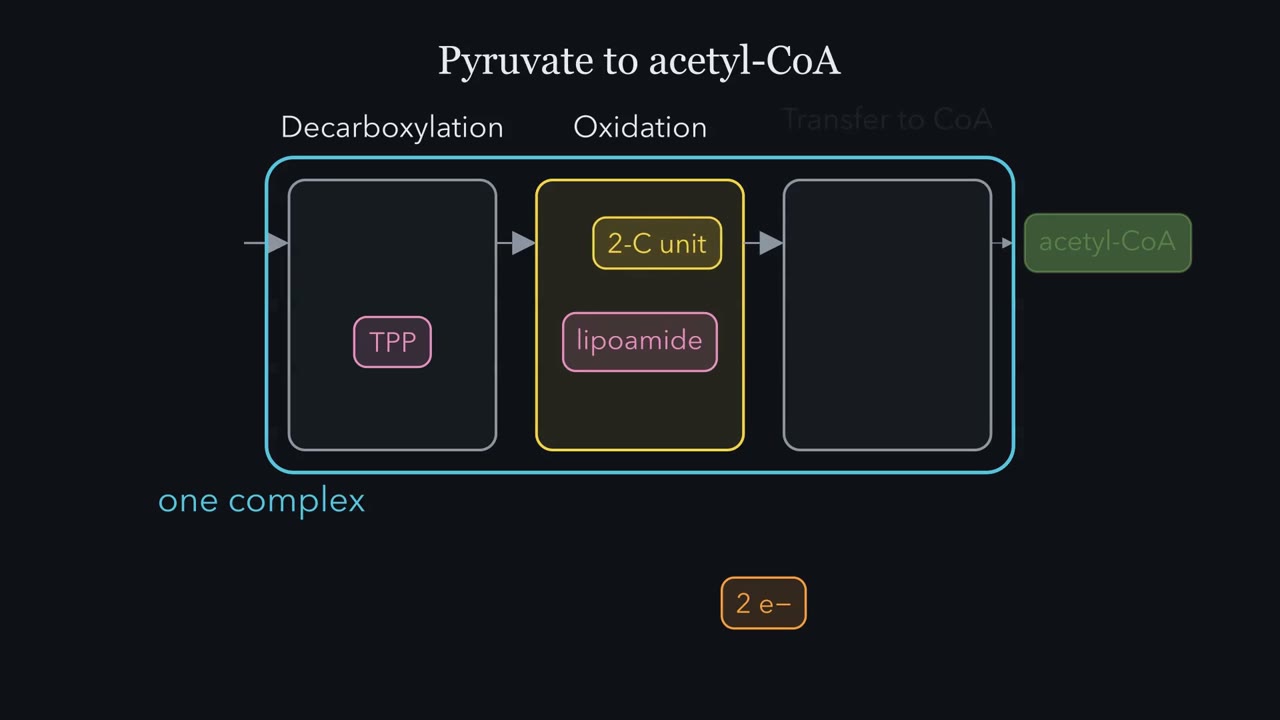
- 0:00 Last time, one pyruvate entered a swinging-arm complex and left as acetyl-CoA, carbon dioxide and NADH.
- 0:09 That acetyl-CoA leaves as a wound spring.
- 0:13 Yet no ATP went in.
- 0:16 So who wound it?
- 0:20 To find out, keep the energy books.
- 0:24 Pyruvate starts at zero, in kilojoules per mole.
- 0:28 Downhill releases energy, and uphill spends it.
- 0:31 We list three entries, not in the order they happen.
- 0:35 First entry: the oxidation.
- 0:38 Two carbons go from aldehyde level to acid level.
- 0:43 Their electrons end on NAD⁺.
- 0:46 That falls about 50 kJ/mol.
- 0:50 Second entry: the acetyl group is stored as a thioester on coenzyme A, not set free as acetate. That costs about 31, uphill.
- 1:01 It spends most of the oxidation's 50.
- 1:04 Third entry: carbon dioxide leaves, about 14 more downhill.
- 1:10 That one is found by difference, so it is approximate.
- 1:14 Add them up: minus −50, plus +31, minus −14.
- 1:18 About minus −33 overall.
- 1:21 So here is the answer.
- 1:24 The oxidation is the main energy source.
- 1:28 It pays for the NADH and for the thioester.
- 1:32 What is left, together with losing carbon dioxide, makes the gate one-way.
- 1:37 How one-way? A drop of about 33 gives an equilibrium constant near 4 × 10⁵ at body temperature. In practice, the reaction runs only forward.
- 1:51 In animals, no enzyme runs it backward.
- 1:55 Now look at the spring itself.
- 1:58 Picture two esters: an ordinary one, joined through oxygen, and this one, joined through sulfur. Split each with water.
- 2:07 Which releases more energy?
- 2:14 The sulfur one. The oxygen ester gives about 21.
- 2:20 The thioester gives about 31, roughly matching ATP's 30.5.
- 2:26 That is the same 31 the oxidation paid to build it.
- 2:31 Why? Not because energy hides in the bond.
- 2:36 Breaking a bond always costs energy.
- 2:40 Sulfur is larger than oxygen, so it overlaps the carbonyl carbon poorly.
- 2:45 The thioester gets little resonance help.
- 2:49 Its products, acetate and free coenzyme A, are much more stable.
- 2:54 The thioester is a boulder perched on a cliff.
- 2:58 So no ATP wound the spring.
- 3:02 Oxidizing two carbons one notch further did, and it paid for the NADH too.
- 3:08 Acetyl-CoA carries that push into the citric acid cycle's first step, and into fatty-acid synthesis.
- 3:15 What remained keeps the traffic one-way.
Cellular respiration: the same idea, other levels
A level is a place to start, not a rank. If this loses you, the rung below teaches the same idea, told more simply.
College, upper level · the level you chose
Metabolism: Basic Concepts and Design
Steak, potato and olive oil all funnel into acetyl-CoA, loading NADH and FADH₂.
Biochemistry · about 27 min · 3 practice questions
Glycolysis: The Investment-and-Payoff Pathway
All ten steps of splitting glucose, and why the cell spends ATP first.
Biochemistry · about 25 min · film 2:37 · 17 practice questions
The Pyruvate Dehydrogenase Complex: The One-Way Gate to the Cycle · this lesson
One machine, three enzymes, five coenzymes: pyruvate to acetyl-CoA, CO₂ and NADH.
Biochemistry · about 31 min · film 3:04 · 3 practice questions
The Citric Acid Cycle: Harvesting Electrons
The cycle makes almost no ATP; its real product is electrons.
Biochemistry · about 25 min · film 3:31 · 3 practice questions
Oxidative Phosphorylation: The Electron-Transport Chain
Electrons fall to oxygen, pump protons, and the gradient makes the ATP.
Biochemistry · about 24 min · film 3:54 · 5 practice questions
High school · the level you chose
Glucose and oxygen become carbon dioxide and water, rebuilding about 30 ATP per glucose.
Biology · about 40 min · film 3:15 · Virginia BIO.2e
Play the ladder · 9 films, about 30 min, from grade 7 to upper-level college. Each film waits for you to press play.
Next door
- Photosynthesis: Why One Photon Is Not Enough · 3:18 Photosynthesis stores the energy that respiration later releases.
- Enzymes: Lower the Ridge, Not the Valleys · 3:18 Every step of respiration is run by its own enzyme.
- Organelles: Where the Volume Goes · 3:15 · College: the core Most of it happens in one organelle, the mitochondrion.
- Blood sugar control: How the body switches fuels · 2:32 Glucose has to reach the cell before the cell can use it.
More films from this lesson
Continue in the lesson: The Pyruvate Dehydrogenase Complex: The One-Way Gate to the Cycle →
Free, with captions and a transcript. The lesson has the full text, the questions and the sources.
How this film was made. Narration: an AI narrator voice (Kokoro, af_heart) reading narration written from this lesson's text. Animation: AI-generated in code (Manim) by Claude, a schematic with no drawn molecular structures. Captions come from the narration script. See something wrong? Report it.