Where the Volume Goes
Read the transcript of “Where the Volume Goes”
Film transcript: Where the Volume Goes
A cell looks like one bag. But where does all its volume go? Chapter one followed amount over volume as a yeast cell grew. Now ask what share each compartment takes, and whether that share holds during growth. A membrane-bound compartment is a region enclosed by a membrane. The nucleus, which holds most of the DNA, is one.
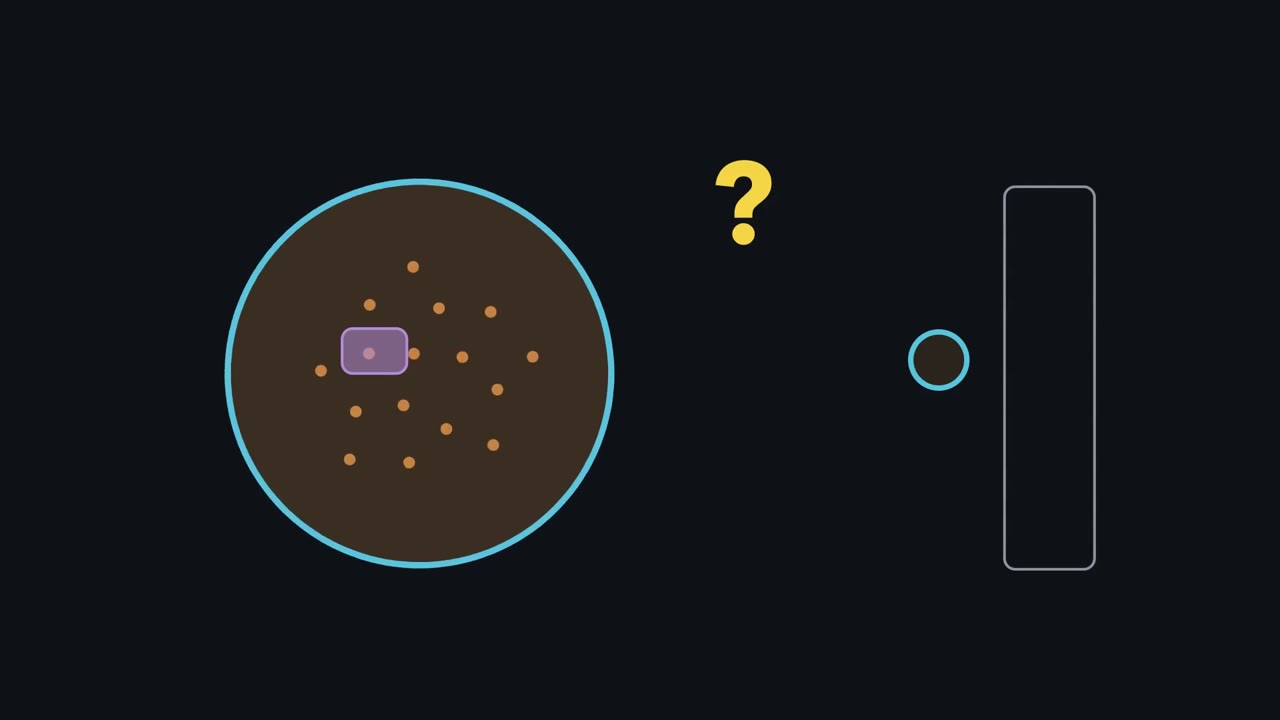
Divide its volume by the cell's, and you get its share. Here is one carefully measured cell line: hamster V79, growing in a dish. The nucleus fills about 27% % of the cell. Mitochondria, another compartment, fill about 5%. Now a fission yeast, a rod that grows at its ends. Its nucleus is about 8%. percent. In this yeast, the nucleus grows with the cell, so its share holds as the cell grows. Two careful measurements, two very different answers. So which number is the nuclear share of a cell: 27%, % or 8%? Pause and decide.
Both, each for its own cell. There is no universal nuclear fraction. A share means something only with its cell type attached, so carry the cell type with every number. One question stays open. Does the nucleus follow the DNA inside it, or the cell around it? The design problem below lets you test it.
Plant cells change their shares as they grow. Take the outer layer of a root in Arabidopsis, a small lab plant. In young cells, the vacuole fills about 30 to 40%. percent. As the cells lengthen, vacuolar occupancy rises to about 80 to 90%. percent. Across the comparison, cell volume is about 14-fold greater. But space outside the vacuole is only about two- to threefold greater. Most of the added cell volume is vacuolar. The smaller rise outside it requires relatively little new RNA and protein. This can ease a biosynthetic cost of being big.
Which cells have which parts? Animal, plant and fungal cells share a plasma membrane, nucleus, mitochondria, ER, Golgi, and cytoskeleton. For these core parts, focus on three differences: walls, plastids, and vacuoles. A root cell deep in soil usually has plastids, but no chloroplasts. Fission yeast keeps its nuclear share as it grows.
Shares are cell-specific; elongating Arabidopsis root cells add mostly vacuolar volume.
A cell has no ruler, so how does it know its size, and what does being big cost it?
Continue in the lesson: Cells Control Their Size: A Measured Eukaryotic Cell →
3:15 · Free, with captions and a transcript. The lesson has the full text, the questions and the sources.
More films from this lesson
How this film was made. Narration: an AI narrator voice (Kokoro, af_heart) reading narration written from this lesson's text. Animation: AI-generated in code (Manim) by Claude, a schematic with no drawn molecular structures. Captions come from the narration script. See something wrong? Report it.