Press play to start at .
Why Animal Pathways Rewire Cheaply
From the film
- Modular domains, short motifs, and regulatory DNA make new wiring cheap.
- Unlike a bacterial two-component relay's short-lived aspartate phosphate, a lasting phosphotyrosine lets separate SH2 reader domains dock and branch the signal.
- Moving an interaction domain, mutating one or two residues next to a tyrosine, or shifting regulatory DNA can rewire a receptor in a few steps.
- Single-celled choanoflagellates carry tyrosine kinases, phosphatases and SH2 domains without Wnt or TGF-beta, so the tyrosine kit predates animals.
Read the transcript of “Why Animal Pathways Rewire Cheaply”
Film transcript: Why Animal Pathways Rewire Cheaply
Tap a sentence to play from there.
- 0:02 In the first film, duplication multiplied animal receptors over a shared core.
- 0:09 How does a copied receptor plug into a new pathway without inventing a new enzyme?
- 0:15 Start with a simpler design.
- 0:18 Many bacteria use a two-component relay.
- 0:22 A membrane sensor kinase takes one phosphate from ATP and puts it on its own histidine. Its partner responder moves that phosphate onto its own aspartate, flipping its shape to switch genes on.
- 0:36 The sensor's enzyme has a different fold from animal kinases, and animals lack this system.
- 0:43 Notice that mark. A phosphate on aspartate is short-lived.
- 0:49 The responder itself helps shed it, within seconds for some, minutes or more for others. It changes only that responder.
- 0:59 On an animal receptor tail, a phosphate on tyrosine stays until a phosphatase removes it. What new kind of connection does a lasting mark allow?
- 1:15 Because the mark stays put, it acts as a docking tag.
- 1:19 Separate reader pieces, like SH2 domains, bind the marked tyrosine and recruit downstream pathways.
- 1:27 One receptor can hold several marks and launch several branches at once.
- 1:33 Modular parts make rewiring cheap in three ways.
- 1:37 A domain is a folded piece of protein that works on its own.
- 1:42 First, moving an SH2 domain onto another protein builds a new link in one step.
- 1:49 Second, mutating one or two amino acids beside a tyrosine builds a new docking site.
- 1:55 Third, regulatory DNA is a short stretch, usually near a gene, that decides which cells build it. Changing it puts an unchanged receptor into a new tissue with different targets.
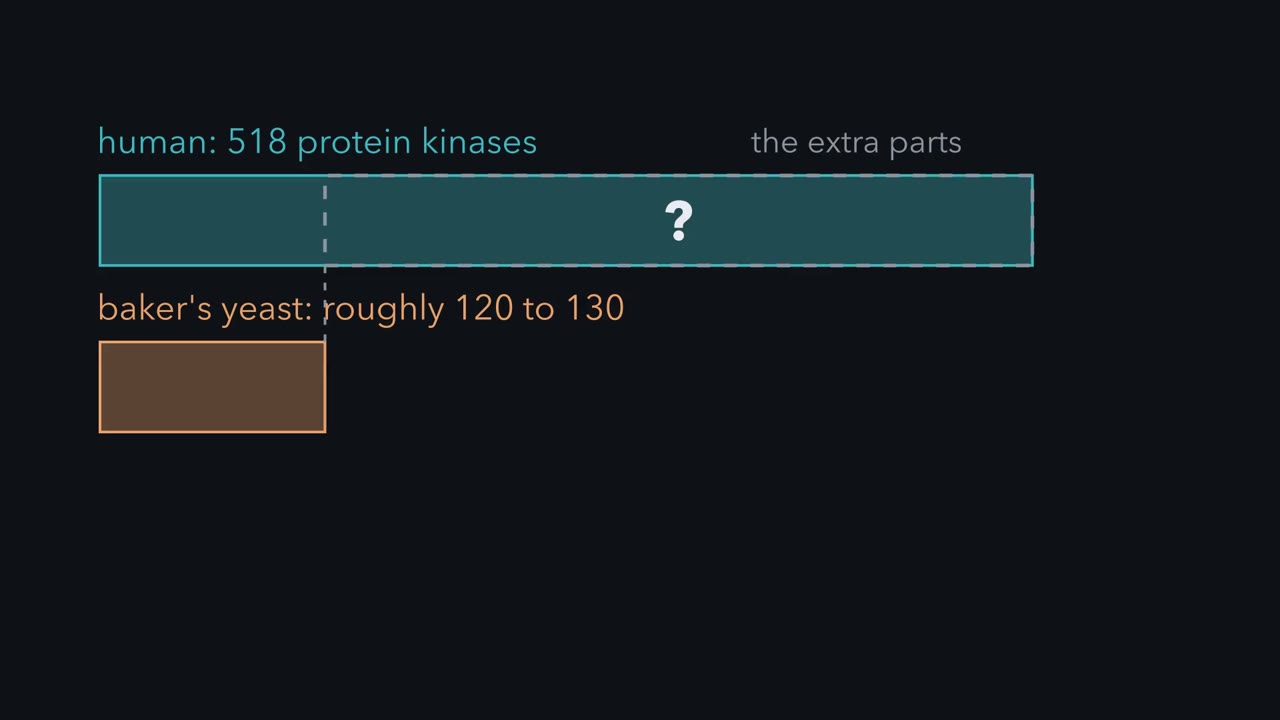
- 2:09 Genome counts match: budding yeast has one SH2 protein, while humans carry over a hundred.
- 2:16 When did this tyrosine toolkit appear?
- 2:20 Look at a choanoflagellate, the closest living single-celled relative of animals.
- 2:26 It carries 128 tyrosine kinases to our 90, plus tyrosine phosphatases and SH2 domains. Yet it lacks recognisable genes for pathways like TGF-beta.
- 2:40 Parts shared by animals and their closest relative were likely in their common ancestor, so the kit predates animals.
- 2:49 Its job in one cell is largely unknown.
- 2:52 Rewiring copied receptors into shared hubs builds a network rather than separate wires. If one receptor fails, sisters made in the same cells can cover part of the loss. Hubs buy robustness, but they bring clinical costs too.
- 3:10 Modular domains, short motifs, and regulatory DNA make new wiring cheap.
Two-component systems: the same idea, other levels
A level is a place to start, not a rank. If this loses you, the rung below teaches the same idea, told more simply.
Graduate · the level you chose
How Signaling Evolved · this lesson
A sensor kinase passes one phosphate to a partner protein: the simplest relay.
Cell Signaling · about 23 min · 3 practice questions
Next door
- Bacteria: Microbes, Protists and Fungi · Starting college Bacteria use these sensors to detect food, toxins and crowding in their surroundings.
- Antibiotic resistance: The Few That Survive · 3:12 · High school Some bacteria use these relays to sense an antibiotic and switch on defence genes.
- Protein phosphorylation: The Charge That Changes the Odds · 3:35 The relay passes a phosphate from one protein to the next, and phosphate removal ends the signal.
More films from this lesson
Continue in the lesson: How Signaling Evolved →
Free, with captions and a transcript. The lesson has the full text, the questions and the sources.
How this film was made. Narration: an AI narrator voice (Kokoro, af_heart) reading narration written from this lesson's text. Animation: AI-generated in code (Manim) by Claude, a schematic with no drawn molecular structures. Captions come from the narration script. See something wrong? Report it.