The Charge That Changes the Odds
Read the transcript of “The Charge That Changes the Odds”
Film transcript: The Charge That Changes the Odds
How can a small mark change what a protein does without rebuilding it? Watch this population of protein copies. Each copy flickers among shapes, and those shapes make different contacts. The cell will change the odds, not manufacture a replacement. That is faster than waiting to make new protein.
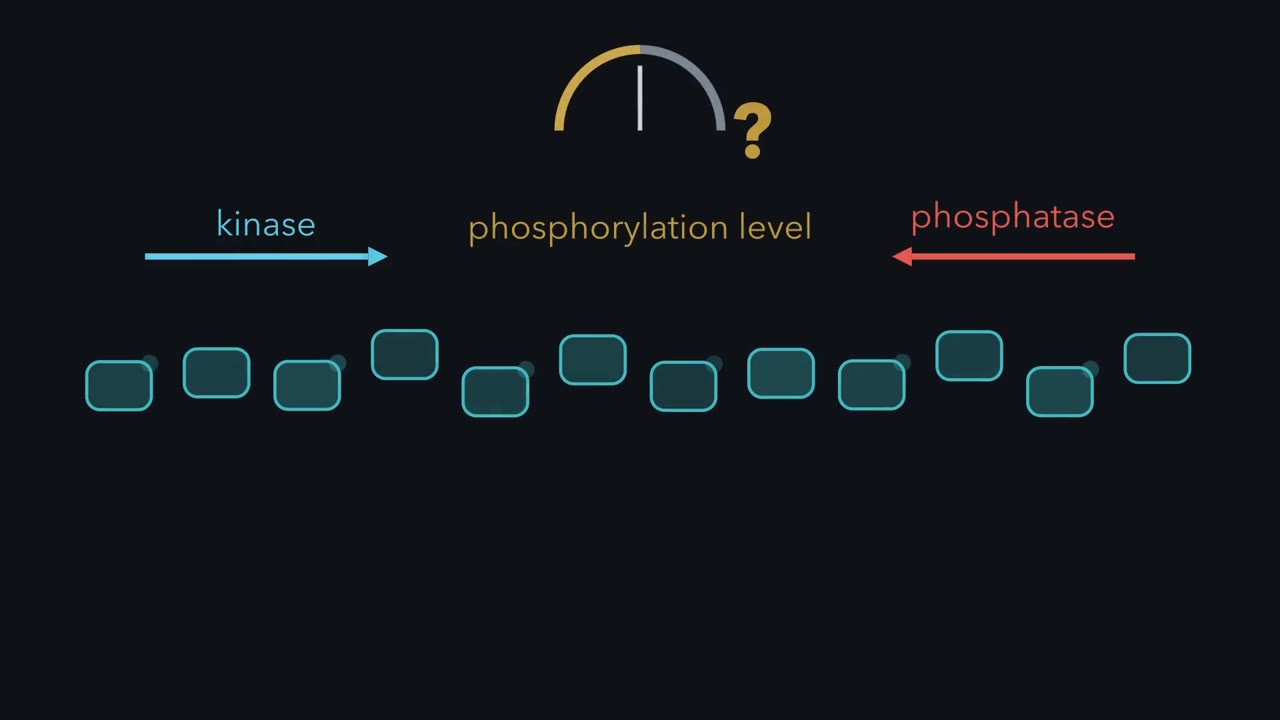
A kinase brings ATP beside a hydroxyl-bearing site on a protein. The kinase transfers the end phosphate, leaving ADP. In animal signaling, the best-studied targets are serine, threonine, and tyrosine. The protein remains the same chain, but its local chemistry has changed. This attachment is a reversible covalent modification. Near neutral pH, the attached phosphate carries a strong negative charge. Put that charge among the protein's other charges. Attractions strengthen in some arrangements and weaken in others. The population shifts toward shapes and contacts that accommodate the new charge.
Partners can also read the phosphate's shape. Phosphate changes probabilities; it does not issue a universal command. Here is your prediction. If the chemical mark is always the same, must phosphorylation always activate its target protein?
Phosphorylation shifts glycogen phosphorylase toward activity. It inhibits glycogen synthase, which builds glycogen. The direction depends on the protein and the site. The same charge can favor a different shape or disrupt a different contact. Sometimes the important change is a contact, not catalytic activity. A partner can recognize the phosphorylated surface and dock. Elsewhere, the mark can expose or hide a location signal. A phosphate can also prepare a nearby site for another kinase. These are different outcomes of the same physical change. The mark lasts until an enzyme removes it. A phosphatase uses water to release inorganic phosphate and restore the unmodified site. It does not reverse the kinase reaction or remake ATP.
Writing and erasing are separate reactions, controlled by separate enzymes. A complete trip spends an ATP molecule. That separation makes the mark both stable and reversible. ATP is plentiful enough that a kinase rarely waits for its donor. The phosphate persists without an eraser, yet can disappear quickly when a phosphatase acts. Cells can therefore alter existing proteins faster than rebuilding the whole population. Carry this rule into every case. Ask where the phosphate appears, which shapes or partners it favors, and what removal restores. The outcome may be activity, inhibition, docking, movement, or priming. The common cause is a stable phosphate, read through its charge and shape, that an enzyme can erase.
How can one small chemical mark change what a protein does without rebuilding it?
Continue in the lesson: Phosphorylation: Kinases and Phosphatases →
3:35 · Free, with captions and a transcript. The lesson has the full text, the questions and the sources.
More films from this lesson
How this film was made. Narration: written from this lesson's text and read by an AI narrator voice (Kokoro, af_heart). Animation: AI-generated in code (Manim) by Claude, a schematic with no drawn molecular structures. Captions come from the narration script. See something wrong? Report it.