Press play to start at .
Putting the Tool in One Cell Type
From the film
- Promoters and recombinases place each tool in chosen cells.
- In a transgene, the promoter decides where and when a gene is read, and the coding sequence decides what is made.
- Cre turns a gene on by cutting out a stop block between two same-direction loxP sites, and the cut is permanent across descendants.
- Because brief early Cre expression can cut DNA elsewhere, every Cre line must be checked with a reporter; adding Flp lets you address a second cell type.
Read the transcript of “Putting the Tool in One Cell Type”
Film transcript: Putting the Tool in One Cell Type
Tap a sentence to play from there.
- 0:02 In the first film, you met a glowing reporter and a light-gated actuator.
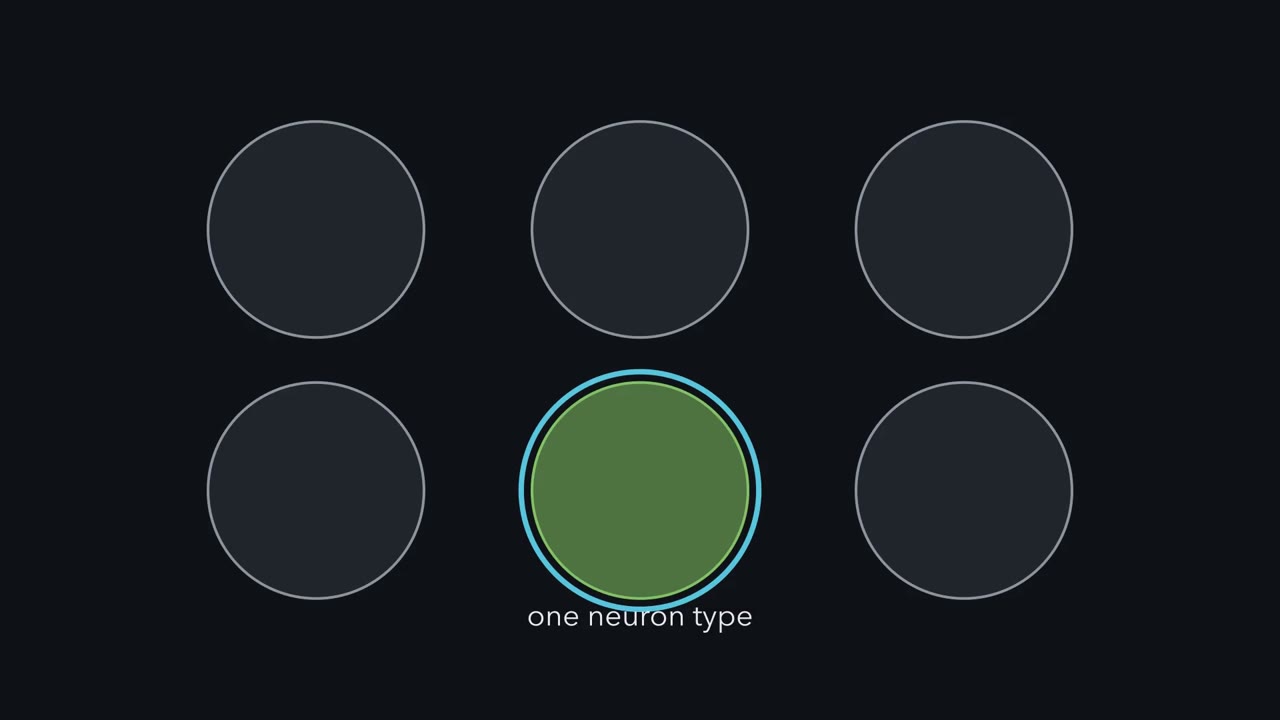
- 0:08 In a brain with billions of cells, how do you put them into one chosen cell type?
- 0:14 Almost every cell holds the same chromosomes, so control comes from where a gene is read.
- 0:20 Start with a transgene, a piece of engineered DNA added to a fertilized egg.
- 0:27 Every transgene pairs two parts.
- 0:30 The promoter decides where and when a gene runs.
- 0:34 The coding sequence decides which protein the cell builds.
- 0:38 Pair a promoter active in every cell with the green fluorescent protein gene.
- 0:44 Every cell reads it, and you get a glowing green mouse.
- 0:48 That proves a transgene works, yet every neuron lights up at once.
- 0:53 You still cannot isolate one cell type.
- 0:56 To target one cell type cleanly, split the job across two genes.
- 1:02 Put your reporter behind a strong promoter, then block it with a stop signal that halts reading. Flank that stop block with two short tags called loxP, pointing the same way. With the stop intact, every cell stays dark.
- 1:18 Now bring in a recombinase called Cre, an enzyme from a bacterial virus.
- 1:24 A recombinase cuts and rejoins DNA, and Cre does it at loxP sites.
- 1:30 Here is the twist.
- 1:32 Cre turns a gene on by deleting DNA.
- 1:36 It cuts out the stop block, clears the roadblock, and lets the cell build the tool.
- 1:41 So which cells make Cre?
- 1:44 Place the Cre gene behind a promoter active mainly in neuron type A. Type A makes Cre, snips out the stop, and lights up green.
- 1:54 Neighboring cells never make Cre, keep their stop blocks, and stay dark.
- 1:59 Pause here for a key consequence.
- 2:02 Cre removed that stop block from neuron A's chromosome for good.
- 2:07 Suppose that cell later divides, and its daughter cells stop making Cre.
- 2:12 Do those daughter cells still make the glowing reporter?
- 2:21 Yes, they do. Because the stop block is gone from the chromosome, every descendant inherits the unlocked gene.
- 2:31 That permanent mark lets biologists trace cell lineages.
- 2:35 Yet it carries a catch.
- 2:38 Brief early Cre activity can unlock unintended cells too, so check every Cre line with a reporter.
- 2:45 Need a second tool in neuron type B?
- 2:48 Add Flp, a yeast enzyme that cuts only its own sites.
- 2:53 Drive Cre in type A and Flp in type B, and each unlocks its own tool cleanly.
- 2:59 Promoters and recombinases place each tool in chosen cells.
Knockout mice: the same idea, other levels
A level is a place to start, not a rank. If this loses you, the rung below teaches the same idea, told more simply.
Graduate · the level you chose
Hacking the Cell: Reporters, Actuators and Genetic Tools · this lesson
Transgenes, knock-ins and Cre at loxP put a tool into one cell type.
Cell Signaling · about 19 min · film 3:24 · 3 practice questions
Tools for Following Cells and Genes
Cre cuts a floxed gene only where it runs; reporter light is not deletion.
Developmental Neuroscience · about 26 min · film 3:11 · 3 practice questions
Next door
- Forward, reverse genetics: Which Way Do You Run Genetics? · 3:34 · College: the core Knocking out a chosen gene to see what changes is reverse genetics, done in a whole animal.
- Genetic engineering: From DNA Fragment to Verified Clone · 3:39 · College: the core Adding, removing or changing a gene in a mouse uses the same cutting and joining tools as other gene editing.
- Lineage tracing: What Can a Label Prove? · 3:21 Cre and lox can switch on a lasting mark in chosen cells, so their descendants can be followed.
- Remove and rescue: Where the Twins Disagree · 3:51 · College: the core Putting the gene back into a knockout mouse tests whether the missing gene caused the effect.
More films from this lesson
Continue in the lesson: Hacking the Cell: Reporters, Actuators and Genetic Tools →
Free, with captions and a transcript. The lesson has the full text, the questions and the sources.
How this film was made. Narration: an AI narrator voice (Kokoro, af_heart) reading narration written from this lesson's text. Animation: AI-generated in code (Manim) by Claude, a schematic with no drawn molecular structures. Captions come from the narration script. See something wrong? Report it.