Where the Twins Disagree
Read the transcript of “Where the Twins Disagree”
Film transcript: Where the Twins Disagree
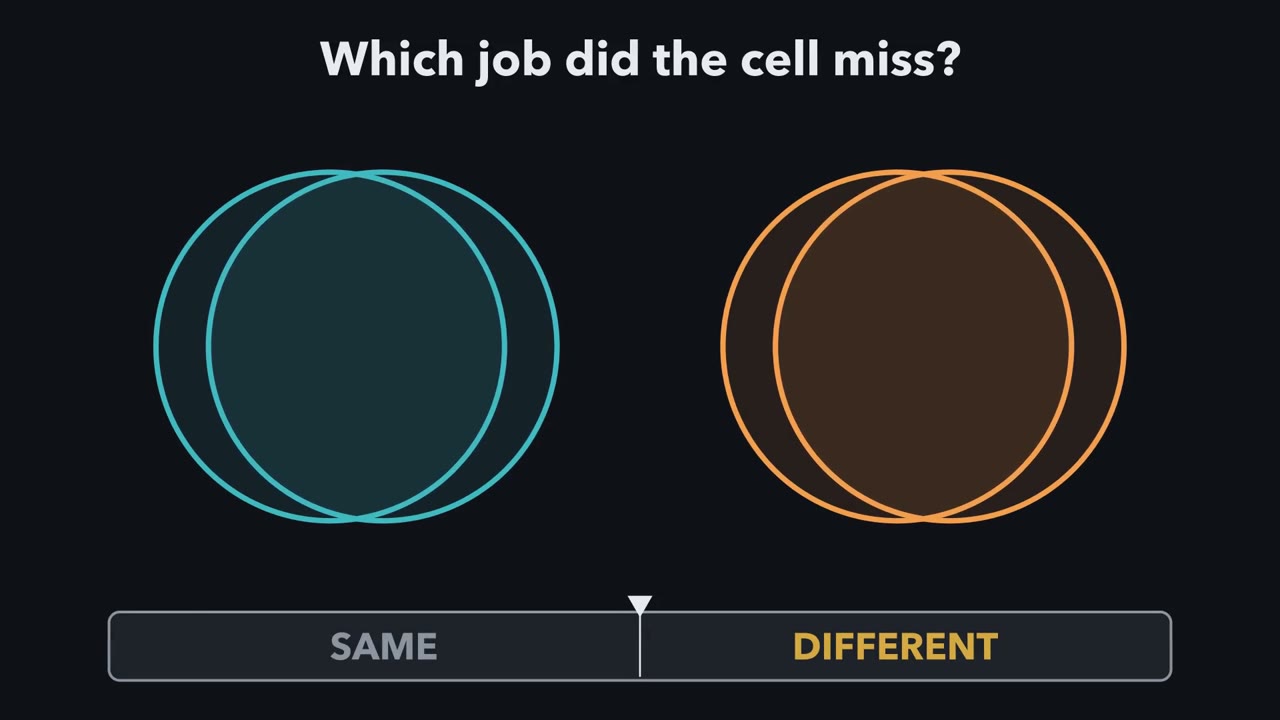
This protein sits in the right place, at the right time. Does that tell you what it does? Here are two possible answers, each true in its own cell. Call the cells twins: identical, except each has a different model built in. Every experiment runs on both at once. Here is the rule: a result can choose only where the twins disagree. First question: where does the protein live?
Model one, in the teal twin: in lysosomes. Model two, in the orange twin: in mitochondria. Break both cells open and spin the pieces, at rising speeds, into five tubes. Test one. Is the protein enriched in tube L, more concentrated than in the starting mix? In the teal twin, yes. In the orange twin, also yes: tube L holds plenty of mitochondria. This test cannot choose. Test two reads all five tubes. Each bar is the protein's share in one tube. Two faint tracks show where the lysosome marker and the mitochondrial marker went. If the protein is lysosomal, which track should it trace?
Here the twins disagree. In the lesson's made-up data, the protein follows the lysosome track across all five tubes. A whole profile is stronger evidence than one peak, though still not proof. Tube L leans toward lysosomes, but leaning is not purity. So what is tube L mostly made of? Hold that question. Second question: in what order does a protein visit the compartments? Tag one batch and watch. In the teal twin, carriers ferry it between fixed Golgi compartments. In the orange twin, each Golgi compartment itself matures. In both twins, the gold label lights the E R, then the Golgi, then the granules. The order alone cannot choose. Other tests can.
Third question: does the protein cause what you see? A drug stops these cancer cells growing. It was built to block one kinase, an enzyme that adds phosphate to proteins. The curve shows growth falling as the dose rises. Now take the kinase out of both twins. The cells still grow. Give the drug again. In this two-model cartoon, a drug acting only through that kinase shifts the curve right, to higher doses. One acting only through another target leaves it put. Mixed effects fall between. The measured curve barely moves.
Cells without that kinase are stopped by about the same dose. So in these assays, the drug acts mainly through other targets. Now silence the protein's message, its m R N A, with R N A interference, and the job fails. But other messages may be silenced too. So put the protein back, in a form the interference cannot touch. How can it be the same protein, yet escape? So: where does it live, in what order does it travel, does it cause the defect? Before any result, ask what each model predicts. Agreeing twins cannot choose.
Where does a protein live, in what order does it travel, and does it cause the defect you see? Each question is best answered by a different experiment, and a pellet named 'mitochondria' is never only mitochondria.
Continue in the lesson: Experiments That Distinguish Mechanisms →
3:48 · Free, with captions and a transcript. The lesson has the full text, the questions and the sources.
More films from this lesson
How this film was made. Narration: written from this lesson's text and read by an AI narrator voice (Kokoro, af_heart). Animation: AI-generated in code (Manim) by Claude, a schematic with no drawn molecular structures. Captions come from the narration script. See something wrong? Report it.