Press play to start at .
Empty, Busy, or Both
From the film
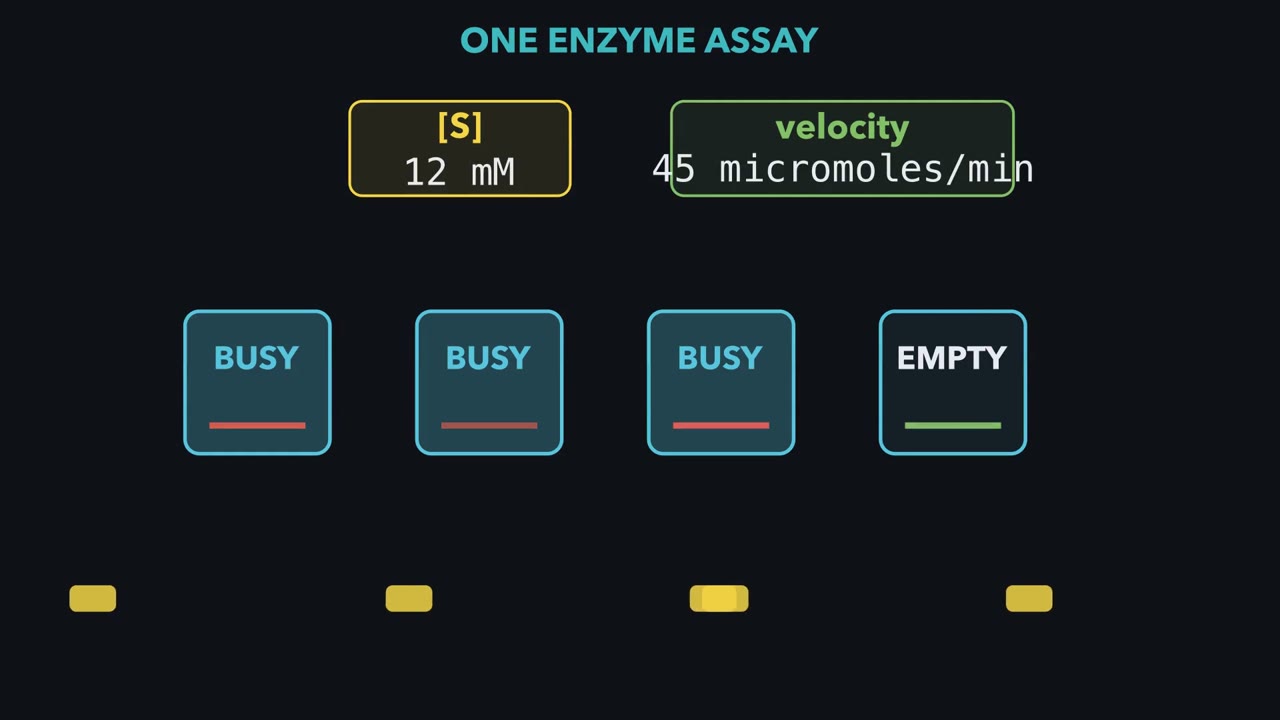
- A reversible inhibitor can tie up empty enzyme, busy enzyme, or both, and that choice sets its pattern.
- A competitive inhibitor grabs only empty enzyme: the apparent Km rises, but Vmax is unchanged.
- An uncompetitive inhibitor grabs only busy enzyme, so the apparent Km and Vmax fall by the same factor.
- A pure noncompetitive inhibitor grabs both equally, like having less enzyme: Vmax falls and Km is unchanged.
- Pure noncompetitive is a special case of mixed inhibition, where the apparent Km can rise or fall.
Read the transcript of “Empty, Busy, or Both”
Film transcript: Empty, Busy, or Both
Tap a sentence to play from there.
- 0:00 Last time, velocity was one busy enzyme's pace times how much enzyme was busy.
- 0:07 Now add an inhibitor.
- 0:09 Three kinds slow this same enzyme, yet each bends its curve a different way.
- 0:15 Why?
- 0:19 Every enzyme is either empty or busy.
- 0:23 A reversible inhibitor can tie up empty enzyme, busy enzyme, or both.
- 0:29 Tied-up enzyme makes no product.
- 0:32 Reversible means the inhibitor can come off again.
- 0:36 First, an inhibitor that grabs only empty enzyme, usually at the active site.
- 0:42 Substrate and inhibitor cannot bind at the same time.
- 0:46 This is competitive inhibition.
- 0:49 It now takes more substrate to make half the enzyme busy.
- 0:54 At this dose, the half-speed point moves from 4 mM to 12.
- 0:59 That is an apparent Km.
- 1:02 The enzyme's own Km has not changed.
- 1:05 At very high substrate, almost no empty enzyme is left to grab.
- 1:11 So Vmax stays 60.
- 1:13 Second, an inhibitor that grabs only busy enzyme, locking it mid-reaction as ESI.
- 1:20 This is uncompetitive inhibition.
- 1:24 By Le Chatelier's principle, pulling busy enzyme away draws more enzyme and substrate together.
- 1:30 So half the enzyme holds substrate at a lower concentration, and the apparent Km falls. But much of that enzyme is stuck, making nothing.
- 1:42 Vmax falls too. Here both fall threefold.
- 1:46 Here is the guiding idea.
- 1:49 An inhibitor's pattern is set by which enzyme it ties up: empty, busy, or both.
- 1:56 Each choice moves the half-speed point and the ceiling in its own way.
- 2:00 Now a third inhibitor binds a separate site.
- 2:04 It grabs empty and busy enzyme equally well.
- 2:08 At this dose, does the half-speed point move?
- 2:17 No. Taking the same share from empty and busy enzyme is like having less enzyme.
- 2:25 Vmax falls, here from 60 to 20.
- 2:28 Km stays at 4. This is pure noncompetitive inhibition.
- 2:34 Pure noncompetitive is a special case of mixed inhibition.
- 2:39 There, the inhibitor grips empty and busy enzyme with different strengths.
- 2:45 Vmax still falls, but the apparent Km can rise or fall.
- 2:50 So before reading an inhibited curve, ask what the inhibitor grabs.
- 2:55 Grabbing empty enzyme raises the half-speed point.
- 2:59 Grabbing busy enzyme lowers both values together.
- 3:03 Grabbing both equally just lowers the ceiling.
Enzymes: the same idea, other levels
A level is a place to start, not a rank. If this loses you, the rung below teaches the same idea, told more simply.
College, upper level · the level you chose
Basic Concepts of Enzyme Action
An enzyme lowers the hill, never the valleys: faster, with the same ending.
Biochemistry · about 25 min · film 3:18 · 5 practice questions
Enzyme Kinetics: The Michaelis–Menten Model · this lesson
Why doubling the substrate stops doubling the rate: Km and Vmax.
Biochemistry · about 29 min · film 3:36 · 7 practice questions
High school · the level you chose
Heat, pH and substrate each change the rate; pineapple and gelatin show how.
Biology · about 40 min · film 3:13 · Virginia BIO.2c
Play the ladder · 3 films, about 10 min, from high school to upper-level college. Each film waits for you to press play.
Next door
- Cellular respiration: Metabolism: Basic Concepts and Design Respiration is a long chain of enzyme-run steps.
- From gene to protein: The Strand Is Chosen at the Start · 3:31 · College: the core An enzyme is a protein, and a gene holds the order of its parts.
More films from this lesson
Continue in the lesson: Enzyme Kinetics: The Michaelis–Menten Model →
Free, with captions and a transcript. The lesson has the full text, the questions and the sources.
How this film was made. Narration: an AI narrator voice (Kokoro, af_heart) reading narration written from this lesson's text. Animation: AI-generated in code (Manim) by Claude, a schematic with no drawn molecular structures. Captions come from the narration script. See something wrong? Report it.