Count the Working Sites
Read the transcript of “Count the Working Sites”
Film transcript: Count the Working Sites
Drop a slice of raw potato into hydrogen peroxide, and it fizzes. Something in the potato does the work, so why is it never used up? Hydrogen peroxide breaks down alone, but slowly. The bubbles are oxygen gas. The worker is catalase, an enzyme found in potato cells, liver cells and many others. An enzyme is a molecule, almost always a protein, that speeds up a specific reaction. Follow one catalase. Its substrate, the molecule it acts on, is hydrogen peroxide. The substrate drifts into the active site, a small pocket on the enzyme. There it is turned into products, water and oxygen. The products leave, and the enzyme is unchanged. Then it takes in the next one, and the next.
The same enzyme works again and again. That makes it a catalyst, a substance that speeds up a reaction without being used up. Why does this pocket take only hydrogen peroxide? The active site's shape and electric charges fit only certain molecules.
So each enzyme usually speeds up one reaction, or a few similar ones. And why does fitting make the reaction faster? Picture a ball that must be pushed over a hill before it rolls down the other side. Activation energy is the energy needed to get a reaction started, like that hill. An enzyme does not add energy. It lowers the hill.
With a lower hill, many more molecules cross each second. The hill is a graph of energy, not a real place. Now pull back to eight active sites, one per block. Two things set how fast the tube makes products. First, how many active sites are working, still in the shape that fits. Second, the speed of each site: how much product it makes per second. The rate is the two multiplied together: working sites times the speed of each site. A site makes product only while a substrate sits in it. So temperature, pH and the amount of substrate each turn one dial, or both. Suppose one active site is bent out of shape, so the substrate no longer fits. What happens to the counter, and to the rate?
The counter drops to seven of eight. That site is not working, so the rate bar shrinks by an eighth. The other seven sites run just as fast as before. A site bent so far that the substrate no longer fits does not work slowly. It does not work at all. Anything that bends active sites out of shape lowers the count.
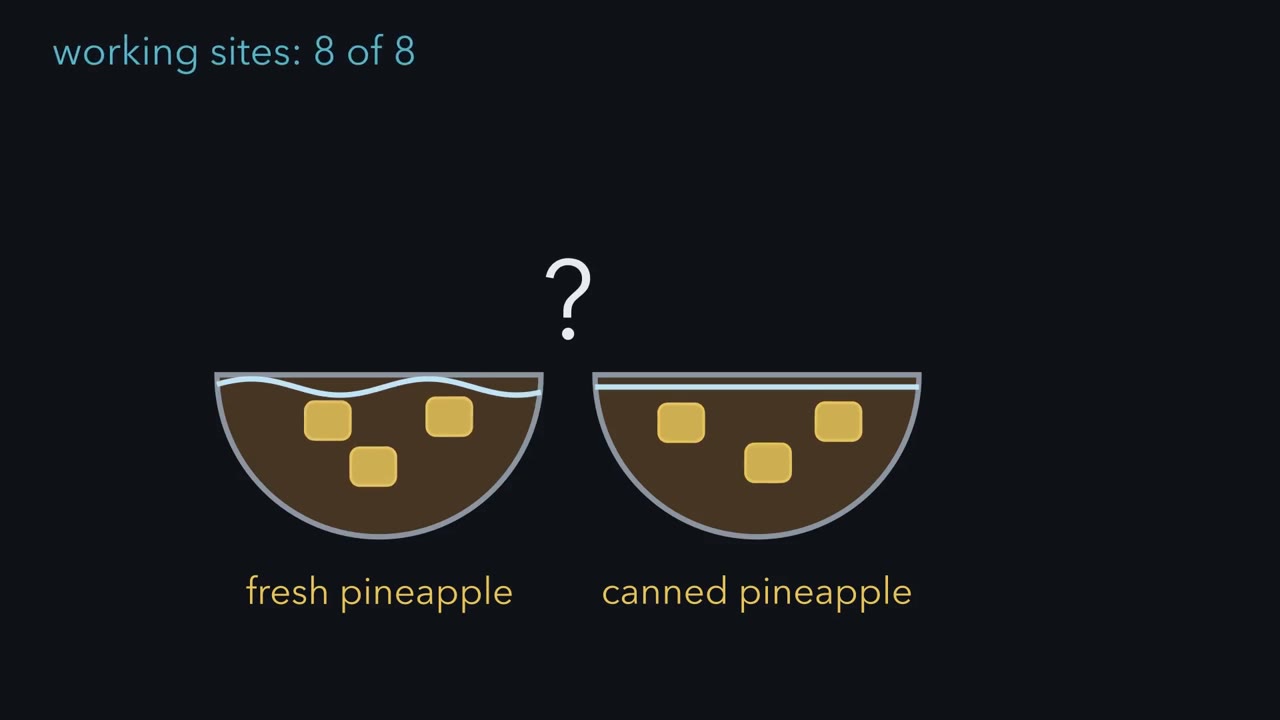
Why does fresh pineapple keep gelatin from setting, while canned pineapple lets it set?
Continue in the lesson: Enzymes at Work →
3:13 · Free, with captions and a transcript. The lesson has the full text, the questions and the sources.
More films from this lesson
How this film was made. Narration: written from this lesson's text and read by an AI narrator voice (Kokoro, af_heart). Animation: AI-generated in code (Manim) by Claude, a schematic with no drawn molecular structures. Captions come from the narration script. See something wrong? Report it.