Films · Genetics and Molecular Biology
The Strand Is Chosen at the Start
Read the transcript of “The Strand Is Chosen at the Start”
Film transcript: The Strand Is Chosen at the Start
Both DNA strands carry complementary information. How does a cell choose which strand the polymerase reads? Watch the same polymerase approach a stretch of duplex with no promoter marked. It could face either way, so these base pairs alone give us no answer.
A promoter changes that. It is a DNA site where initiation machinery assembles. Its orientation places polymerase at a start site, facing downstream. The polymerase opens a short bubble. One strand enters the active site as the template. RNA polymerase now matches RNA letters to the template. It joins each new letter to the growing end. That growing end is the 3′ end. RNA therefore extends from 5′ to 3′. The polymerase moves along the template from 3′ to 5′. Suppose the promoter points the other way on the same duplex. Which strand will enter the active site, and which way will RNA grow?
The whole arrangement reverses. The other DNA strand becomes the template, and the polymerase travels in the opposite direction. Chemistry has not changed. RNA still grows 5′ to 3′. Flipping the start's orientation changed both the strand read and the direction of travel. The DNA strand not used as the template is the coding strand. Read in the same direction as RNA, its sequence matches the RNA. RNA uses U where DNA uses T. The RNA pairs with the template instead, so those strands are complementary and antiparallel. Now remove the promoter and RNA, leaving only the duplex. The template label becomes uncertain again. An RNA product can restore the answer because it matches coding DNA and pairs with template DNA.
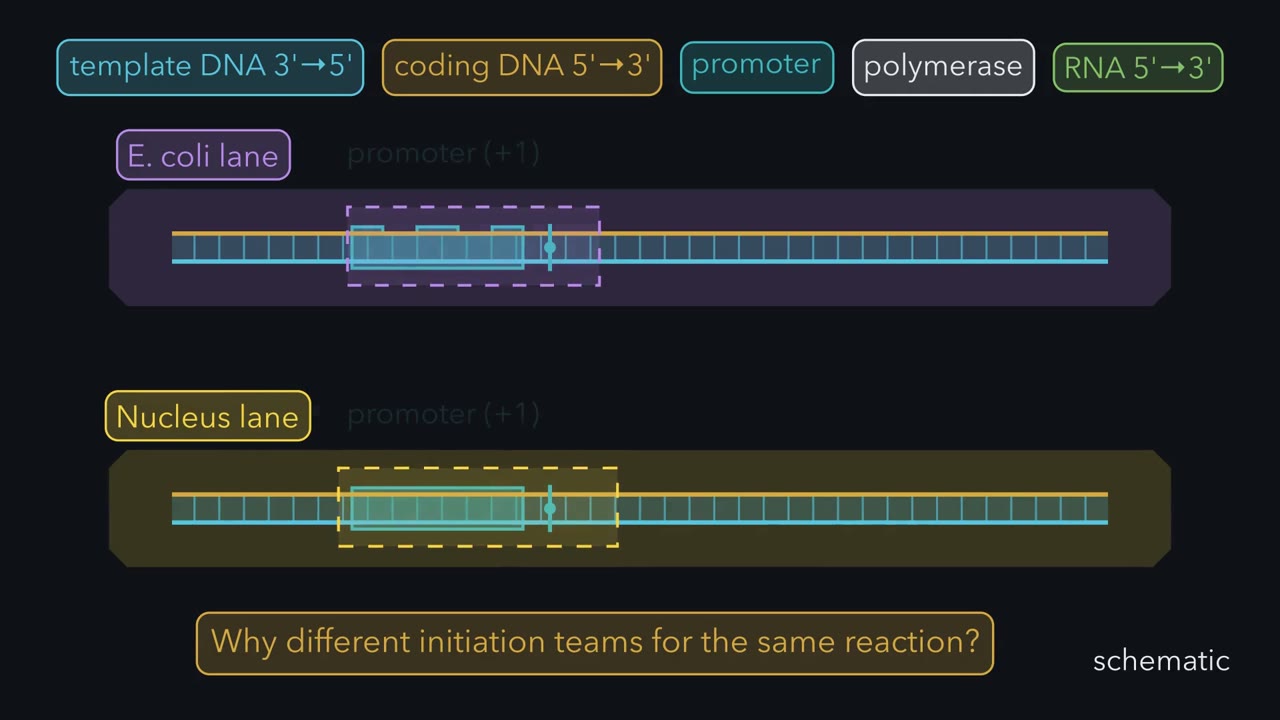
DNA opens ahead of polymerase and closes behind it. The growing RNA peels away through a separate path. Polymerase reads one strand while preserving the other strand's sequence in RNA. Use these checks on any sequence. Write both DNA strands 5′ to 3′. Match RNA to coding DNA after swapping U for T. Then confirm that RNA pairs antiparallel to the template. Together, these checks give the direction of travel. The polymerase moves toward the template's 5′ end. This rule applies whenever RNA is copied from double-stranded DNA. Promoters vary, and different cells use different initiation proteins.
Yet once a start and its direction are set, RNA grows by adding to its 3′ end. Antiparallel pairing then makes the polymerase read the template 3′ to 5′.
A gene has two DNA strands. What chooses which one the polymerase reads?
Continue in the lesson: Transcription: From DNA to RNA →
3:29 · Free, with captions and a transcript. The lesson has the full text, the questions and the sources.
More films from this lesson
How this film was made. Narration: written from this lesson's text and read by an AI narrator voice (Kokoro, af_heart). Animation: AI-generated in code (Manim) by Claude, a schematic with no drawn molecular structures. Captions come from the narration script. See something wrong? Report it.