Press play to start at .
When Leak Outruns Lymph
From the film
- Filtered fluid enters blind-ended lymph vessels through flap-like openings and is pumped on by lymphangions, helped by muscle and breathing.
- Edema is filtration outrunning lymph drainage.
- Four routes lead there: raised capillary pressure, low plasma protein, leaky microvessels and blocked lymph.
- Three safety factors limit swelling: tissue pressure rises, washout lowers tissue protein, and lymph flow rises.
- Low plasma protein does raise filtration; the safety factors, and globulins that may partly stand in for albumin, may explain why swelling without albumin is usually mild.
Read the transcript of “When Leak Outruns Lymph”
Film transcript: When Leak Outruns Lymph
Tap a sentence to play from there.
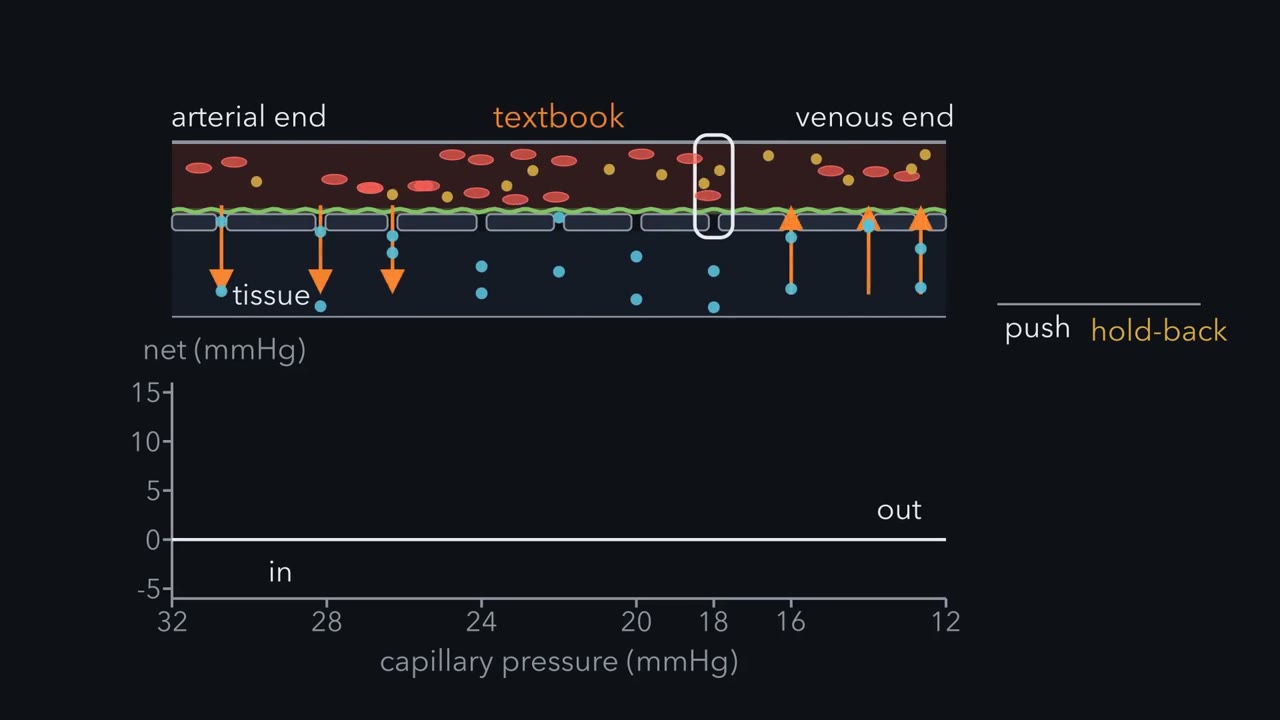
- 0:00 Small vessels leak a little all along their length, and plasma protein only slows the leak. Albumin supplies most of that pull.
- 0:10 Yet adults born with almost none usually swell only mildly.
- 0:15 What protects them?
- 0:19 Start with where the leak goes.
- 0:22 Filtered fluid enters blind-ended lymph vessels.
- 0:26 Their overlapping cells leave flap-like openings between them, which let fluid in, not out.
- 0:33 Bigger lymph vessels have valves.
- 0:36 Each segment between two valves, a lymphangion, contracts as a pump.
- 0:42 Squeezing from nearby muscle and from breathing also pushes lymph along.
- 0:47 Recent reviews put an adult's daily filtration near eight liters.
- 0:53 Roughly half is thought to rejoin the blood in lymph nodes.
- 0:57 The rest enters the veins at the base of the neck.
- 1:00 Here is the one idea.
- 1:03 Edema, swelling of the tissue, is filtration outrunning lymph.
- 1:08 Fluid collects only when more leaves the capillaries than lymph carries away.
- 1:13 So there are four ways to swell.
- 1:17 Raise capillary pressure, as in heart failure, and the push grows.
- 1:21 Lower plasma protein, and the hold-back shrinks.
- 1:25 Make the small vessels leaky, as in inflammation, and protein escapes, so the hold-back shrinks too.
- 1:33 Or block the lymph, as in lymphedema, and drainage fails.
- 1:37 Now suppose filtration outruns lymph, and fluid starts to collect in the tissue.
- 1:43 Which way does tissue pressure move, and what does that do to the push?
- 1:53 Tissue pressure rises, so the push shrinks.
- 1:57 That is one safety factor.
- 1:59 Faster filtration also rinses protein out of the tissue, which strengthens the hold-back. The third: lymph flow itself rises.
- 2:09 Back to albumin. Take a round teaching example.
- 2:14 Halving albumin lifts the net outward pressure from 1 mmHg to nearly 12.
- 2:21 Washout brings it down to about 8.
- 2:24 Lower, but still large.
- 2:27 So low protein is not harmless: filtration does rise.
- 2:31 What holds the line is all three safety factors, acting together.
- 2:36 In people born without albumin, globulins may partly stand in for it.
- 2:42 That may be why their swelling is common but usually mild, and a few have none.
- 2:48 So a steady leak is normal, and lymph carries it home.
- 2:52 Swelling begins only when it beats the drain, and the tissue pushes back on three fronts.
Capillary exchange: the same idea, other levels
A level is a place to start, not a rank. If this loses you, the rung below teaches the same idea, told more simply.
College, upper level · the level you chose
Capillary Exchange, Lymph and Edema · this lesson
Starling's reabsorbing venous end fails: filtration all along, set by Pc, Pi, albumin.
Physiology · about 28 min · 4 practice questions
College, a first course · the level you chose
Blood Vessels, Blood and Lymph
Push out minus pull in: Landis timed trapped red cells in frog capillaries.
Organismal Biology · about 19 min · film 3:14 · 3 practice questions
Next door
- Osmosis: Water Goes Where the Solute Stays · 3:16 Plasma proteins hold water in the blood by osmosis, which is the pull that balances the pressure pushing fluid out.
- Blood flow resistance: Resistance, Compliance and Local Blood Flow The pressure in the capillary comes from how much resistance the small arteries before it have used up.
More films from this lesson
Continue in the lesson: Capillary Exchange, Lymph and Edema →
Free, with captions and a transcript. The lesson has the full text, the questions and the sources.
How this film was made. Narration: an AI narrator voice (Kokoro, af_heart) reading narration written from this lesson's text. Animation: AI-generated in code (Manim) by Claude, a schematic with no drawn molecular structures. Captions come from the narration script. See something wrong? Report it.