Press play to start at .
What Plasma Sodium Reports
From the film
- Plasma sodium is a concentration, so a change in body water moves it, not only a change in sodium.
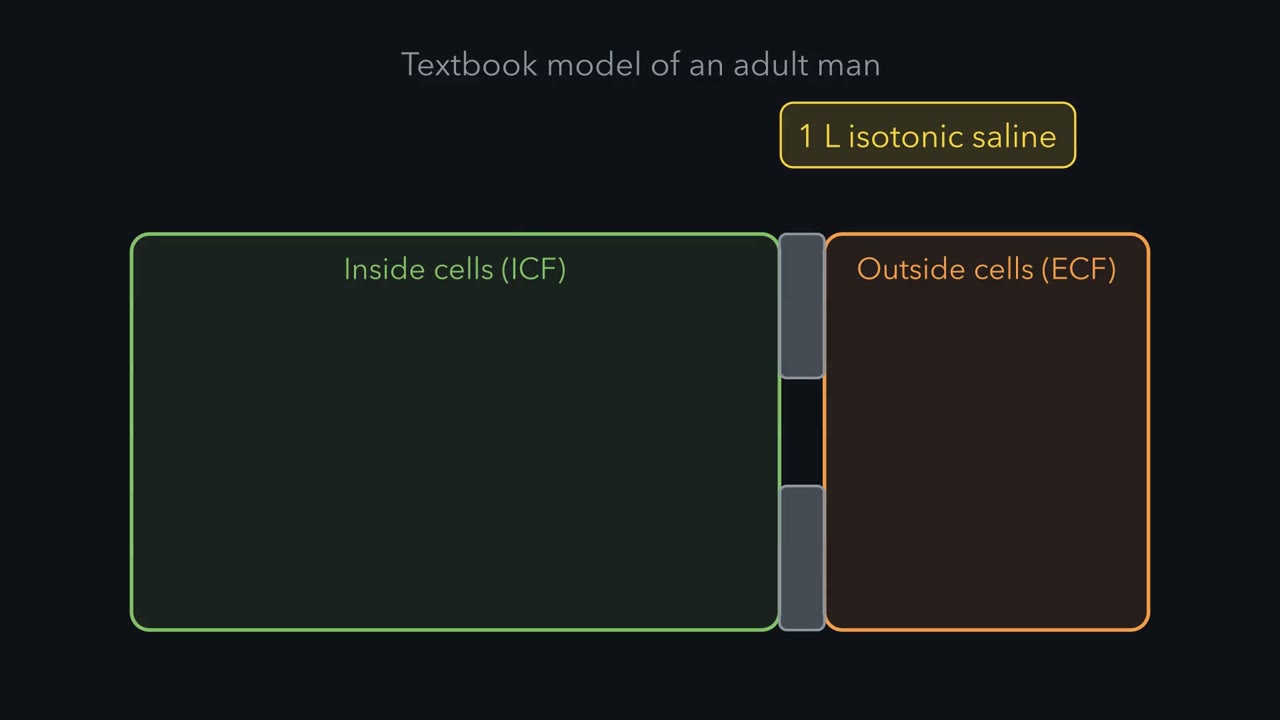
- In the model, retaining a litre of solute-free water dilutes plasma sodium from 140 to about 136.7 mmol per L with no sodium lost.
- When cells lose potassium salts, they hold less water, and that water dilutes plasma sodium.
- Edelman's 1958 data in 98 sick patients showed serum sodium tracking exchangeable sodium plus potassium per litre of body water, a correlation, not an experiment.
- A low plasma sodium means too much water for the cation present; by itself it does not show whether body sodium is low, normal or high.
Read the transcript of “What Plasma Sodium Reports”
Film transcript: What Plasma Sodium Reports
Tap a sentence to play from there.
- 0:00 Last time, water crossed between two rooms until every litre held the same number of stuck guests. Now a blood test reads low plasma sodium.
- 0:11 Has this body lost sodium?
- 0:16 Plasma sodium is a concentration: sodium per litre of water.
- 0:22 So the reading has two parts, the sodium and the water it sits in.
- 0:27 Change either one, and the needle moves.
- 0:30 Take the litre of solute-free water again.
- 0:33 No sodium left the body.
- 0:36 But the litre spread through all body water, and diluted the sodium outside cells.
- 0:42 In the model, plasma sodium falls from 140 to about 136.7 mmol per L.
- 0:50 Now a stranger case, as bookkeeping.
- 0:54 Remove 600 mOsm of potassium salts from the cells, and from the body.
- 1:00 Not one sodium ion leaves.
- 1:03 Does plasma sodium rise, fall, or stay the same?
- 1:12 It falls. Potassium salts are the cells' stuck guests.
- 1:18 With fewer of them, cells hold less water.
- 1:21 In the model, cells shrink from 28 to about 27.3 L. That water moves outside.
- 1:30 Fluid outside cells rises to about 14.7 L. Plasma sodium falls from 140 to about 133. No sodium was lost.
- 1:44 Real potassium depletion is messier, but the body still loses effective solute.
- 1:50 So plasma sodium still falls.
- 1:53 Here is the idea. Plasma sodium tracks all the exchangeable cation, sodium and potassium, per litre of body water.
- 2:03 It is a ratio of cation to water.
- 2:06 It is not a gauge of the body's sodium stock.
- 2:09 In 1958, Isidore Edelman and colleagues tested this in 98 chronically ill patients.
- 2:17 In most, they measured exchangeable sodium, exchangeable potassium and total body water by isotope dilution.
- 2:26 Exchangeable means the part of each store that mixes with an injected isotope.
- 2:31 Serum sodium correlated poorly with any single store.
- 2:36 It followed sodium plus potassium per litre of body water, with a correlation coefficient of 0.83.
- 2:45 Patients with edema, carrying excess body sodium, could still have low plasma sodium.
- 2:51 Keep the limits. This is a correlation in sick patients, not an experiment.
- 2:58 And exchangeable cation is not total cation, because much bone sodium does not exchange.
- 3:05 So a low plasma sodium means too much water for the cation present.
- 3:10 By itself, it does not show whether body sodium is low, normal or high.
Body water: the same idea, other levels
A level is a place to start, not a rank. If this loses you, the rung below teaches the same idea, told more simply.
College, upper level · the level you chose
Body Water and Its Compartments · this lesson
Reference man: 42 L of water, 28 inside cells, measured by dilution.
Physiology · about 34 min · film 3:16 · 3 practice questions
Next door
- Osmosis: Which Way Does the Water Go? · 3:09 · Starting college Water crosses cell membranes toward more dissolved stuff, which sets how body water divides between cells and the rest.
- Edema: why tissues swell: Capillary Exchange, Lymph and Edema When fluid collects in the space between cells faster than it is drained, the tissue swells.
- Water and salt balance: Two Loops, One Ratio · 3:22 Animals keep these compartments steady by matching every gain and loss of water and salt.
More films from this lesson
Continue in the lesson: Body Water and Its Compartments →
Free, with captions and a transcript. The lesson has the full text, the questions and the sources.
How this film was made. Narration: an AI narrator voice (Kokoro, af_heart) reading narration written from this lesson's text. Animation: AI-generated in code (Manim) by Claude, a schematic with no drawn molecular structures. Captions come from the narration script. See something wrong? Report it.