Developmental Neuroscience · Skim version
The Wiring Problem: How a Brain Gets Built
Read the full lesson → Skim the whole course →
The guiding idea
About 20,000 genes, about 86 billion neurons. The genome cannot list the wiring, so what does it store instead?
The genome cannot list every connection of a brain, so it stores rules and the tissue measures the rest.
From the film
- The genome cannot list every connection of a brain, so it stores rules and the tissue measures the rest.
- A label says which cell a neuron is, not whom it should connect to: a label is not a wire.
- Graded labels and local growth-cone rules can give a map its overall order, and activity can sharpen the neighbour order they leave rough.
- Blocking spikes left rough order but spread the endings in regrowing goldfish, while zebrafish embryos formed compact maps without spikes, so where the line falls differs between systems.
-
One circuit, built right
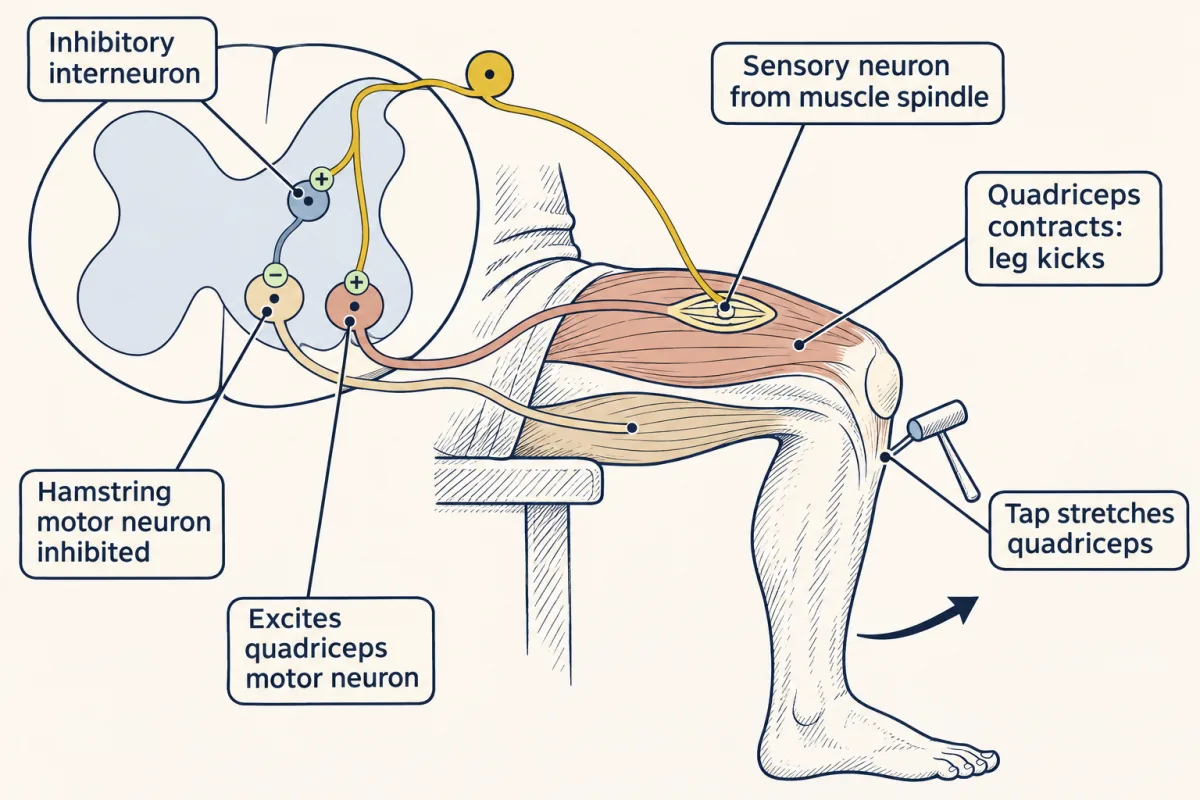
The knee-jerk is a circuit of three kinds of neuron with the right partners and the right signs: the sensory neuron from the quadriceps spindle excites the quadriceps motor neurons, and through an inhibitory interneuron it inhibits the motor neurons of the opposing hamstring. Development had to make each of those connections. AI-generated illustration -
The wiring problem
-
Three strategies instead of a list
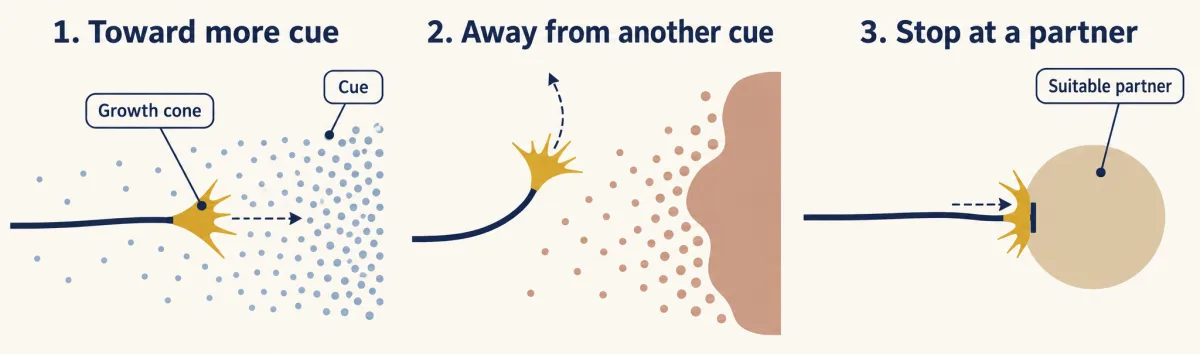
A growth cone senses only what is next to it. Three local rules, grow toward more of a cue, avoid another, stop at a suitable partner, can still build a map that spans millimetres. AI-generated illustration -
Why one noisy gradient gives only rough order
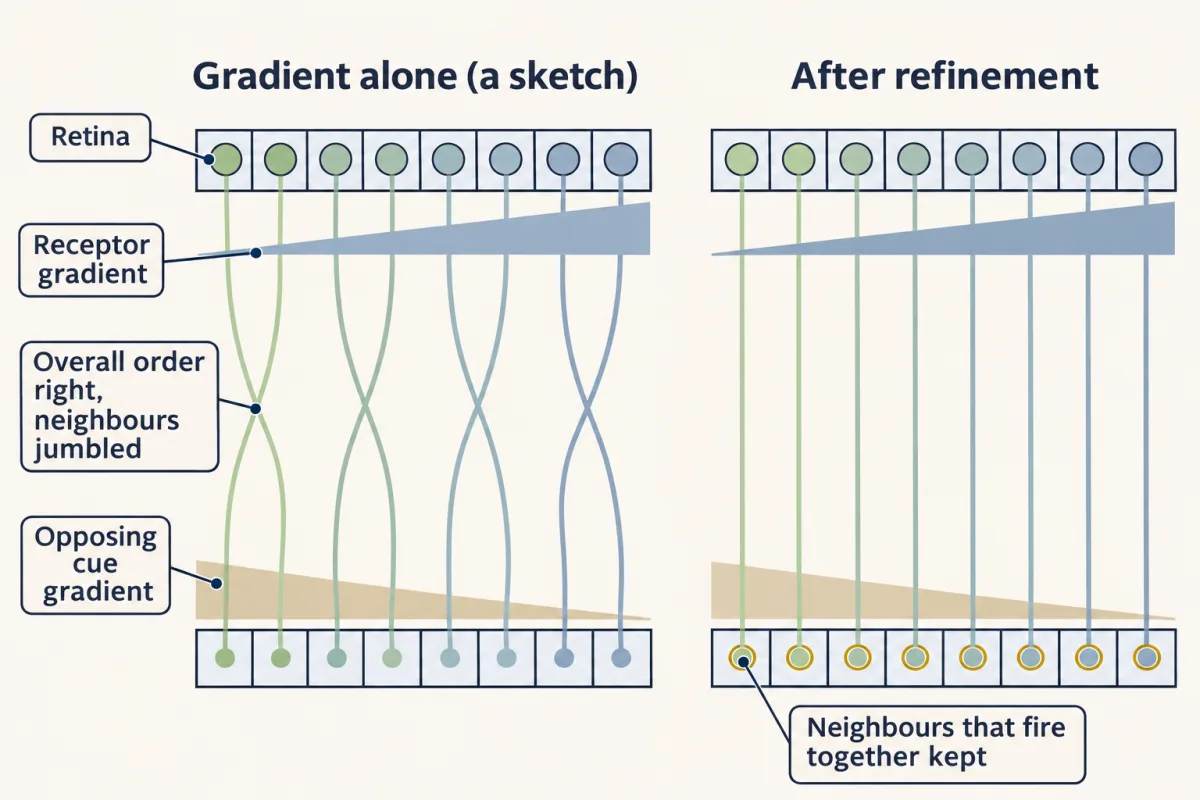
In the gradient sketch, opposing receptor and cue gradients put axons in the right overall order, but noise leaves neighbours jumbled. Branches that land among neighbours that fire with them tend to be kept, and with competition this can sharpen the neighbour order that a gradient leaves rough. AI-generated illustration -
Testing the split: block the spikes
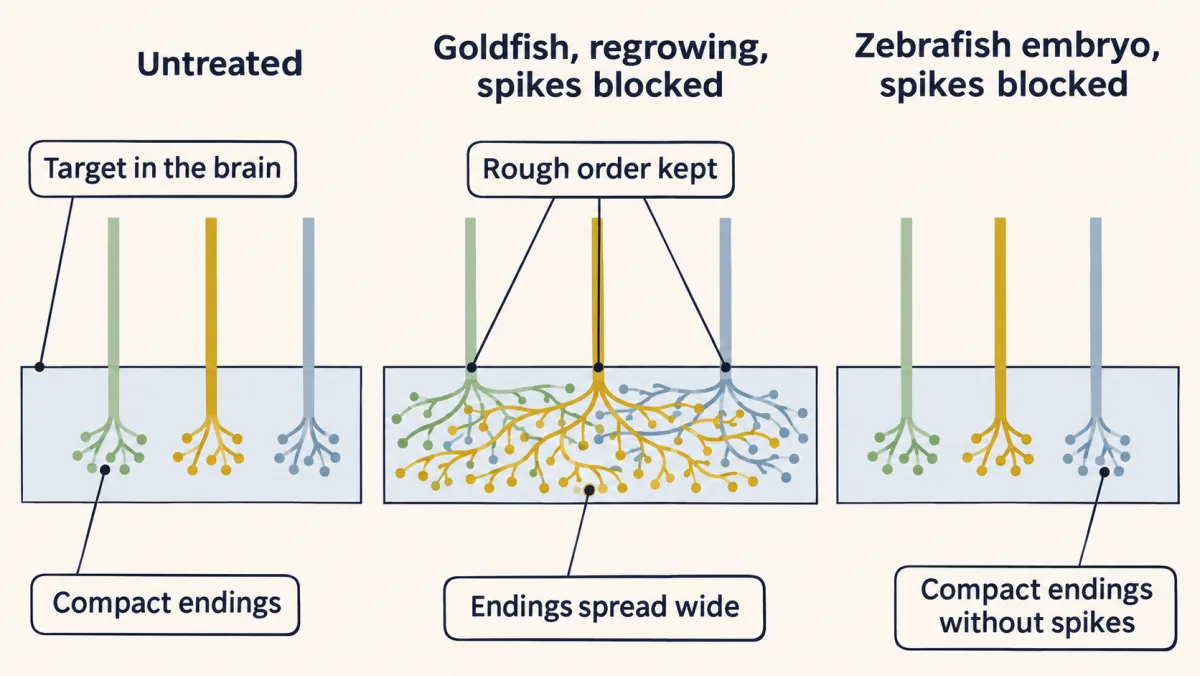
Blocking spikes in goldfish whose optic nerve was regrowing left the rough order of the map but spread each axon's endings widely. Blocking spikes in zebrafish embryos building the map for the first time left the endings compact, so what needs spikes differs between the two conditions tested. AI-generated illustration -
Overproduce, then select, across a human life
-
The roadmap: from induction to refinement
-
Going deeper
Where this lesson fits
After thisStudy next
- The Growth Cone: The Tip That Steers the AxonThis course · Lesson 3
It shows how a growth cone reads only local cues, the second strategy this lesson names.
- Topographic Maps: Sperry's Eye and Eph GradientsThis course · Lesson 26
It follows the Eph and ephrin gradient experiments that this lesson uses to show graded labels giving a map.
- Activity Before Experience: Spontaneous Retinal WavesThis course · Lesson 38
It takes up retinal waves, which sharpen the neighbour order that one noisy gradient leaves rough.
Elsewhere on the siteFilms, simulations and method films in other courses
- Where Every Command EndsFilm · Neuroscience
It shows the stretch reflex circuit and why the connection from sensory axon to motor neuron matters.
- Centre and surroundSimulation · Neuroscience
It shows how retinal cells are organized, the system whose map this lesson tests with blocked spikes.
Suggested by an AI model from the lessons themselves, then checked. How we use AI