Biochemistry · Skim version
Vitalism: How Chemistry Captured Life
Read the full lesson → Skim the whole course →
The guiding idea
Before biochemistry could begin, one idea had to die — this is its seventy-year retreat.
Before biochemistry could begin, one idea had to die: that the molecules of life can only be made by life.
From the film
- Vitalists claimed that life's chemistry required a special vital force.
- Wöhler made urea without a body, but his starting materials left a loophole.
- Kolbe narrowed that loophole using materials chemists counted as lifeless.
- Buchner's filter and antiseptic showed yeast fermentation needed no living cell.
- Testing a claim that chemistry needs life requires proving life is gone.
-
The wall
-
Wöhler’s flask, 1828
-
Kolbe narrows the loophole, 1845
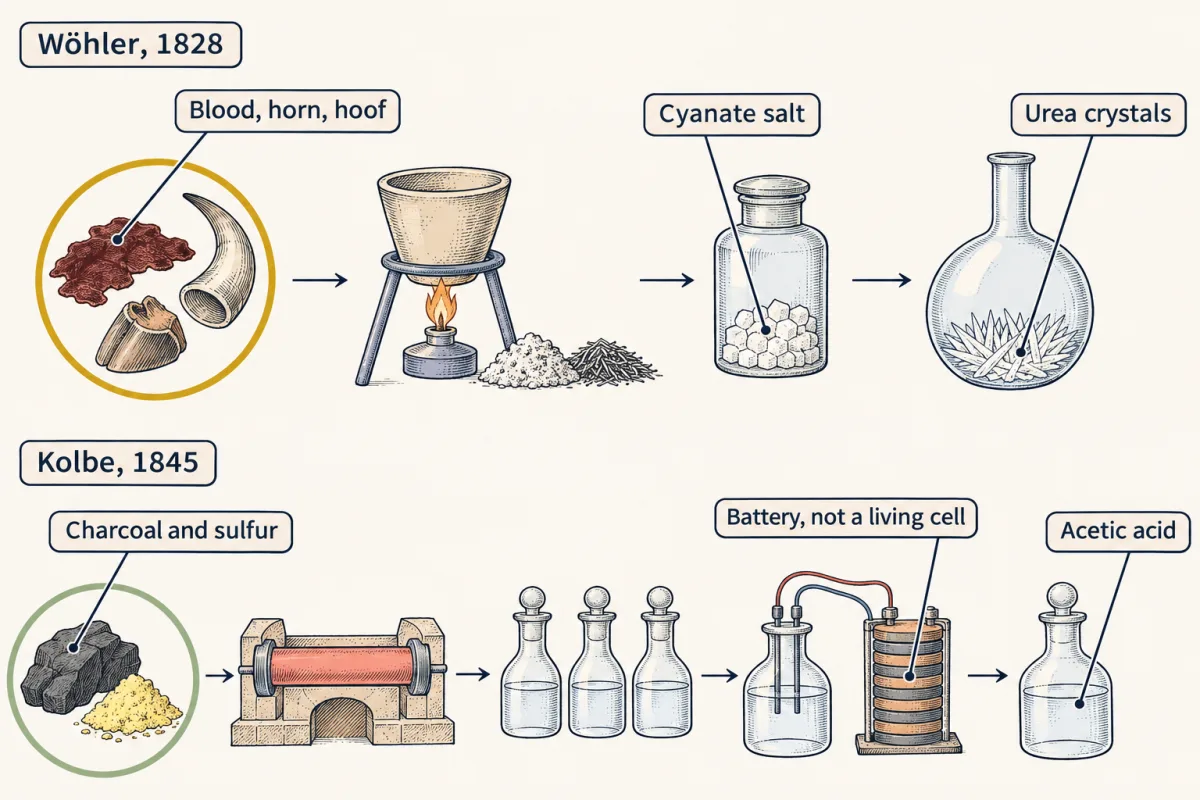
Where each chain begins. Wöhler's cyanate traced back to blood and horn, so a skeptic could say life was still in the starting materials. Kolbe started from charcoal and sulfur, which chemists then counted as elements (charcoal is usually made from wood), and finished with a battery. That made the provenance objection hard to sustain. AI-generated illustration -
Berthelot’s fats, 1854
-
The last redoubt: fermentation
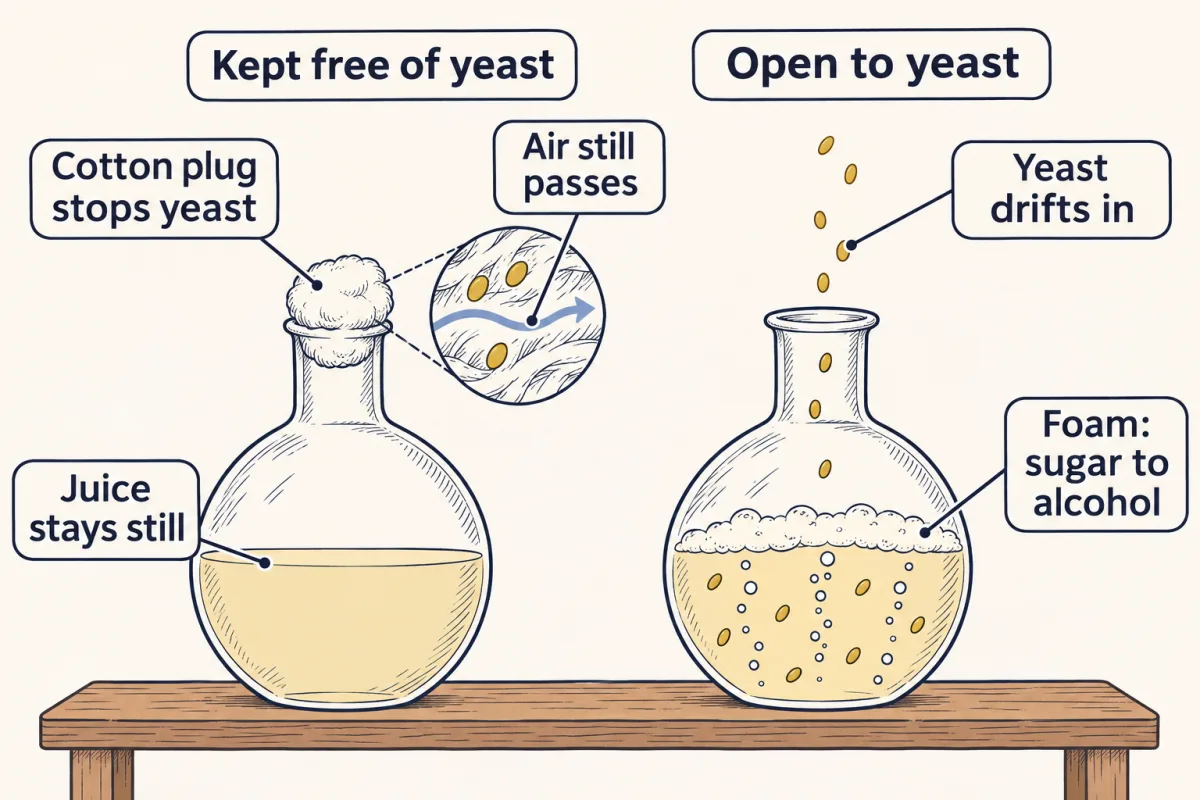
Pasteur showed that sterile grape juice kept free of yeast stayed inert, while juice that yeast could reach foamed into alcohol: fermentation appeared only alongside living yeast. (Keeping out yeast, not keeping out air, is what stopped it; yeast ferments without air.) AI-generated illustration -
Buchner’s flask, 1896–97
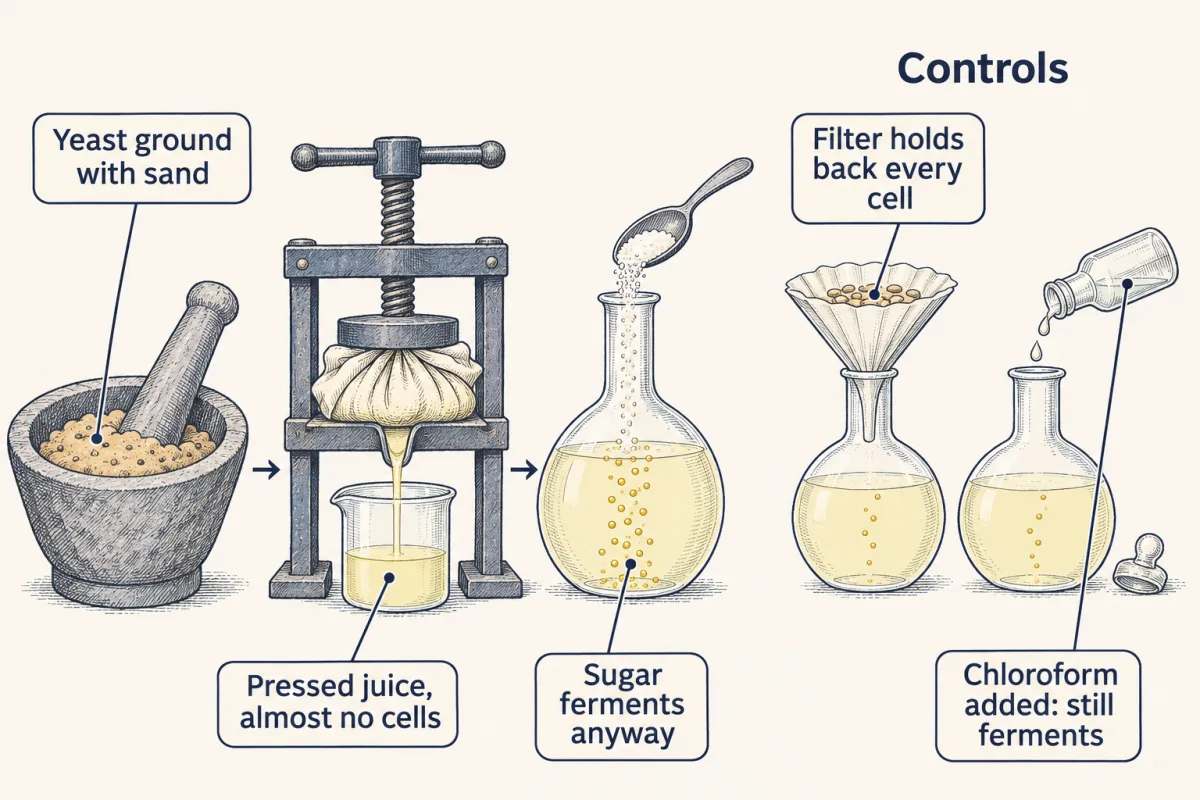
Buchner's press juice, 1896. Yeast ground with sand and pressed gave a juice with almost no intact cells, and sugar added to it fermented. Juice passed through a sterile filter that holds back every cell still fermented, and so did juice saturated with chloroform, an antiseptic. Those two controls are what showed no living cell was needed. AI-generated illustration -
The retreat in one table
-
Why this is Chapter Zero
-
Going deeper
Where this lesson fits
After thisStudy next
- Introduction to Biochemistry and Cell Biology: Compartments Create ControlThis course · Lesson 2
It starts from the premise that a cell obeys ordinary chemistry and shows how compartments give that chemistry control.
- Basic Concepts of Enzyme ActionThis course · Lesson 7
Buchner's zymase was an enzyme, and this lesson explains how enzymes speed up reactions without changing what is possible.
- Glycolysis: The Investment-and-Payoff PathwayThis course · Lesson 16
The fermentation Buchner freed from the cell is glycolysis plus the steps that make ethanol.
Elsewhere on the siteFilms, simulations and method films in other courses
- Radioactive and stable isotope tracersMethod film
Tracing atoms through a reaction is how an isomerization like urea's can be shown to keep the same atoms.
- Count the Working SitesFilm · Biology
It shows enzymes as ordinary catalysts, the kind of molecules Buchner found working in dead yeast juice.
Suggested by an AI model from the lessons themselves, then checked. How we use AI