Genetics and Molecular Biology · Skim version
Three-Point Crosses: Gene Order and Double Crossovers
Read the full lesson → Skim the whole course →
The guiding idea
If two crossovers restore the outer genes' parental arrangement, how can offspring counts reveal them?
A middle marker makes double crossovers visible; comparing observed and expected doubles reveals crossover spacing.
From the film: The Marker in the Middle
- A middle marker makes double crossovers visible.
- The largest pair is provisionally parental; the smallest pair provisionally represents double crossovers.
- Match each double to its closest parental; the only different marker lies in the middle.
- Count every double crossover in both adjacent intervals.
- Rarity is a clue, not proof: check that the rare pair is reciprocal and every class survives and is scored.
From the film: Do Crossovers Act Independently?
- Comparing observed and expected doubles reveals crossover spacing.
- Under independence, expected doubles come from multiplying the adjacent interval frequencies.
- Coincidence is observed divided by expected; interference is one minus coincidence.
- Coincidence and interference describe one pair of intervals in one organism, not a species constant.
- Genetic distance reflects crossover frequency, not a fixed length of DNA.
-
Read the eight classes in a fixed order
-
Compare observed doubles with chance
-
Genetic distance is not DNA length
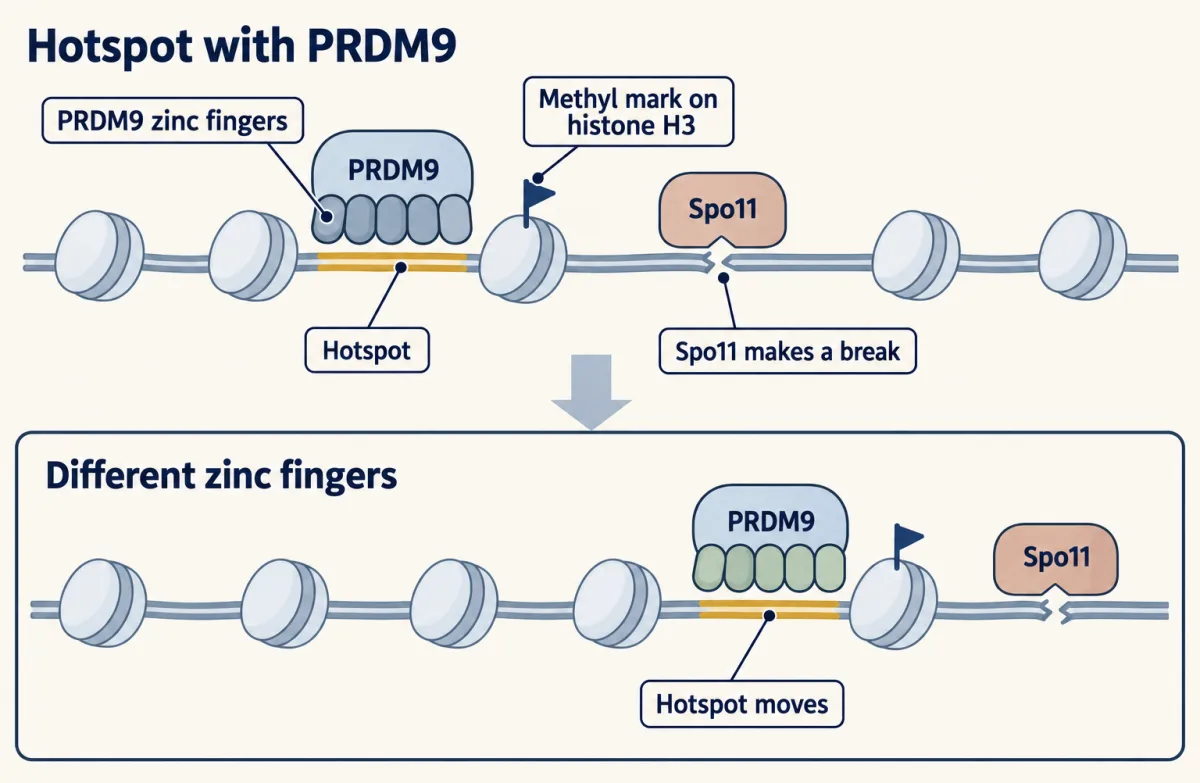
In humans and mice, PRDM9's zinc fingers bind particular sequences and mark histone H3 nearby, and Spo11 breaks near such sites start recombination. Change the zinc fingers and the hotspots move. AI-generated illustration -
Going deeper: when the simple comparison changes
Where this lesson fits
Before thisReview first
- Linkage and Recombination MappingThis course · Lesson 8
You need two-point recombination frequency and map distance from there before adding a third marker.
- Chromosomes and Meiosis: The Physical Basis of Mendel's LawsThis course · Lesson 2
Crossovers between non-sister chromatids in meiosis are what produce the recombinant classes you count here.
- Probability, Crosses and the Chi-Square TestThis course · Lesson 3
Expected doubles come from multiplying independent probabilities along a path, as practised there.
After thisStudy next
- DNA Repair and RecombinationThis course · Lesson 15
It explains how crossovers and gene conversion start, which underlies hotspots and interference seen here.
- Complex Traits, Heritability and GWASThis course · Lesson 26
It uses recombination between markers and traits to localize genes in whole genomes.
Suggested by an AI model from the lessons themselves, then checked. How we use AI