Developmental Neuroscience · Skim version
The Organizer: Spemann and Mangold
Read the full lesson → Skim the whole course →
The guiding idea
How can a small graft make its host build a second spinal cord from cells meant for skin?
A cell's fate can be set by its neighbours, but only while those cells are still competent to answer.
From the film: One Sheet, Two Fates
- A cell's fate can be set by its neighbours.
- In newts, an organizer moved to a new place makes host cells build much of a second back around it.
- This works only while the host cells are still competent, that is, able to answer.
- The idea says who changed fate and where, not what the signal is.
From the film: Whose Cells Built It?
- A pale graft in a pigmented host showed that most of the second neural tube was built by host cells, so the graft induced it.
- The graft's own cells became notochord, it recruited host mesoderm into somites, and it induced host ectoderm to become neural tube.
- Older ectoderm responds less and largely stops responding by the end of gastrulation, so the responder must be competent.
From the film: Dead Tissue That Still Induces
- Killed and even boiled organizer tissue could still make ectoderm neural, though it did not build an organized second axis.
- Many other killed tissues and unrelated materials induced too, so a yes could not name the natural signal.
- That result left the natural signal unidentified and stalled the search.
-
One sheet, two fates
-
The graft: whose cells built the second back?
-
Induction needs two parties
-
More than one induction: the organizer builds an axis
-
Dead tissue that still induces
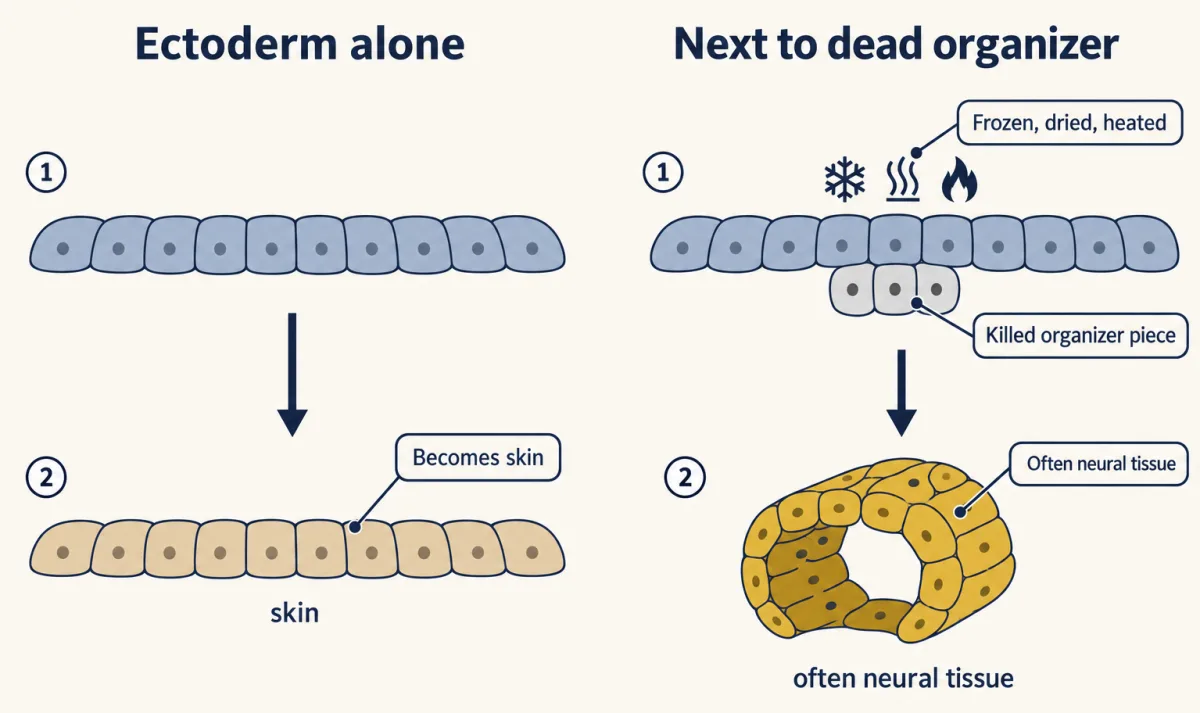
Holtfreter froze, dried and heated pieces of newt embryos, killing them before placing them against ectoderm from early gastrulae. On its own the ectoderm became skin; next to dead organizer it often became neural tissue. AI-generated illustration -
Putting it together
-
Going deeper
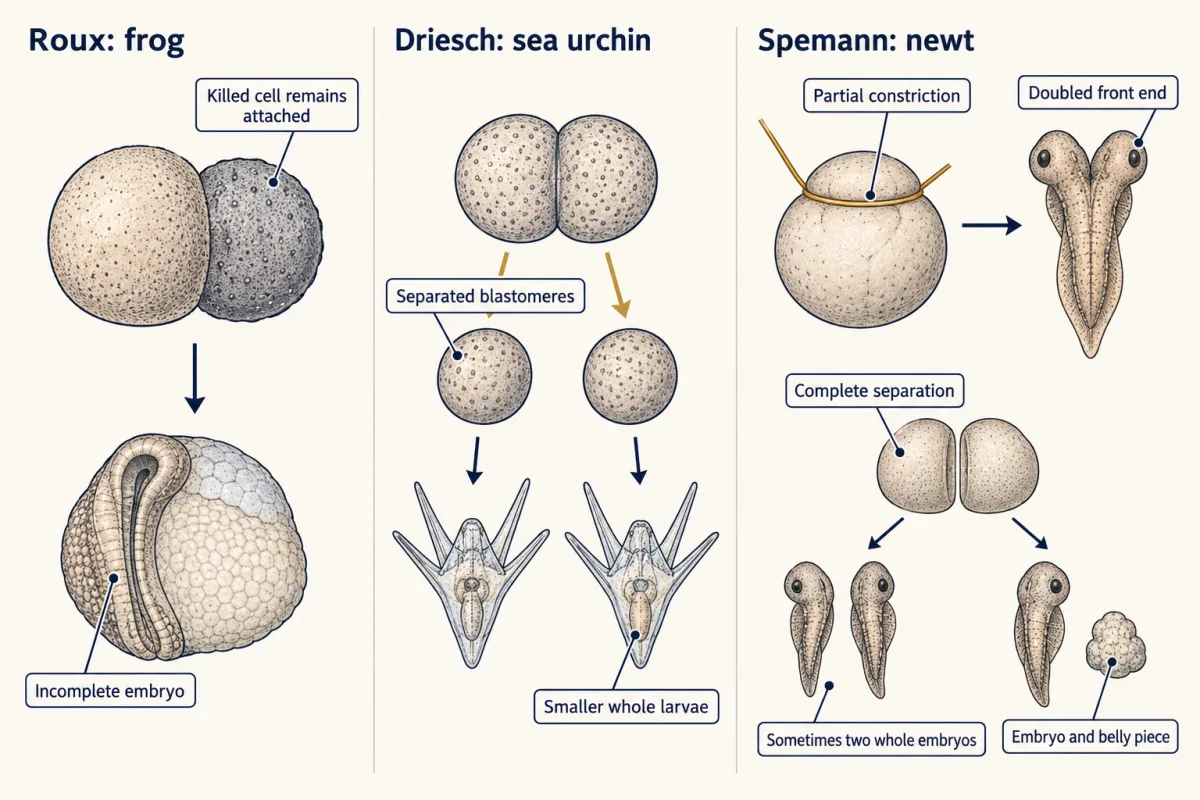
Roux left a killed frog blastomere attached, and the survivor could form something like half an embryo. Driesch's separated sea-urchin blastomeres could form smaller whole larvae. In Spemann's newt experiments, partial constriction produced doubled front ends; complete separation sometimes produced two whole embryos, and sometimes an embryo plus an axis-free belly piece. AI-generated illustration
Where this lesson fits
Before thisReview first
- The Wiring Problem: How a Brain Gets BuiltThis course · Lesson 1
It sets out how a brain is built from signals between cells, the question this graft experiment answers.
After thisStudy next
- Neural Induction: The Default ModelThis course · Lesson 6
It asks whether the organizer supplies a neural signal or removes a brake, the question left open here.
- Neurulation and Neural Tube DefectsThis course · Lesson 7
It follows the induced neural plate as it folds and closes into the neural tube.
- Head to Tail: Hox Genes, Retinoic Acid and RhombomeresThis course · Lesson 8
It shows how the neural tube the organizer induces is given head-to-tail identity.
Suggested by an AI model from the lessons themselves, then checked. How we use AI