Neuroscience · Skim version
Synaptic Plasticity
Read the full lesson → Skim the whole course →
The guiding idea
A synapse that stores an association should strengthen when its own input is active at the same moment as the cell it talks to. How could one synapse know what the whole cell is doing?
At an NMDA-type synapse, LTP is triggered by Ca2+ entering the spine through NMDA receptors, and substantial entry needs glutamate from the presynaptic cell and depolarization of the postsynaptic membrane together.
From the film: A Synapse That Could Learn
- Hebb's rule asks a synapse to strengthen when its own input and the cell it talks to are active together.
- Long-term potentiation was first measured in the rabbit dentate gyrus, and a pathway that is not trained stays flat, which shows the change is input specific.
- Synaptic strength is read from the slope of the field response, and the spike can grow out of proportion to it.
From the film: A Gate That Needs Two Signals
- At normal magnesium levels, an NMDA receptor lets in much calcium only when glutamate and depolarization coincide.
- Depolarization clears the magnesium block, and the spine's voltage reports what the postsynaptic cell is doing.
- The gate is graded rather than a switch, so a little calcium enters at rest, and summation during a fast train drives the large rise.
From the film: Testing the Gate
- Block the NMDA receptor, the calcium or the depolarization, and LTP fails.
- Pairing glutamate with enough depolarization produces LTP, so coincidence matters and high-frequency input is not required.
- Not every LTP uses this gate, because mossy fibre LTP in guinea pig CA3 needed no NMDA receptors.
From the film: What the Rule Explains
- One gate reading two signals explains input specificity, cooperativity and associativity.
- An input that releases no glutamate is not potentiated, however depolarized the cell becomes.
- A weak input paired with a strong one can be potentiated, because the strong input supplies the depolarization that clears the block.
From the film: Turning It Up or Down
- In the standard model, a synapse turns up or down with how much calcium enters and how fast.
- A large, fast calcium rise recruits CaMKII and adds AMPA receptors, while a modest, prolonged rise recruits phosphatases and removes them.
- This calcium rule is a model, and no single calcium threshold between LTD and LTP is established.
From the film: Fast Changes, and the Road to Memory
- Facilitation and depression are mostly a separate, presynaptic machine that needs no postsynaptic coincidence.
- At the synapses tested, synaptotagmin 7 is a sensor that reads leftover calcium to produce facilitation.
- Linking LTP to memory takes tests of necessity and sufficiency, not correlation alone.
-
A synapse that could store an association
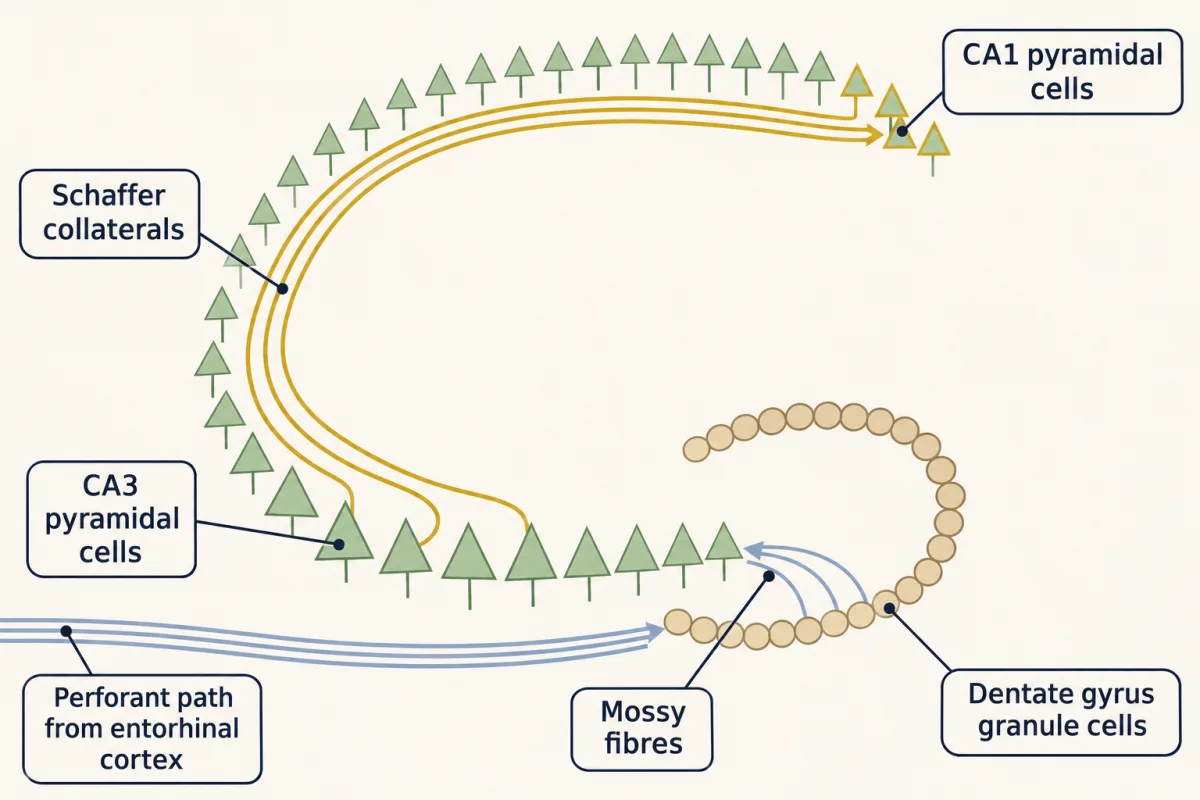
The hippocampal chain runs perforant path to dentate gyrus, mossy fibres to CA3 and Schaffer collaterals to CA1, the synapse where most of this lesson's mechanism was worked out. AI-generated illustration -
The gate that needs two signals
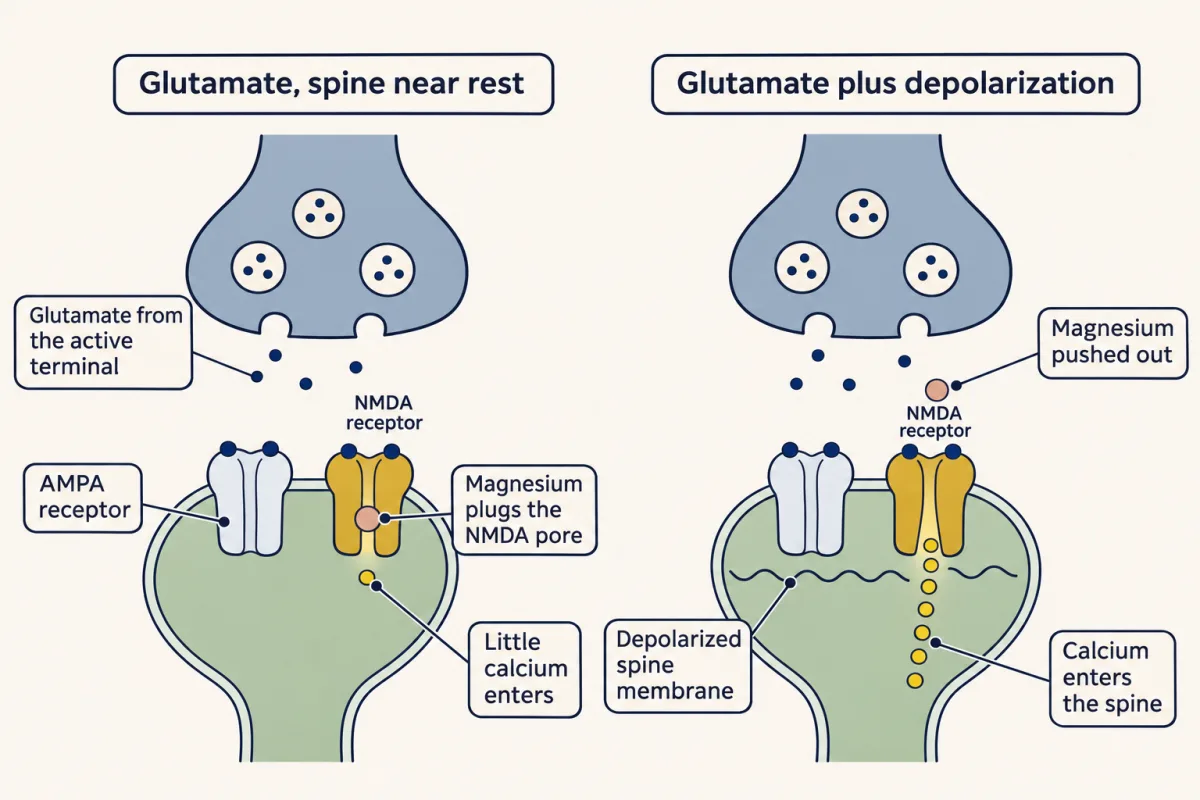
The NMDA receptor lets substantial calcium into the spine only when glutamate is bound and the spine is depolarized enough to push magnesium out of its pore; near rest, only a little enters. AI-generated illustration -
Testing the gate
-
What the rule explains: specificity, cooperativity, associativity
-
Up or down: what the Ca2+ does
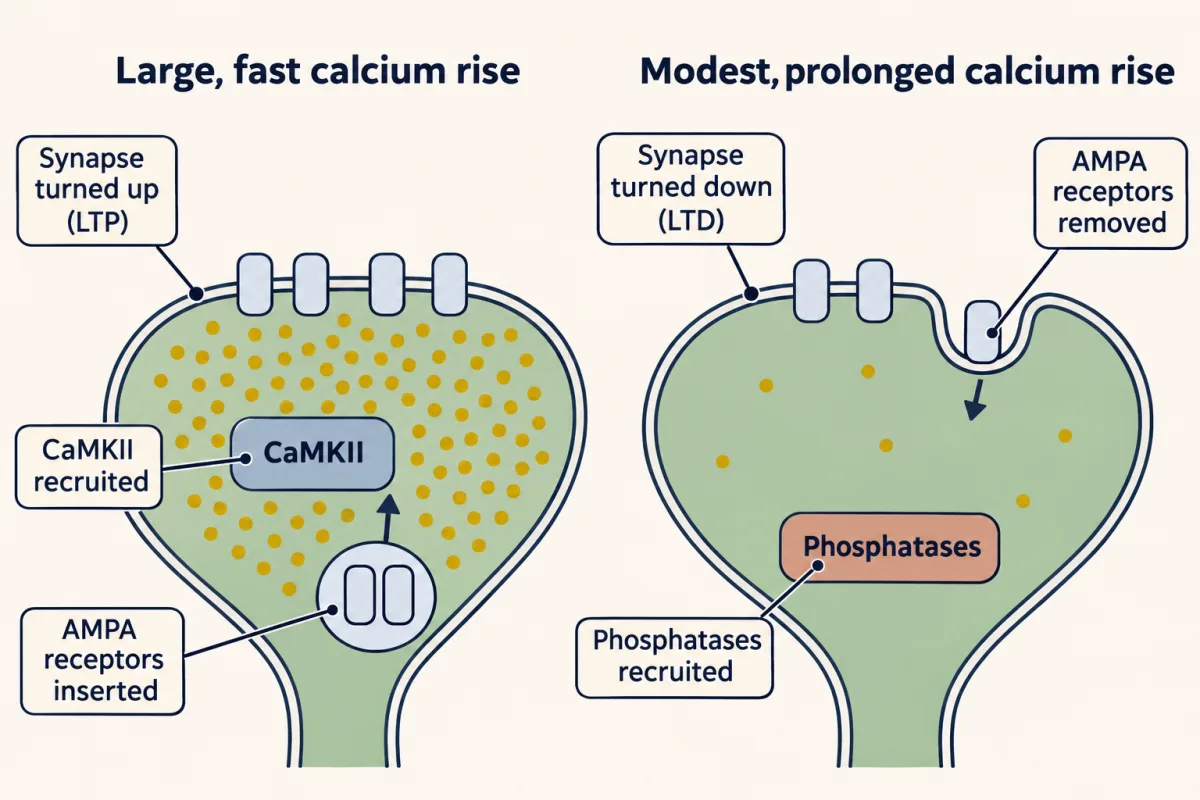
In the standard model, a large, fast calcium rise recruits CaMKII and adds AMPA receptors, turning the synapse up, while a modest, prolonged rise recruits phosphatases that remove them, though no single calcium threshold is established. AI-generated illustration -
A different machine: short-term plasticity
-
From synapse to memory: what the evidence licenses
-
Going deeper
Where this lesson fits
Before thisReview first
- Synaptic Transmission and Quantal ReleaseThis course · Lesson 5
You need glutamate release and EPSPs from there to follow what a train of pulses does at the synapse.
- The Resting Membrane and Passive SignalsThis course · Lesson 3
The balance-point rule for the spine's voltage comes from how leak and synaptic conductances set the resting potential.
- Integration, Inhibition and NeuromodulationThis course · Lesson 7
Summation of EPSPs there is what depolarizes the spine enough to clear the Mg2+ block.
After thisStudy next
- Plasticity, Networks and ConsolidationThis course · Lesson 23
It takes LTP further, testing whether networks of potentiated synapses are needed and enough for stored memories.
- Memory SystemsThis course · Lesson 22
It asks which kinds of memory the hippocampus and its plastic synapses actually support.
- Emotion and StressThis course · Lesson 20
It uses plasticity at amygdala inputs to explain how a tone comes to predict a shock.
Elsewhere on the siteFilms, simulations and method films in other courses
- Quantal analysisMethod film
It shows how to tell whether a change in synaptic strength is presynaptic or postsynaptic from the sizes of quantal responses.
- The Muscle Proposes, the Nerve DisposesFilm · Developmental Neuroscience
It shows how a synapse's receptors are clustered and kept, the machinery that LTP changes by adding AMPA receptors.
Suggested by an AI model from the lessons themselves, then checked. How we use AI