Neuroscience · Skim version
Circadian Rhythms and Sleep
Read the full lesson → Skim the whole course →
The guiding idea
Stay up all night and you feel worst near dawn, then better by the afternoon, still without sleep. How can more time awake make you less sleepy?
In the two-process model, sleep pressure builds while you are awake and drains in sleep, and a clock of about 24 hours moves the upper and lower levels at which you fall asleep and wake.
From the film: Pressure and the Clock
- In the simple model, sleep pressure builds while you are awake and drains while you sleep.
- You fall asleep when pressure climbs to an upper level and wake when it drains to a lower one, and the clock raises both levels by day and lowers them by night.
- Two levels with a gap keep the model's sleep in one long block, and recovery sleep after a missed night is longer than usual but nowhere near hour for hour.
From the film: A Clock You Can Transplant, and How Light Sets It
- In hamsters, a grafted suprachiasmatic nucleus imposed the donor's period on the host, so the nucleus acts as a pacemaker and not just a relay.
- The clock is a delayed negative feedback loop: CLOCK-BMAL1 switch on Per and Cry, and PER and CRY block CLOCK-BMAL1 until they are degraded.
- The loop keeps a period near 24 hours, not exactly, so light in the biological evening delays the clock and light in the biological morning advances it.
From the film: Reading a Night
- Sleep is scored in 30-second epochs from brain waves, eye movements and muscle tone, and most N3 falls in the first half of the night, when pressure is highest.
- In the model, REM grows toward morning, following both the clock and the time already slept.
- In one flip-flop model, a switch with a memory is one way to explain the gap between the two levels.
- Orexin neurons are thought to hold the switch steady in waking, and narcolepsy type 1 is associated with severe loss of them.
-
Two processes decide when you sleep
-
Where the clock is
-
How the clock ticks
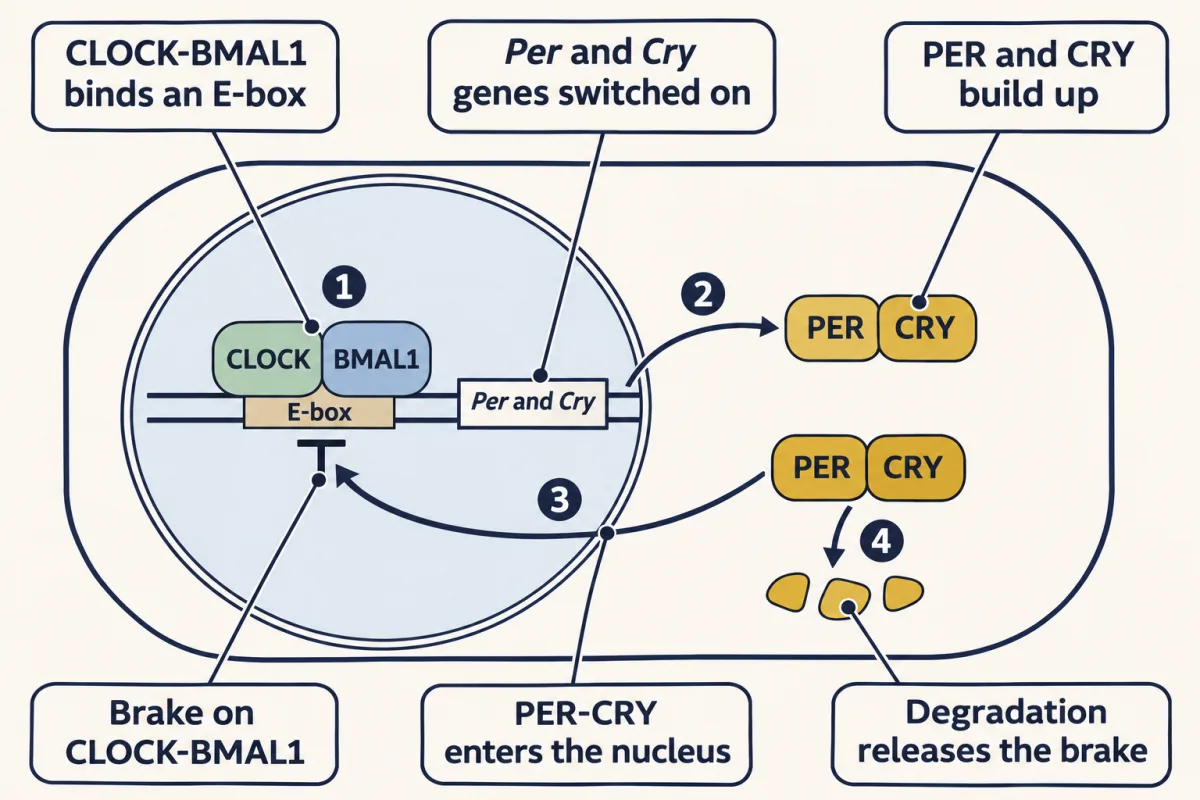
The clock is a delayed feedback loop: CLOCK-BMAL1 switches on Per and Cry, PER and CRY build up and return to the nucleus to shut CLOCK-BMAL1 off, and only their degradation lets a new cycle begin. AI-generated illustration -
How light keeps the clock on time
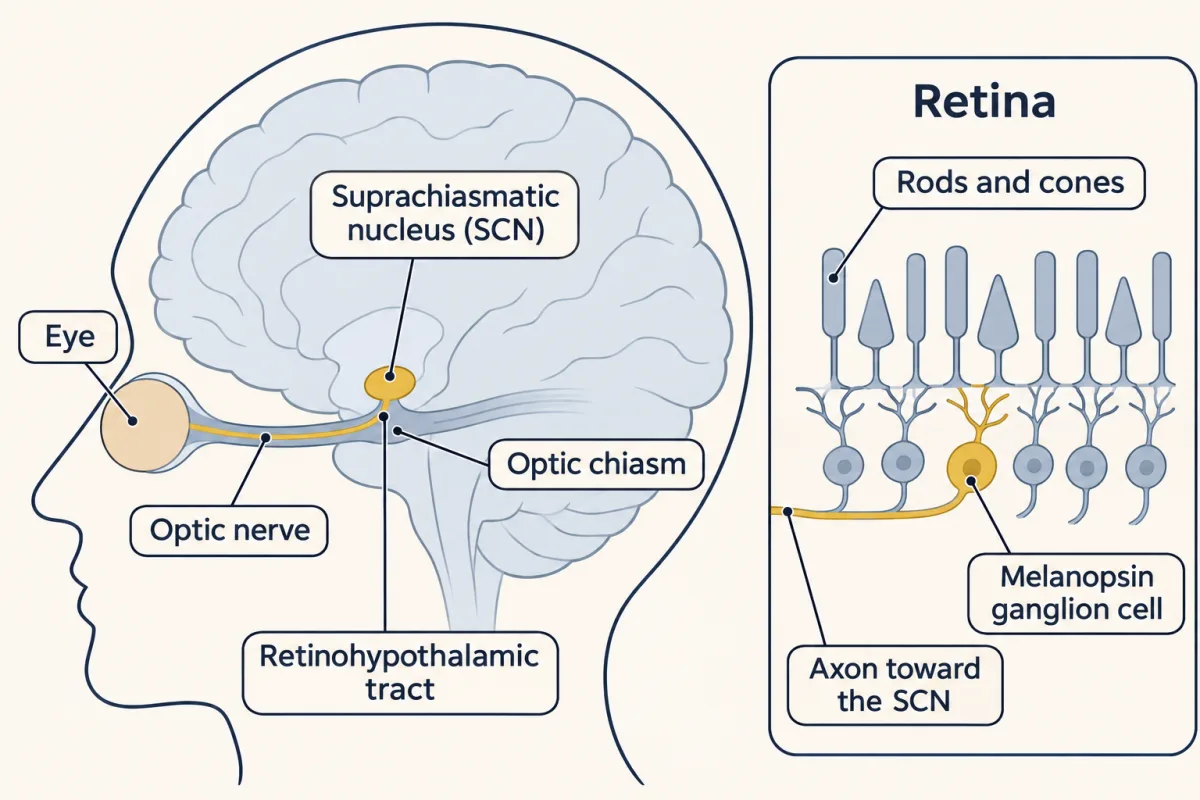
Light reaches the clock in the suprachiasmatic nucleus through the retinohypothalamic tract, carried by retinal ganglion cells, many of which sense light themselves with melanopsin, with help from rods and cones. AI-generated illustration -
Reading a night
-
The switch: why sleep comes in one block
-
Orexin holds the switch
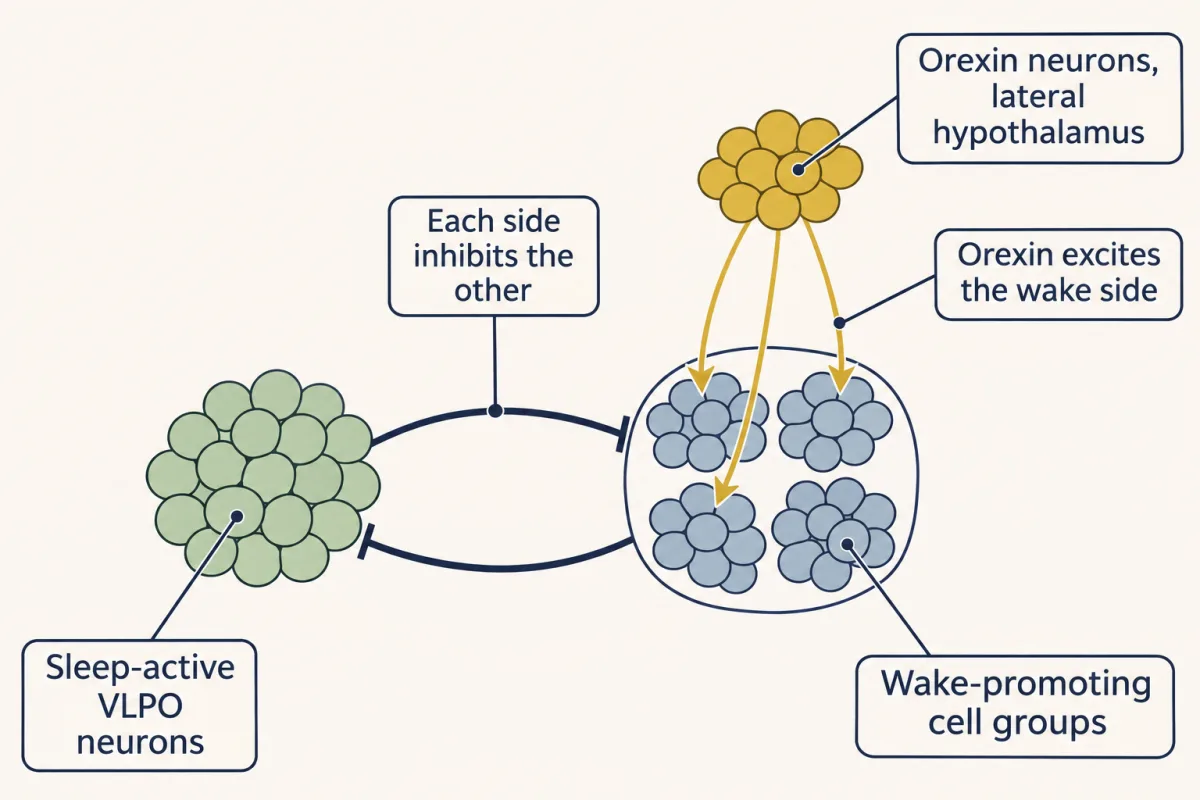
In the flip-flop model, sleep-active VLPO neurons and wake-promoting groups inhibit each other, and orexin neurons, which excite the wake side, are thought to hold the switch steady in waking. AI-generated illustration -
Going deeper
Where this lesson fits
Before thisReview first
- Autonomic Control and the HypothalamusThis course · Lesson 18
The suprachiasmatic nucleus sits in the hypothalamus, and you need that map of its groups and roles.
- The RetinaThis course · Lesson 10
Light reaches the clock through retinal ganglion cells, so you need the retina's cell types and light pathway from there.
- Transmitter Systems and DrugsThis course · Lesson 6
The sleep switch relies on GABA, histamine, noradrenaline and serotonin groups acting on each other, which that lesson introduces.
After thisStudy next
- Plasticity, Networks and ConsolidationThis course · Lesson 23
It takes up what the sleeping brain does with its hours, including replay of hippocampal activity.
Elsewhere on the siteFilms, simulations and method films in other courses
- From One Day to One YearFilm · Life Science
Introduces the circadian rhythm of about 24 hours that the clock genes here generate.
- A Blind Mouse That Knows It Is DayFilm · Sensory Systems
Shows the melanopsin cells that set the body clock to the day in mice lacking rods and cones.
Suggested by an AI model from the lessons themselves, then checked. How we use AI