Physiology · Skim version
Skeletal Muscle: Length, Load and Speed
Read the full lesson → Skim the whole course →
The guiding idea
A muscle lifting nothing and a muscle holding a load it cannot move both do zero external work. Where is the power?
How much force can an activated skeletal muscle hold, how fast can it shorten against a load, and what keeps it supplied with ATP until it fatigues?
-
Length sets the ceiling
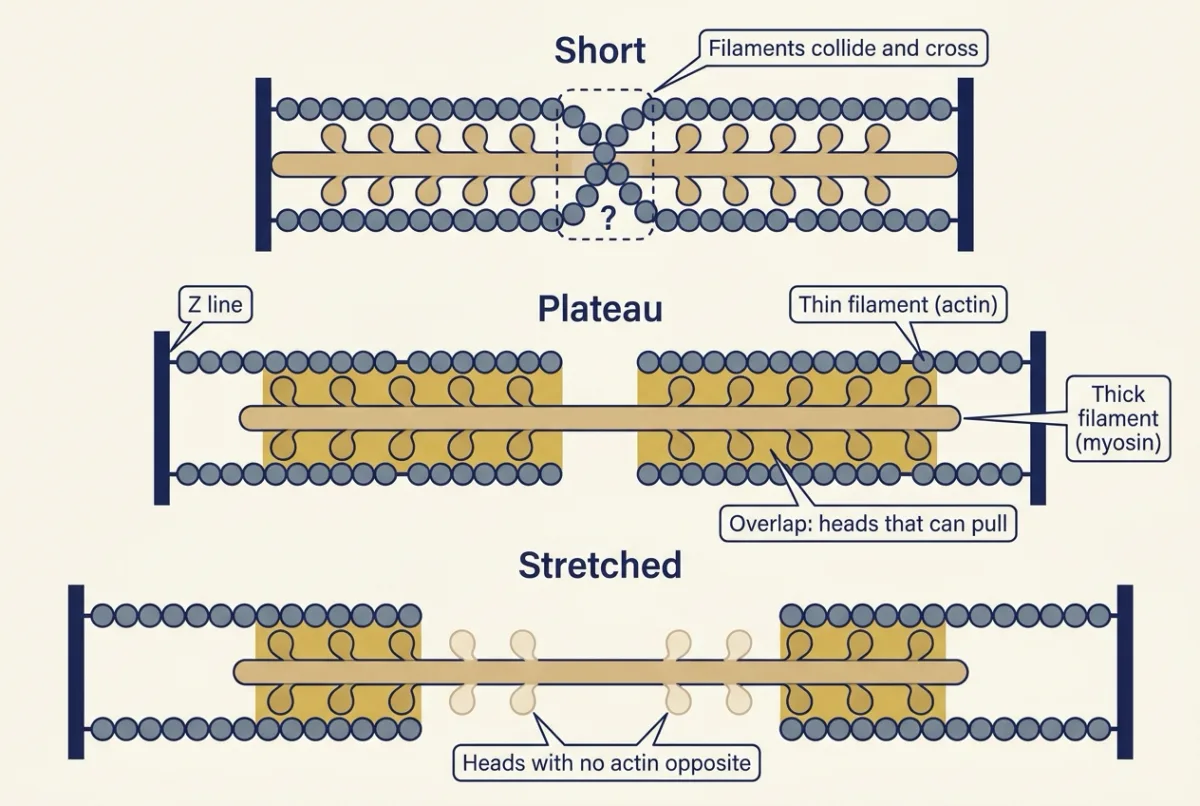
Length sets the ceiling: on the plateau every myosin head can reach actin; stretch the sarcomere and fewer heads face a thin filament, so the force a fully activated fibre can hold falls in step; at short lengths the filaments collide and cross, the usual reading of the loss there. AI-generated illustration -
Load sets the speed
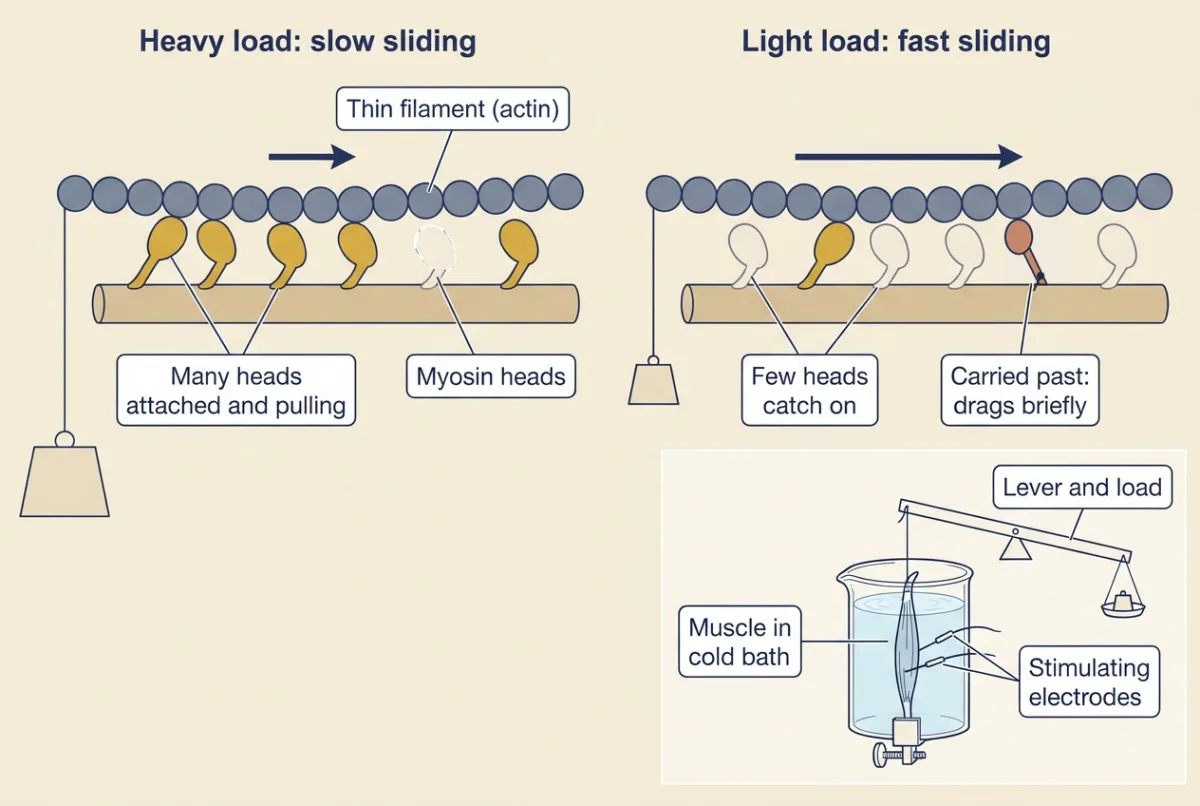
Load sets the speed: when the filaments slide fast, fewer heads catch on and some are carried past their pulling position and drag, so a muscle shortens at the speed at which just enough heads are attached to carry the load; Hill measured the speeds with a cold frog muscle lifting loads on a lever. AI-generated illustration -
Power peaks at a middle load
-
Activation: how much of the ceiling you get
-
Fibre types set the top speed
-
Three ATP supplies, running at once
-
What fails in fatigue
-
Two whole-body jobs
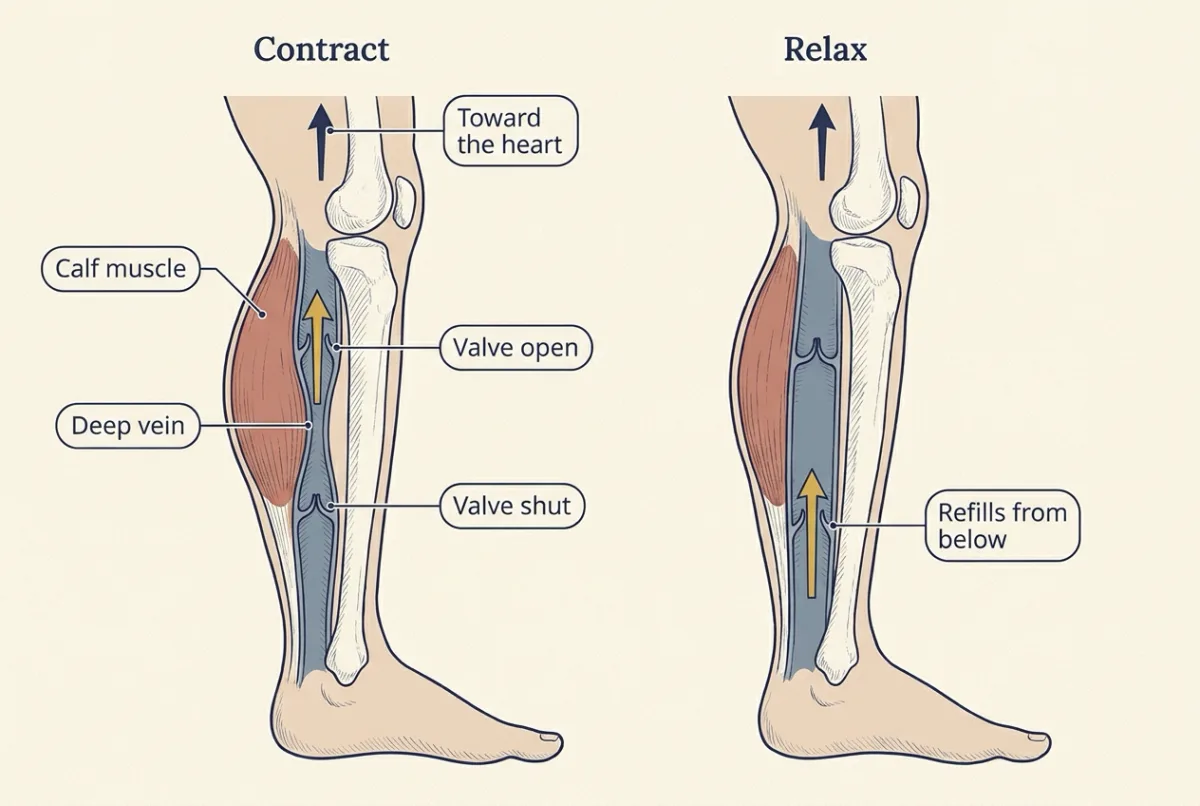
The calf muscle pump: contraction squeezes the deep veins and one-way valves let blood move only toward the heart; on relaxation the veins refill from below, aiding venous return from the legs. AI-generated illustration -
Going deeper
Where this lesson fits
Before thisReview first
- Muscle, Bone and MovementOrganismal Biology · Starting college
It teaches sarcomeres, sliding filaments and fibre types, which this lesson uses to explain length, force and speed.
- Respiration and ATPBiology · High school
It shows how cells make ATP by respiration, which you need for the three ATP supplies here.
- Molecular Motors and CargoCell Biology · College: the core
It explains how myosin heads step along actin and let go, the cross-bridge picture behind the force-velocity curve.
After thisStudy next
- Smooth Muscle and the Myogenic ResponseThis course · Lesson 4
It asks how a muscle with different filament and activation arrangements holds force, extending length, load and activation ideas.
- Cardiac Output and Venous ReturnThis course · Lesson 7
It uses the muscle pump in the legs to explain how blood returns to the heart.
- Exercise: The Whole Body at WorkThis course · Lesson 30
It applies muscle power, ATP supplies, fibre types and fatigue to the whole body at work.
Elsewhere on the siteFilms, simulations and method films in other courses
- Spectrophotometry and enzyme kineticsMethod film
Hill's force-velocity constants were fitted from measured rates, and this method shows how rates become fitted curves.
Suggested by an AI model from the lessons themselves, then checked. How we use AI