Organismal Biology · Skim version
Carrying Oxygen and Carbon Dioxide
Read the full lesson → Skim the whole course →
The guiding idea
A litre of your arterial blood carries about 200 mL of oxygen. If that blood were plasma alone, it would carry about 3 mL. What makes up the difference, and how does carbon dioxide get back to the lungs?
Hemoglobin releases its carrying capacity times the fall in saturation between lungs and tissue, and its S-shaped curve keeps lung saturation near full while letting saturation fall far in the tissues.
From the film: Why Blood Needs an S-Shaped Carrier
- Plasma alone would carry about 3 mL of oxygen per litre; hemoglobin in red cells raises that to about 200 mL.
- Hemoglobin releases its carrying capacity times the drop in saturation between lungs and tissue.
- Between lung and tissue pressures, a one-site carrier cannot both load fully and unload a lot: a loose grip leaves it four-fifths full, a tight grip keeps it nearly full in tissue.
- Cooperative binding gives hemoglobin an S-shaped curve, so one carrier loads fully in the lungs and still unloads a lot in the tissues.
From the film: Bohr's Dog Blood: Shifting the Curve
- Bohr, Hasselbalch and Krogh found that more carbon dioxide lowered oxygen binding in dog blood at the same oxygen pressure, most at low oxygen pressures; the design could not separate carbon dioxide from the acid it forms.
- The Bohr effect is the fall in affinity when pH falls or carbon dioxide rises; it shifts the curve right and raises P50.
- Higher temperature and more BPG also shift the curve right, but they are separate effects, not the Bohr effect.
- A modest right shift barely changes loading in the lungs but raises release in working tissue, where carbon dioxide is high and PO2 low.
-
Where the points sit on the curve
-
How much oxygen does the body use?
-
Shifting the curve: what the experiment left open
-
Other carriers, other settings
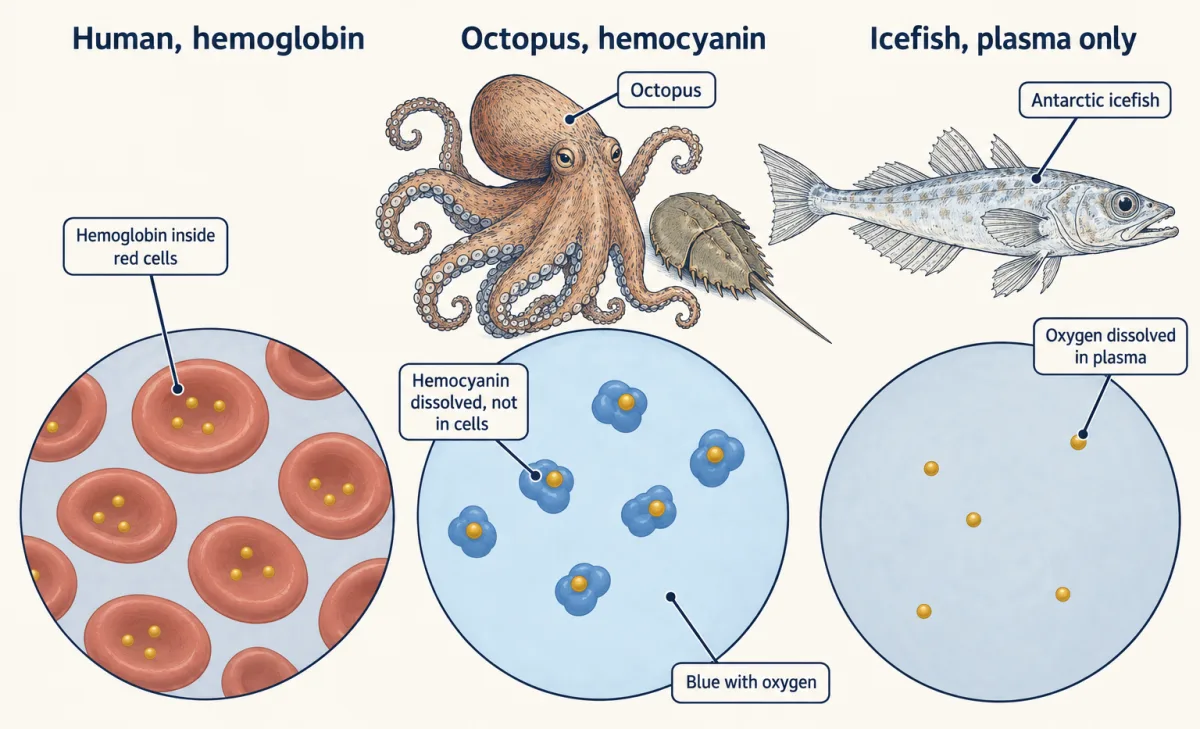
Humans carry oxygen on hemoglobin packed in red cells; octopuses and horseshoe crabs on hemocyanin dissolved in their blood; adult Antarctic icefish have almost no red cells and no working hemoglobin, and their oxygen travels dissolved in plasma. AI-generated illustration -
Carrying carbon dioxide back
-
Going deeper
Where this lesson fits
Before thisReview first
- Gas Exchange and BreathingThis course · Lesson 12
This lesson starts where oxygen enters the blood in the lungs, using the partial pressures set up there.
- Circulation and the HeartThis course · Lesson 10
You need cardiac output from there to calculate oxygen delivery and use by the Fick principle.
- Size, Scale and SurfaceThis course · Lesson 2
Its link between body size and oxygen use per gram explains why small mammals have higher P50 values.
After thisStudy next
- Osmoregulation and Nitrogenous WasteThis course · Lesson 15
It continues the unit on exchange, with water and salts replacing gases as the supply problem.
Suggested by an AI model from the lessons themselves, then checked. How we use AI