Developmental Neuroscience · Skim version
Where Glia Come From
Read the full lesson → Skim the whole course →
The guiding idea
Astrocytes and oligodendrocytes come mostly from the same pool of radial glia that made the neurons, yet the brain's own immune cells were born outside the embryo, in the yolk sac.
The glia of the nervous system do not share one birthplace.
From the film: One Job, Three Birthplaces
- Glia is a job, not a lineage: glia do not share one birthplace.
- Astrocytes and oligodendrocytes come mostly from the radial glia that made the neurons, microglia in mice come from the yolk sac, and Schwann cells and satellite glia come from the neural crest.
- To predict which glia a gene removes, ask where the cell was born and what its progenitor needed at that time.
- The rule predicts the first deficit, not the final count after the animal compensates.
From the film: Marked in the Yolk Sac
- Fate mapping marks a progenitor and looks for the mark in everything it made, so it can show where a cell was born.
- In mice, most microglia descend from yolk-sac cells, but the data cannot give an exact share.
- Read a fate map against the labeling of its source: a third of microglia marked, from a source marked at a third, means most.
- Microglial progenitors reach the brain through the early circulation and need CSF1R, and in healthy adult mice microglia renew themselves.
From the film: Same Progenitor, New Order
- In rodent cortex, the best-studied route to astrocytes needs a progenitor still present, a cytokine signal, and the competence to read it.
- Notch keeps a reserve of progenitors and, in mouse cortex, later helps confer competence through NFIA.
- Early progenitors have the receptor, but the STAT3 site in the GFAP promoter is methylated, so gliogenesis is timed partly inside the cell.
-
One job, three birthplaces
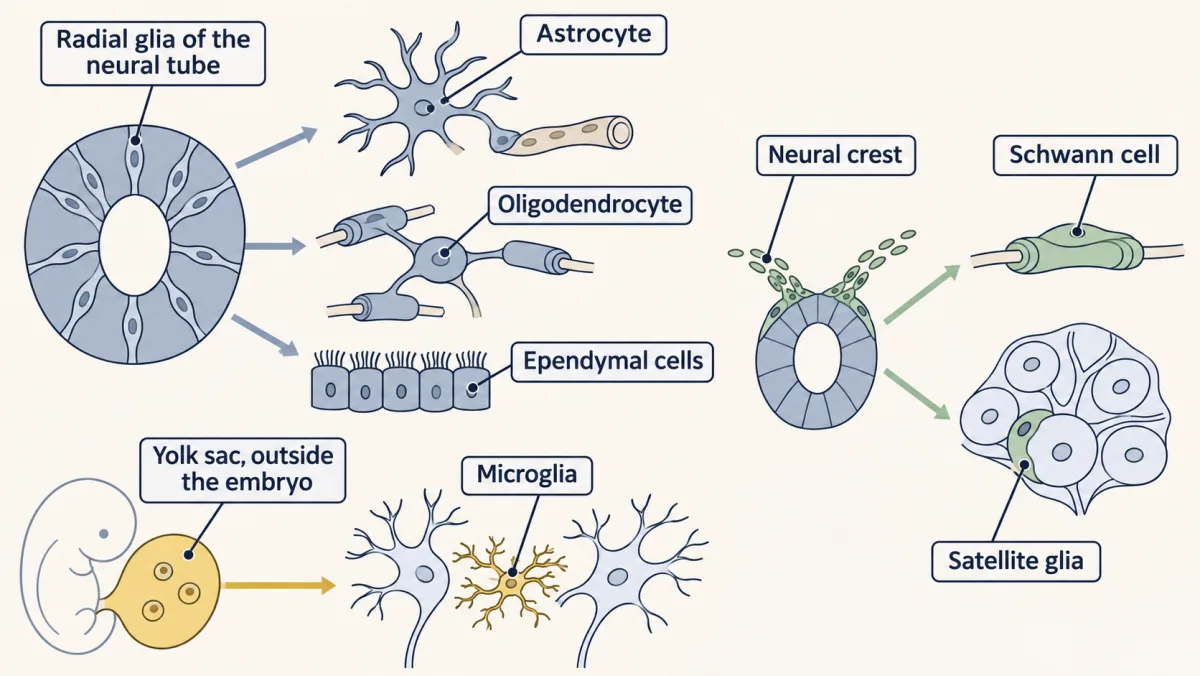
Glia is a job, not a lineage. Astrocytes, oligodendrocytes and ependymal cells come from the neural tube, microglia from the yolk sac outside the embryo, and Schwann cells and satellite glia from the neural crest. AI-generated illustration -
How do you learn a cell’s ancestry?
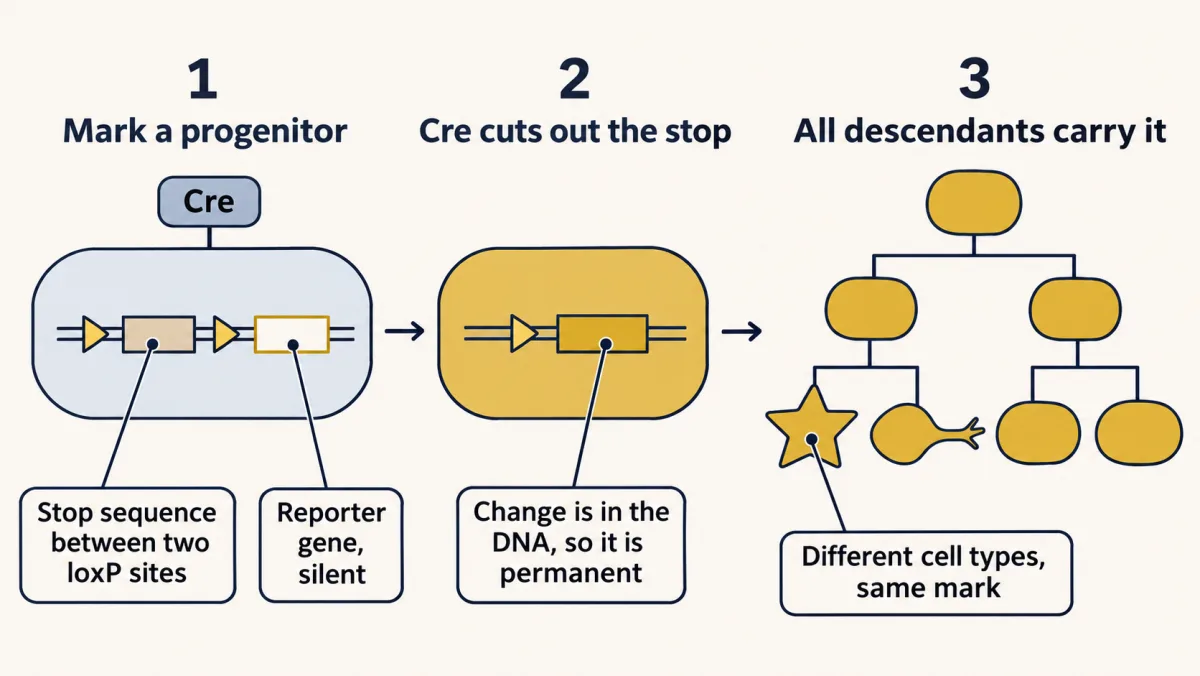
In genetic fate mapping, Cre removes a stop sequence in front of a reporter gene. The change is in the DNA, so every descendant inherits it, whatever genes that descendant uses later. AI-generated illustration -
Microglia come from outside
-
Radial glia switch from neurons to glia
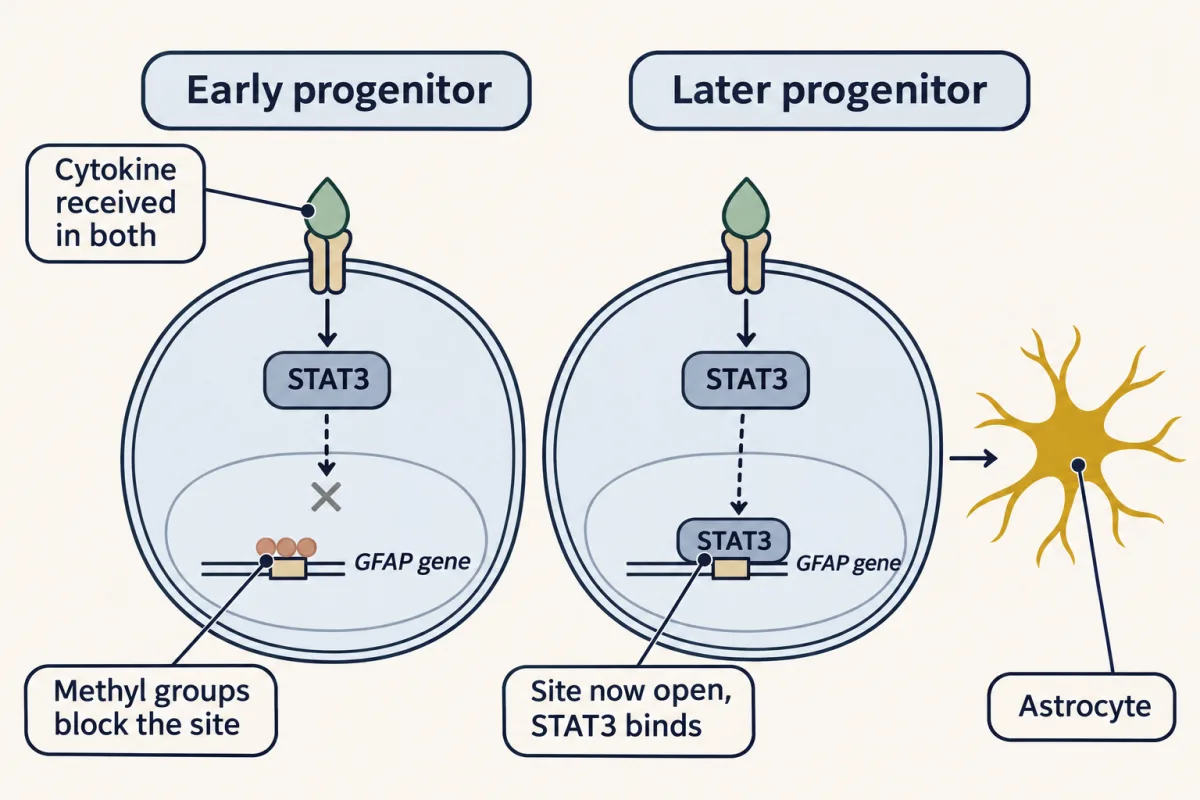
The signal arrives in both cells, but only the later progenitor can answer it: the STAT3 binding site in the GFAP promoter is methylated early and demethylated later, so gliogenesis is timed partly inside the cell. AI-generated illustration -
Oligodendrocytes start in a ventral strip
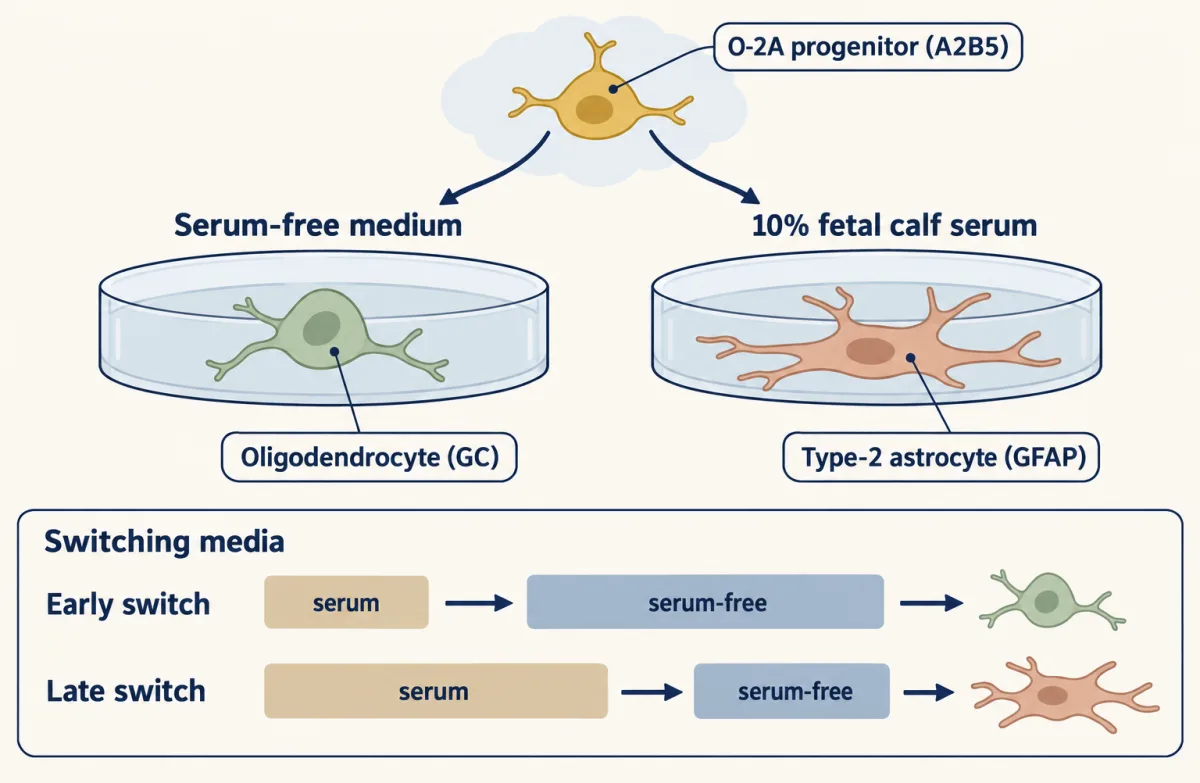
In Raff, Miller and Noble's rat optic-nerve cultures, one A2B5-positive progenitor, O-2A, became an oligodendrocyte in serum-free medium and a type-2 astrocyte in serum. Switching media after a day or two could still reverse the choice; later it was fixed. AI-generated illustration -
Schwann cells come from the crest, in steps
-
Putting it together
-
Going deeper
Where this lesson fits
Before thisReview first
- The Ventricular Zone: Radial Glia as Stem CellsThis course · Lesson 13
Radial glia as cortical stem cells are the pool that later makes astrocytes and oligodendrocytes here.
- The Neural Crest: Cells That Leave HomeThis course · Lesson 20
You need the crest's origin and migration to follow Schwann cells and satellite glia.
- Ventral to Dorsal: Sonic Hedgehog and BMP in the Neural TubeThis course · Lesson 10
Shh divides the ventral cord into domains, including pMN, where oligodendrocyte precursors begin.
After thisStudy next
- Myelination: Wrapping the Axon So the Signal JumpsThis course · Lesson 44
It takes the oligodendrocytes and Schwann cells born here and shows how they wrap axons.
- Feeding the Axon: Glia as Metabolic PartnersThis course · Lesson 45
It shows what astrocytes and oligodendrocytes do for axons once they exist.
Elsewhere on the siteFilms, simulations and method films in other courses
- BioassaysMethod film
The O-2A culture work uses a living cell response to separate instruction from selection by a factor.
- Targeted cell ablationMethod film
Predicting which glia are lost when a progenitor or survival signal is removed rests on killing chosen cells.
- One Protein From Receptor to GeneFilm · Cell Signaling
The cytokine route to astrocytes is read through JAK-STAT, which this film shows from receptor to gene.
- The Receptor Is the MessageFilm · Cell Signaling
Notch holds back progenitors and later confers competence for glia, which this film explains.
Suggested by an AI model from the lessons themselves, then checked. How we use AI