Biology · Skim version
One Cell or Many
Read the full lesson → Skim the whole course →
The guiding idea
How can one Paramecium do every job of life inside a single cell?
Cells fit life's jobs through structure and gene use, alone or together.
From the film: One Cell, Many Jobs
- One cell can do every life job, or many cells share them.
- A unicellular organism carries out every life process inside one cell.
- A multicellular organism can share major jobs among specialized cells.
- In most animals and plants, cells build tissues, organs and organ systems.
- Specialized means especially fitted for a job, not limited to only one job.
From the film: Different Cells, Shared DNA
- Cells fit life's jobs through structure and gene use, alone or together.
- A specialized cell has a structure suited to a particular job.
- Nearly every body cell with a nucleus carries essentially the same DNA.
- Each kind of cell uses a different set of genes.
-
Explore: share out life’s jobs
-
Explain: one cell that does it all
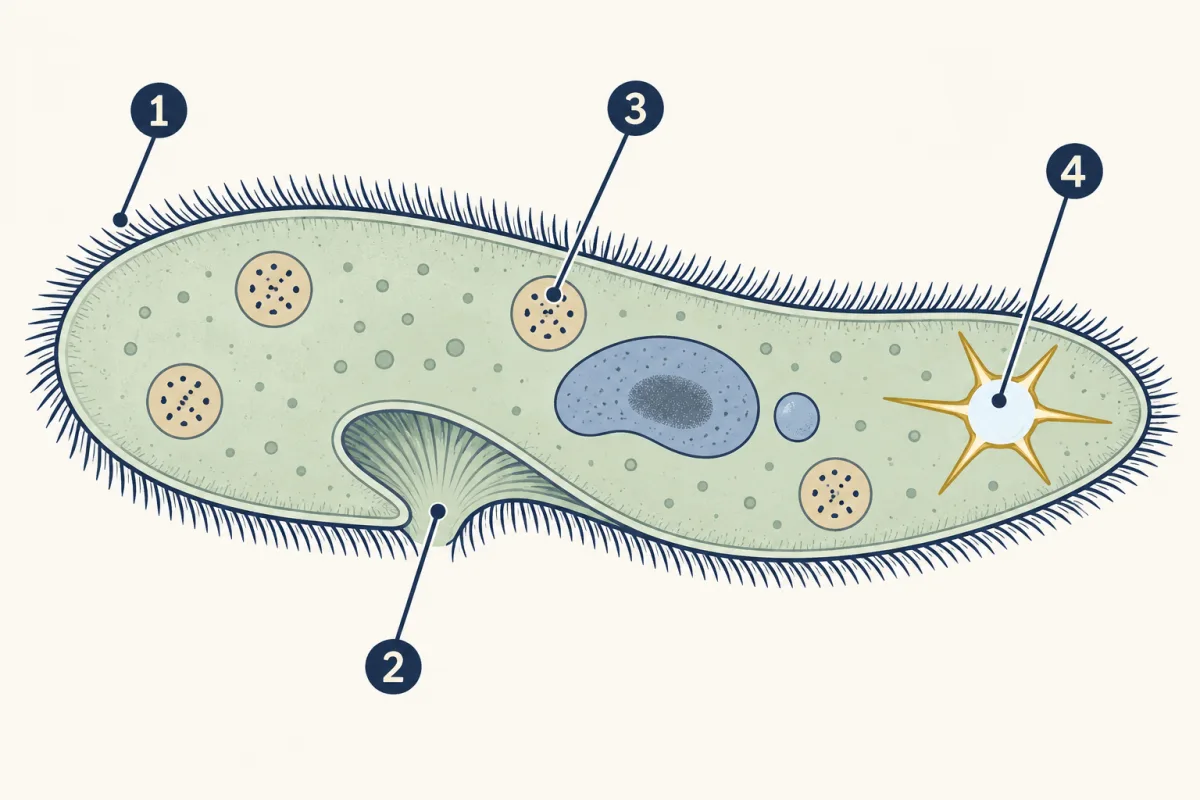
- cilia
- oral groove
- food vacuole
- contractile vacuole
-
Explain: specialized cells, from tissues to systems
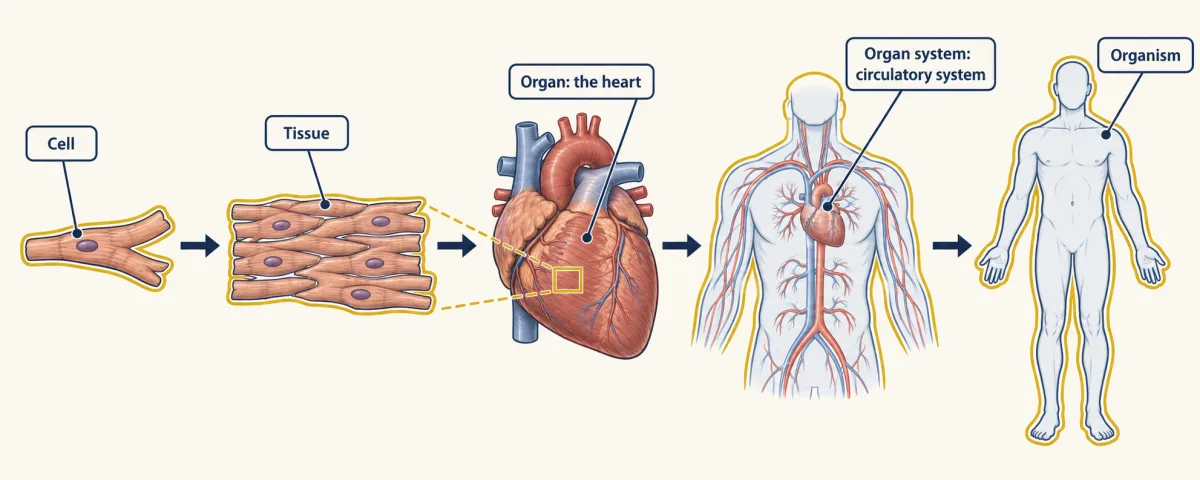
Cell, tissue, organ, organ system, organism: each level is built from the one before it. AI-generated illustration 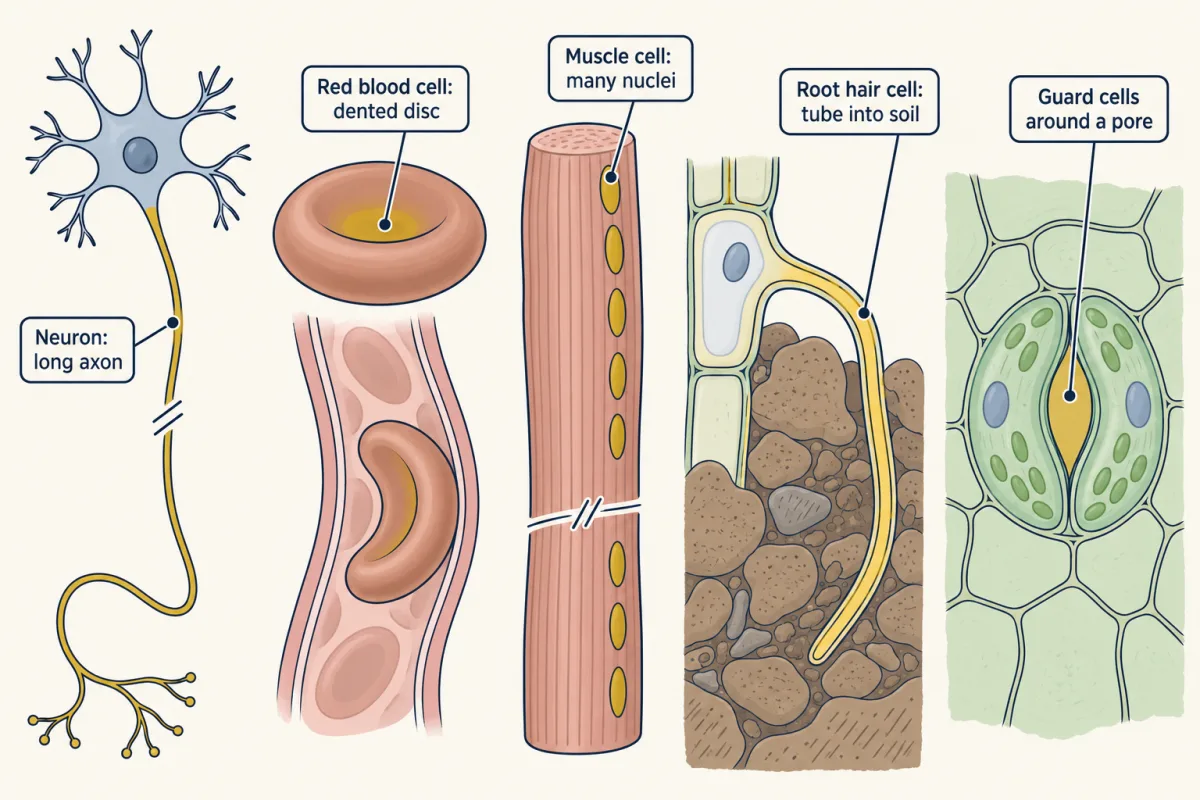
Five specialized cells, each with a shape that fits its job. They are not drawn to the same scale: an axon can reach about a metre, while a red blood cell is about 7 to 8 micrometres across. AI-generated illustration -
Explain: same DNA, different genes
-
Elaborate: measuring specialized cells
-
Going deeper
-
Evaluate: check your thinking
Where this lesson fits
Before thisReview first
- Crossing the MembraneThis course · Lesson 8
You need osmosis from there to see why pond water keeps flowing into a Paramecium and needs a contractile vacuole.
- Organelles as a SystemThis course · Lesson 7
You need the roles of organelles from there to see how one cell uses different structures for different jobs.
After thisStudy next
- From DNA to ProteinThis course · Lesson 18
It explains how a gene is read to make a protein, which is the gene use that makes cell types differ.
- Domains and KingdomsThis course · Lesson 24
It sorts organisms by whether they are one cell or many and by how their cells are built.
Elsewhere on the siteFilms, simulations and method films in other courses
- Share the jobsSimulation · Life Science
It lets you share life's jobs between cells, as a single Paramecium and a many-celled body do.
- One Cell, Every JobFilm · Life Science
It shows a Paramecium doing every life job in one cell, while a body shares jobs among many cells.
- Why a Mouse Needs PlumbingFilm · Organismal Biology
It shows why a larger body needs specialized exchange parts, since surface area falls behind volume.
Suggested by an AI model from the lessons themselves, then checked. How we use AI